
Allen, Costa, and the Quiet Math of UFC Vegas 117
A 13-fight card built on stylistic puzzles, late-notice mismatches, and a featherweight main event the model lands on by a hair.

The model sees thirteen fights in Las Vegas this Saturday, and the most analytically interesting thing about UFC Vegas 117 isn’t the main event. It’s the gap between the market read and what the model sees across the card.
The headline matchup is a featherweight crossroads. Arnold Allen, ranked seventh and sitting at 1-3 in his last four, faces twelfth-ranked Melquizael Costa on a six-fight win streak in Costa’s first UFC main event. Below that, a returning Doo Ho Choi tries to find timing after a seventeen-month layoff against a Daniel Santos who has won four straight but absorbed knockdowns in the last two. A prospect bouncing back against a hyped debutant. Two late-notice replacements on the same news cycle. A ranked women’s bantamweight clash with title implications. And a pair of prelims the model can’t get clean conviction on.
The picks run reverse order from prelim one to the main event below. Each carries the model’s read on the fight, the structural detail that matters most, and an honest read on how strongly the model lands there.
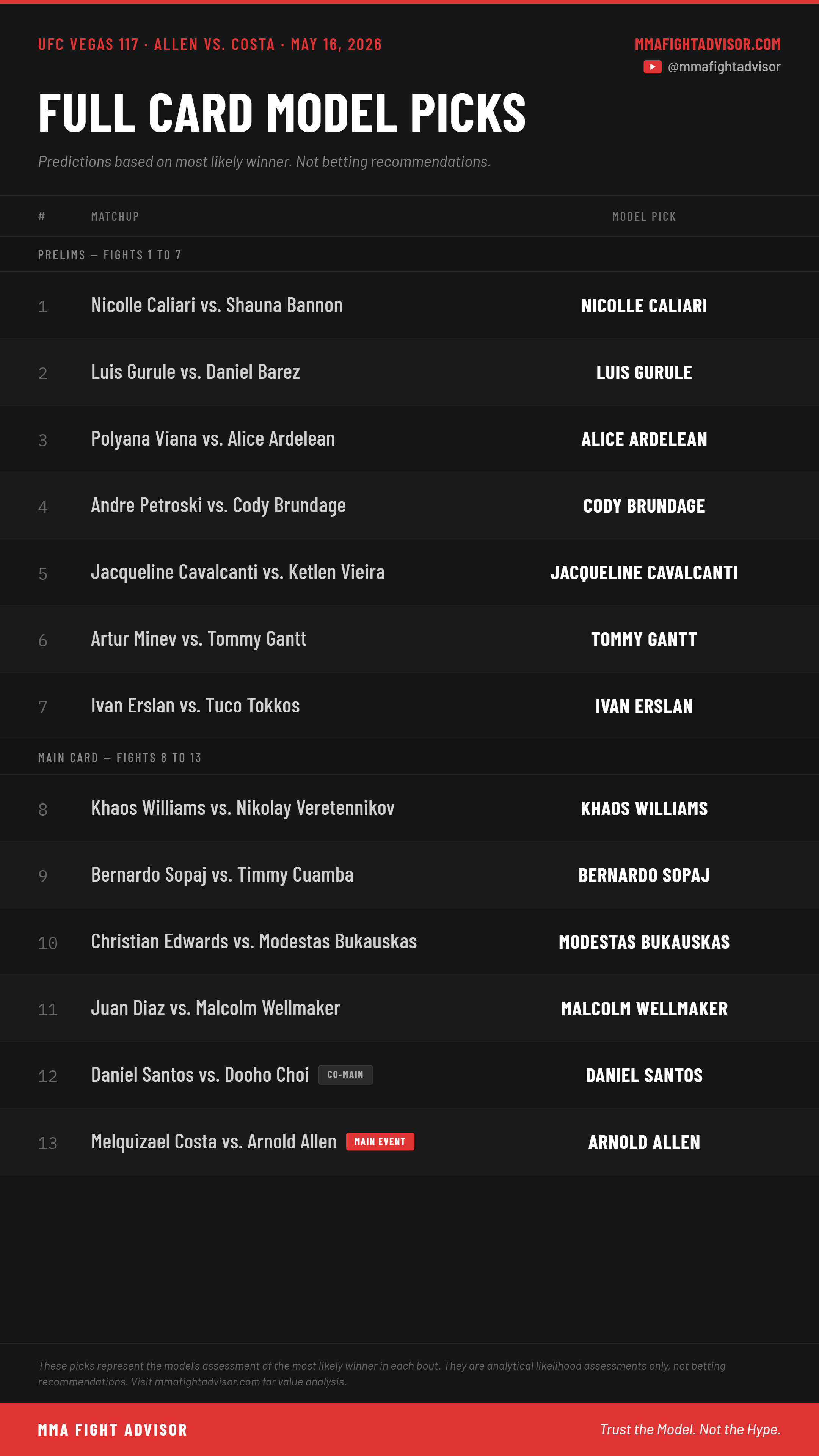
Bannon vs. Caliari — Women’s Strawweight
The model takes Nicolle Caliari in the opening fight, though the matchup plays closer than the call suggests at first read. Caliari sits 0-2 in the UFC across two fights at flyweight, and the most recent of those ended with a third-round knee that finished her at 1:30 of round three. She’s making the cut down to 115 for this one, which adds a variable nobody on the outside can fully price.
Shauna Bannon arrives 2-2, coming off a second-round submission loss to Sam Hughes that exposed real takedown defense problems. Her UFC tape shows a 40% takedown defense, which is the kind of number that matters more in a strawweight scramble than in a stand-up exchange. The model lands on Caliari because her recent volume profile and youth edge tilt the read in her direction, but the qualitative picture is closer than the call alone communicates. This is a fight where Caliari needs to make the weight cleanly and find her range early.
The pick is Caliari with the asterisk of a weight class mover.
Barez vs. Gurule — Flyweight
The model lands on Luis Gurule in the flyweight bout, though both fighters arrive on losing streaks. Gurule is 0-3 in the UFC, including a round-two knockout loss to Ode Osbourne. Daniel Barez is 1-2 with two submission losses on his recent ledger. Neither fighter has built a UFC argument, and the loser of this fight is likely released.
The read favors Gurule on his higher striking volume against an aging Barez. At 37, Barez is the oldest fighter on the card. He’s been finished twice by submission in his last two losses, and Gurule’s path is to push pace, force exchanges, and trust that a fighter coming off a long layoff at 37 will fade in the later rounds of a three-round fight.
The pick is Gurule with cautious framing. The model sees a thin edge, not a confident call.
Viana vs. Ardelean — Women’s Strawweight
This is the cleanest stylistic case on the prelims. Alice Ardelean lands at over seven significant strikes per minute, which puts her near the top of the entire card on output. Her last two wins came on 138 and 154 significant strikes landed across three rounds. The volume style is real and replicable.
Polyana Viana brings the opposite profile. Low-output, submission-heavy, and the kind of fighter who needs the fight to find the ground to win. Her UFC career has produced four first-round submissions and one first-round knockout among five visible wins. The problem is the recent picture: three consecutive losses, two of them finishes against her, and a 35% takedown defense that says she gets exactly the kind of scramble she doesn’t want against a volume striker who happily works off the back foot.
The model takes Ardelean. The structural mismatch favors her staying upright, picking apart Viana from range, and grinding out the three rounds. Viana’s path is a first-round body lock into her armbar, the move she’s hit three times in her UFC tape. If she can’t find it in the first five minutes, the volume war ends in Ardelean’s favor.
There is a small narrative wrinkle worth noting. Ardelean lost a split decision to Shauna Bannon on this same card eighteen months ago. Bannon opens the night against Caliari.
Brundage vs. Petroski — Middleweight
This is one of two fights on the card where the model has the least conviction. The call goes to Cody Brundage, but the read is held with explicitly thin-signal framing. The honest answer is that this fight is harder to predict than most.
Both fighters arrive on losing streaks. Brundage is 0-3 across his last three, including a second-round knockout loss to Cam Rowston in January. Andre Petroski is 0-2, including a first-round knockout loss to the same Rowston. The shared opponent and the shared finish profile tell you what you need to know: both fighters get finished, and both fighters can finish.
The structural case favors Petroski. He averages over three takedowns per fifteen minutes, defends takedowns at 86%, and brings the cleaner grappling toolkit. He has two career submission wins in the UFC, including an anaconda choke and an arm triangle. The model goes the other direction on Brundage’s striking variance, but the conviction simply isn’t there. One narrative footnote: the fight falls on Brundage’s thirty-second birthday.
The call is Brundage. The framing is honest: this is the thinnest analytical signal on the prelims.
Vieira vs. Cavalcanti — Women’s Bantamweight
This is the most genuinely interesting fight on the prelims and a clear stylistic puzzle. Jacqueline Cavalcanti sits at 5-0 in the UFC with all five wins by decision. Her UFC tape shows 5.65 significant strikes per minute, 88% takedown defense, and a striking defense of 68% that puts her near the top of the women’s bantamweight roster on defensive numbers.
Ketlen Vieira is the ranked veteran at number five and a judo black belt with a 90% takedown defense across fifteen UFC fights. Her most recent loss was a split decision to Norma Dumont in November that several outlets scored for Vieira. She’s the more experienced fighter by every measure, including championship-distance experience against Miesha Tate and Holly Holm.
The matchup is range against grappling. Cavalcanti is a higher-output striker with a two-inch reach edge and the takedown defense to keep this on the feet. Vieira’s path is to push to the cage, weather the volume, and pull this into clinch exchanges where her judo plays. The model lands on Cavalcanti because her UFC tape says she wins these slow-burn decision fights when she keeps fighters at distance, and her takedown defense across five UFC fights says she can keep Vieira from forcing the grappling exchange.
The call is Cavalcanti with cautious confidence. A 6-0 UFC start for her would tie the active divisional win streak and put her squarely in the title picture.
Minev vs. Gantt — Lightweight
The cleanest structural mismatch on the card. Tommy Gantt debuts under Daniel Cormier’s coaching at 11-0 with a Contender Series finish from September. His reach is 76 inches. Artur Minev steps in on five days notice at 22 years old with a 7-0 record built on early-round knockouts. His reach is 69 inches.
That seven-inch reach gap is enormous for a finishing striker who needs to land power before a takedown attempt arrives. Gantt’s finishing position on the Contender Series was a guillotine choke at 2:47 of the first round, which is the kind of front-headlock finish that punishes a striker chasing a knockout. Minev is the more polished puncher on regional tape, but the matchup specifics work against him: short prep window, massive reach disadvantage, and an opponent whose entire profile is designed to neutralize his strengths.
The model takes Gantt with confidence. The Cormier-trained debut against a five-days-notice striker is exactly the kind of preparation gap that produces lopsided results, and the read is that this fight finds the ground in the first ten minutes.
Tokkos vs. Erslan — Light Heavyweight
The second of the two genuine toss-ups on the card. Ivan Erslan carries the call, but the conviction sits at the thinnest analytical signal on the prelims. The honest framing is that this is a coin flip the model lands on by a hair, and depth compresses accordingly.
Erslan is 0-3 in the UFC despite a 14-6 career record built on heavy regional finishes. Tuco Tokkos is 1-2 with a single arm-triangle finish over Junior Tafa in July as his lone UFC win. Both fighters fighting for roster survival. Tokkos brings the heavier wrestling profile at over four takedowns landed per fifteen minutes, and Erslan’s most recent UFC fight ended with him being submitted by Jimmy Crute in the first round.
The pick is Erslan because the model lands there, but the structural argument tilts toward Tokkos’ wrestling against Erslan’s exposed defensive grappling. The cautious framing is intentional. There is no confident analytical answer to this fight.
Veretennikov vs. Williams — Welterweight (Main Card Opener)
The model takes Khaos Williams to open the main card. The read is built on Williams’ early knockout power against Nikolay Veretennikov’s 45% striking defense.
Williams has three UFC knockouts under ninety seconds: a 27-second finish of Alex Morono, a 30-second finish of Alhassan, and a 90-second finish of Carlston Harris. When he commits and lands clean, this fight is over inside the first round. The problem in his recent run is that he hasn’t committed. A two-fight losing streak shows him stuck in clinch positions, gun-shy on output, and submitted by Gabriel Bonfim in February of last year. The path back to the win column is firing the trigger he hasn’t pulled in over a year.
Veretennikov is 36, won his last fight by knockout over Niko Price, and brings the kind of low-output, range-fighting profile that lets Williams play to his strengths. If Williams pulls the trigger, the read is that this fight ends in the first round. If he doesn’t, Veretennikov’s experience and momentum keep him alive.
The pick is Williams with cautious confidence.
Cuamba vs. Sopaj — Bantamweight
This is the thinnest-sourced fight on the main card. The model takes Benardo Sopaj at razor-thin conviction against Timmy Cuamba in a fight that most card-level previews cover in one or two sentences each.
Sopaj is 25, the youngest fighter on the card, with a 1-1 UFC record and a sixteen-month layoff coming in. Cuamba is on a two-fight win streak that includes a flying-knee knockout of Roberto Romero from April of last year. The structural picture favors Cuamba on physical edge: he holds a three-inch height advantage and a five-inch reach advantage. Sopaj has the higher striking output, better striking accuracy, and stronger wrestling on paper.
The call lands on Sopaj because his volume and accuracy numbers grade out cleanly, but the sample size on both fighters is small, the layoff factor is real, and the read sits barely on his side. Cautious framing applies. There is no dominant signal here.
Edwards vs. Bukauskas — Catchweight 215
The most confident pick on the card. Modestas Bukauskas is the model’s strongest call against Christian Edwards in a fight that completely changed character when Rodolfo Bellato withdrew. The original matchup was a competitive light-heavyweight fight with top-fifteen implications for Bukauskas. The replacement reframes it as a four-days-notice catchweight debut for a regional-level striker against a fighter on a recent four-fight win streak prior to a January knockout loss to Nikita Krylov.
Edwards is 6’5” with 78 inches of reach. The length is the only structural argument for him. His regional tape shows defensive striking gaps and cardio concerns, and he agreed to a 215-pound catchweight on a prep cycle that was built for nothing in particular. Bukauskas brings the mature, well-rounded toolkit: 79% takedown defense, a recent first-round knockout of Paul Craig, an arm-triangle submission win in his UFC tape, and the kind of fight craft that punishes short-notice debutants.
The read here is mechanical. Short notice, weight class jump, and a more experienced opponent equals the highest-confidence prediction on the card. The only path to an Edwards upset is landing something heavy in the first round before the cardio gap shows.
Diaz vs. Wellmaker — Bantamweight
Malcolm Wellmaker is the second-highest-confidence call on the card. The story is finish-or-collapse against a debutant with one fight of UFC-tracked tape. Wellmaker’s three UFC wins are all first-round knockouts: Saaiman at 1:59, Moutinho at 2:37, and the Contender Series finish of Bramhald at 2:29. His single UFC loss came against Ethyn Ewing in November after his counter hooks failed to find the early finish and he was outvolumed across three rounds.
Juan Diaz arrives 15-1-1 across his career with momentum from a buzzer-beating spinning back elbow knockout on the Contender Series in October. The finish was real, but the previous nine minutes of that fight showed distance management problems and a 0% takedown defense across the only sample available. Wellmaker holds two inches of height and two inches of reach. His UFC output sits near six significant strikes per minute, which is among the highest on the entire card.
The matchup specifics favor Wellmaker in the first round, when he is at his most dangerous. If he doesn’t find the finish in the opening five minutes, the Ewing pattern becomes the risk: he gets gun-shy, gets outvolumed, and gives a debutant the chance to steal rounds. The model takes Wellmaker on the first-round pattern.
Choi vs. Santos — Featherweight (Co-Main)
Daniel Santos carries the call against Doo Ho Choi in a co-main event that’s been rescheduled three times and is finally happening. The decision variable is rust. Choi hasn’t fought since December 2024. The intervening seventeen months washed out his 2025 entirely after a knee injury, and at 35 he’s now one of the more layoff-burdened active featherweights.
The technical striking edge belongs to Choi cleanly. His career accuracy sits at 56% against Santos’ 40%, and his striking defense is five percentage points higher. Choi also holds a three-inch height advantage and a three-inch reach edge. In any straight stand-up exchange where Choi has timing and rhythm, the technical edge wins clean rounds.
The case for Santos is volume, pressure, and the simple math of seventeen months without competition. Santos’ recent four-fight UFC streak includes second-round knockouts of Castaneda and Yoo, both of whom dropped Santos before he rallied. He gets hit a lot, he absorbs damage, and he keeps coming forward. That style is the natural test for ring rust.
The read is that peak-form Choi beats Santos, but peak-form Choi requires the timing and conditioning that comes back over multiple fights, not in one return appearance. Santos by cautious confidence. The over 1.5 rounds prop has support given Santos’ slow-start pattern. If Choi has anything left, it shows in the first five minutes.
Costa vs. Allen — Featherweight (Main Event, 5 Rounds)
The toss-up the model lands on by a hair. Arnold Allen carries the pick against Melquizael Costa in a five-round main event that defines two fighters’ divisional trajectories.
The most underdiscussed structural detail of this matchup is that both fighters are southpaws. Costa’s open-stance kicking arsenal, the diverse range game that has put featherweights on highlight reels in his recent finishes, doesn’t have the same lane against another southpaw. The lead-leg body kick and side kick that punish orthodox opponents work differently with stances matched. Costa still has tools, particularly the head kick that finished Morgan Charrière in December and the spinning back kick that finished Dan Ige in February. But the closed-stance dynamic dampens some of the edge.
Costa’s reach advantage is one inch. Costa is 5’10”, Allen is 5’8”. The physical mismatch is modest.
Allen’s structural path is pressure-boxing, cage-cutting, and five-round cardio. He’s been to a championship-distance fight before, against Max Holloway in 2023, and he’s never been finished across twenty-four professional fights. Costa has never fought five rounds. His six-fight win streak includes three decisions over Erosa, Rodriguez, and Lingo where he was forced into championship-pace territory inside fifteen minutes. The cardio question is genuine.
The qualitative case for Allen is the championship-distance experience and the chin. The qualitative case against Allen is the takedown drought. He hasn’t landed a takedown since April 2021, and across his last five UFC fights he hasn’t even meaningfully attempted one. If the path to a decision win against Costa requires mixing levels and using the threat of the takedown to set up boxing, Allen’s recent pattern suggests he doesn’t pull that trigger.
The model lands on Allen because the cardio differential across five rounds is the most credible deciding factor against Costa’s higher first-round finish potential. The call is a razor-thin lean, the framing is honest, and the read is that whoever survives the championship rounds wins this fight. Costa’s path is the early finish through a high guard. Allen’s path is the cage-cutter at twenty minutes when Costa has nothing left.
The model takes Allen at the slimmest margin on the card.
The Card in One Read
The strongest analytical signals on this card live in the late-notice mismatches at Bukauskas-Edwards and Gantt-Minev, the prospect-versus-finisher test at Wellmaker-Diaz, and the ranked women’s bantamweight clash at Vieira-Cavalcanti. The main event is a coin flip the model lands on Allen because of cardio. The co-main is a coin flip the model lands on Santos because of rust.
Two fights on the prelims are honest toss-ups where the model’s conviction sits below 50% and the framing reflects it. Three picks were flipped from the model’s raw read after calibration confirmed the FADE signal. Every call on this card carries its own confidence level, and the article doesn’t pretend otherwise.