
Anthony Smith, the most important MMA fighter of all time?
A completely serious investigation into a deeply unserious question

Let me start with a statement that is either brilliant, absurd, or both:
Anthony Smith might be the most important MMA fighter ever.
Not the GOAT.
Not the most dominant.
Not the biggest draw.
But important in a very specific sense: if you remove him from the fight-history web, a surprising amount of the rating universe shifts around.
This is exactly the kind of stat that makes people fight in comment sections, so: perfect Substack material.
TL;DR
I used an Elo rating system (think: chess ratings, but for fights).
Then I did a “what if he never existed?” test for every fighter.
Anthony Smith created the biggest average ripple when removed from the dataset.
In this dataset, he’s also #3 in total fights and #7 in promotions fought in, which is a pretty good recipe for “network influence.”
He’s also bounced between weight classes (most notably middleweight and light heavyweight), which helps connect different “neighborhoods” of competition.
What Elo is (no math, I promise)
Elo is basically a running score that updates after every fight:
Everyone starts at the same level.
When you fight, you trade points based on the result and the expectation.
Beat someone the system thinks is better than you, and you gain more.
Lose to someone the system thinks is worse than you, and you lose more.
Over thousands of fights, Elo becomes a giant web of connected updates. Some fighters sit at key junctions in that web. Remove one of those junctions, and you have to re-route a lot of history.
If “rating web” sounds abstract, picture a spider web: each fight is a thread, each fighter is a node, and if you pull one node out, nearby threads have to re-tension.
The test: “delete one fighter and see what breaks”
Here’s the experiment:
1. Compute everyone’s final Elo rating from the full fight history (fixed setting: `K = 110`).
2. Remove a single fighter and every fight they appear in.
3. Recompute everyone’s final Elo from scratch.
4. Measure how much everyone else moved.
The score I’m using for “importance” is:
Mean absolute Elo change = “on average, how much did removing this fighter shift everyone else’s final rating?”
If that number is big, it means that fighter’s career sits in places where the rating web really cares.
The headline
In this dataset:
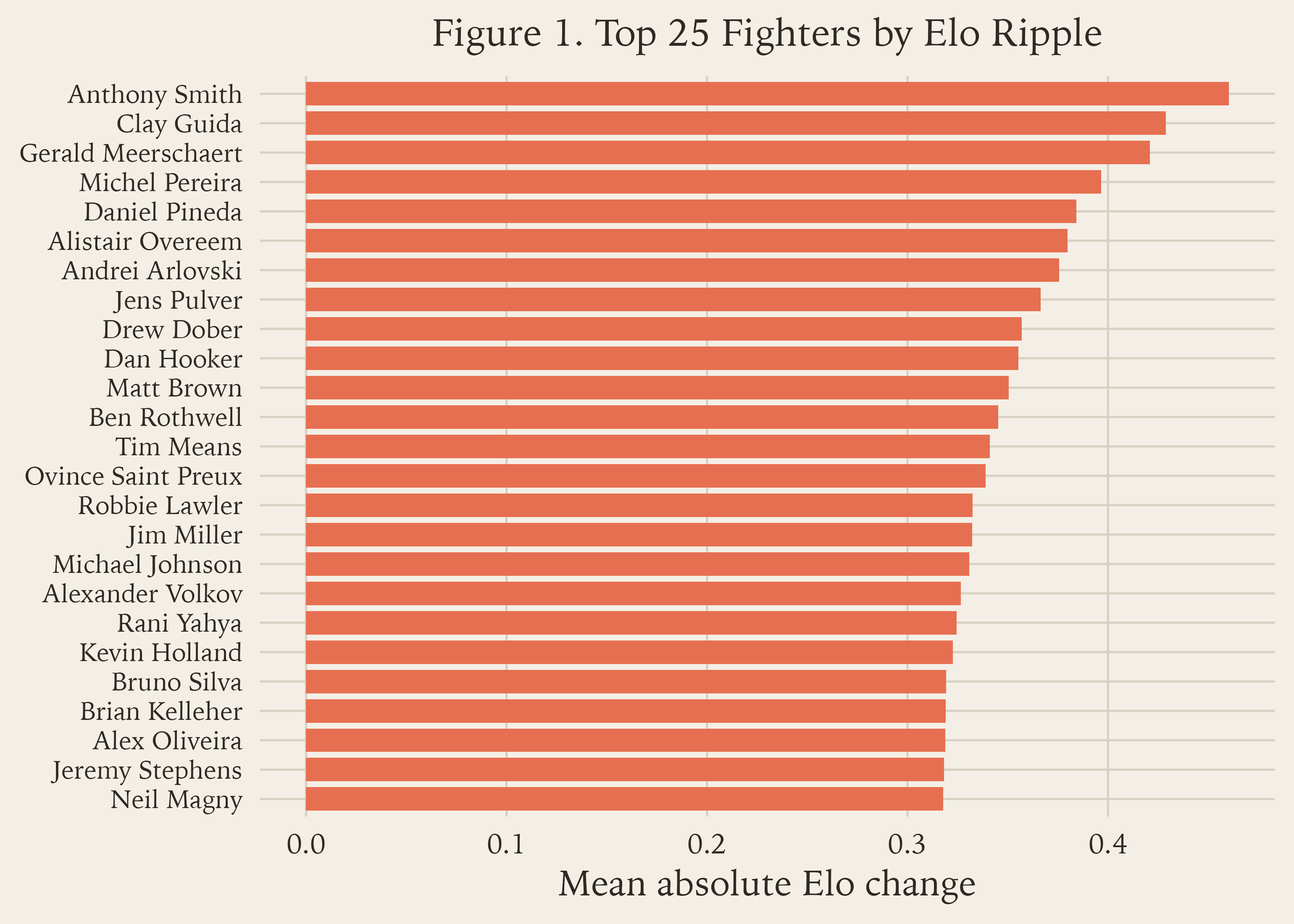
- Anthony Smith ranks #1 in average Elo ripple (mean absolute change = 0.4602).
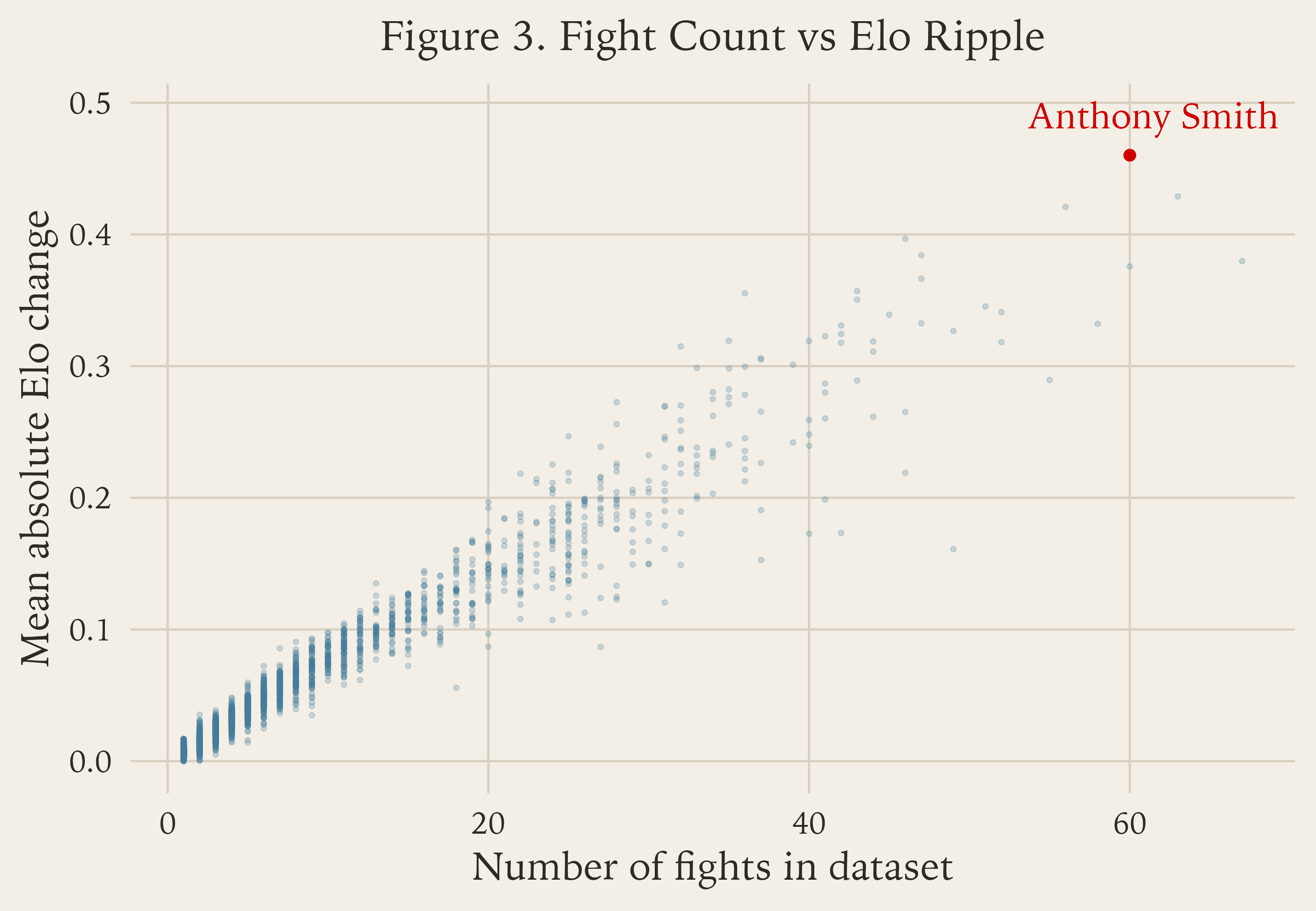
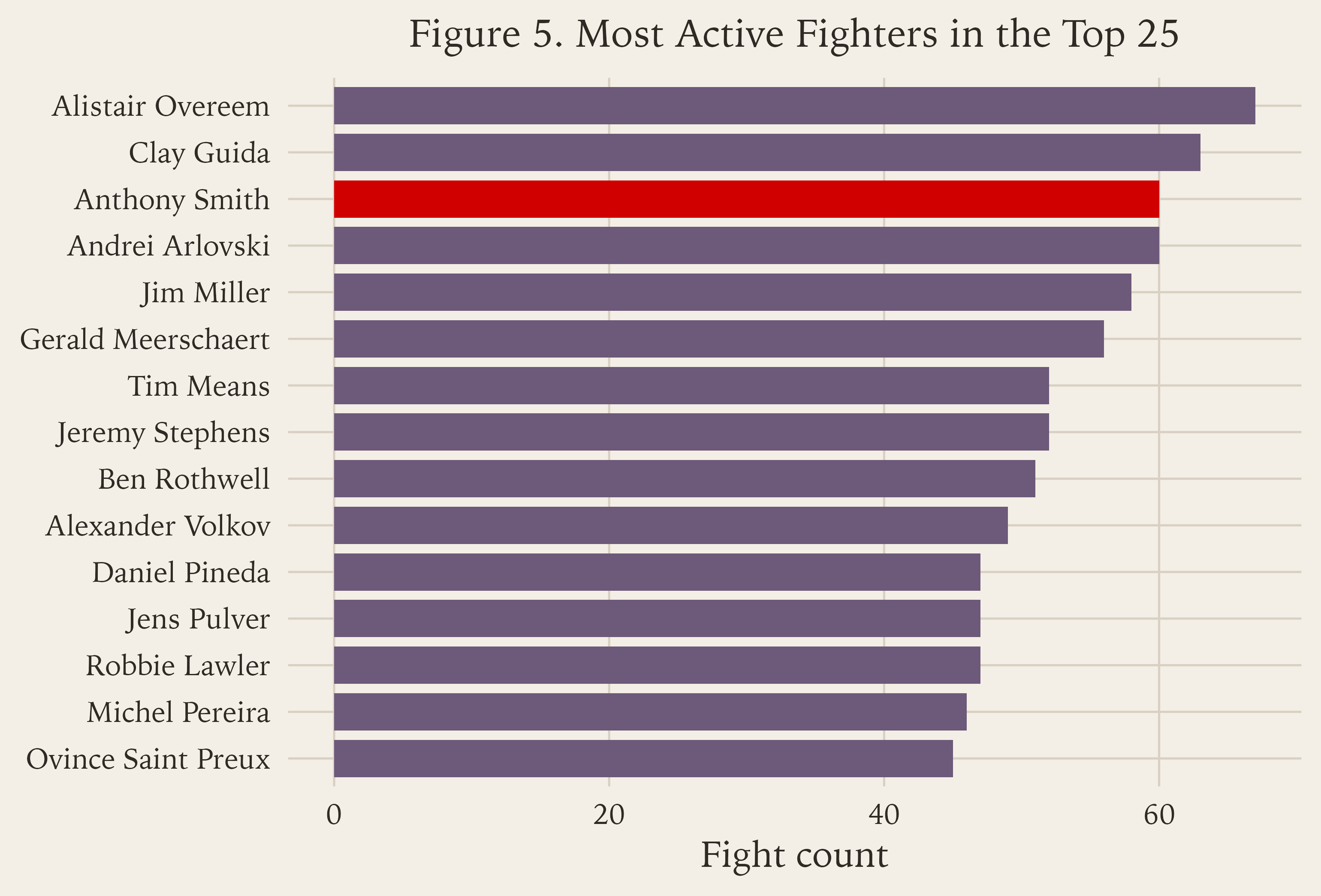
- He appears in 60 fights in the dataset (that’s #3 out of 5,788 fighters).
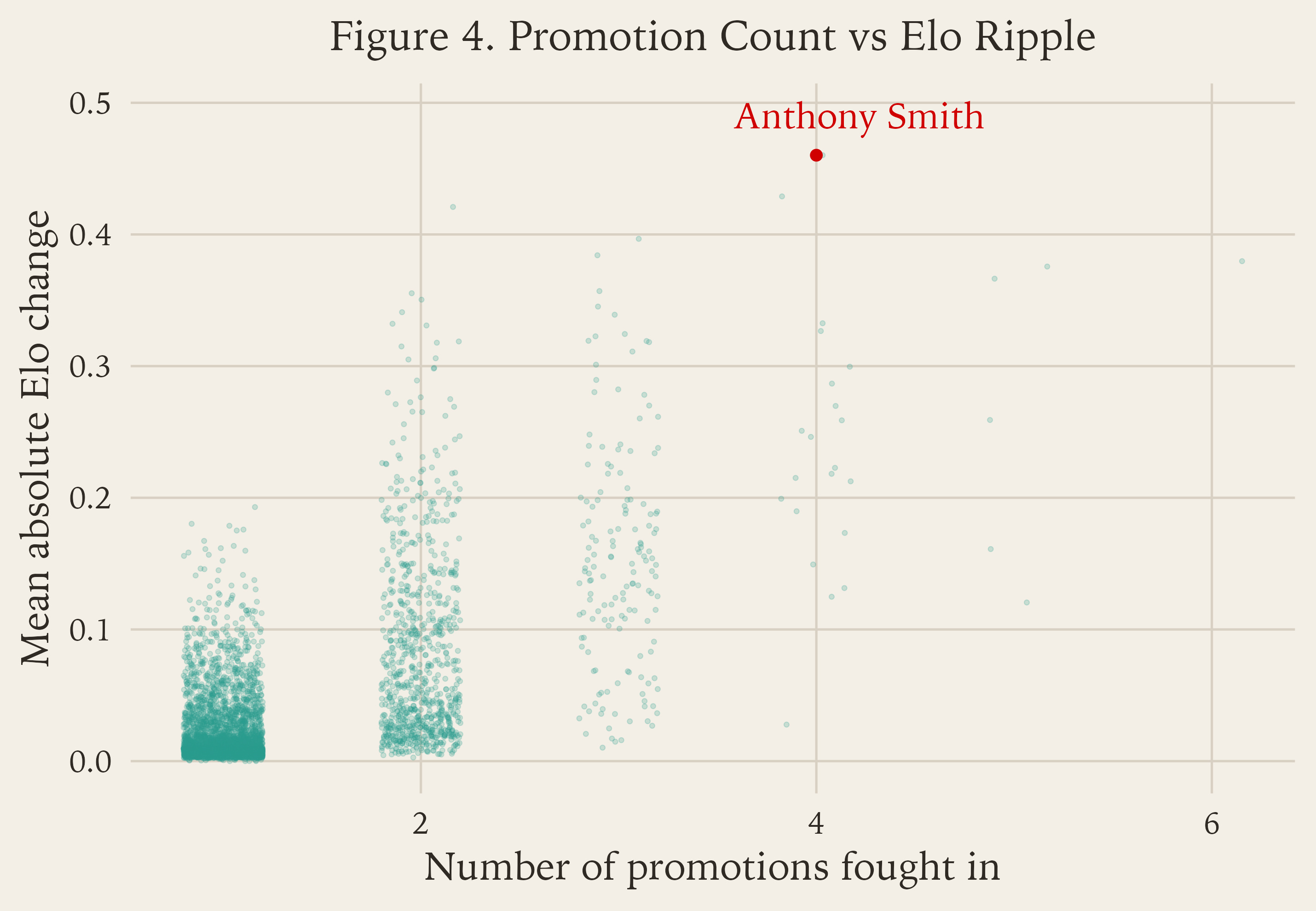
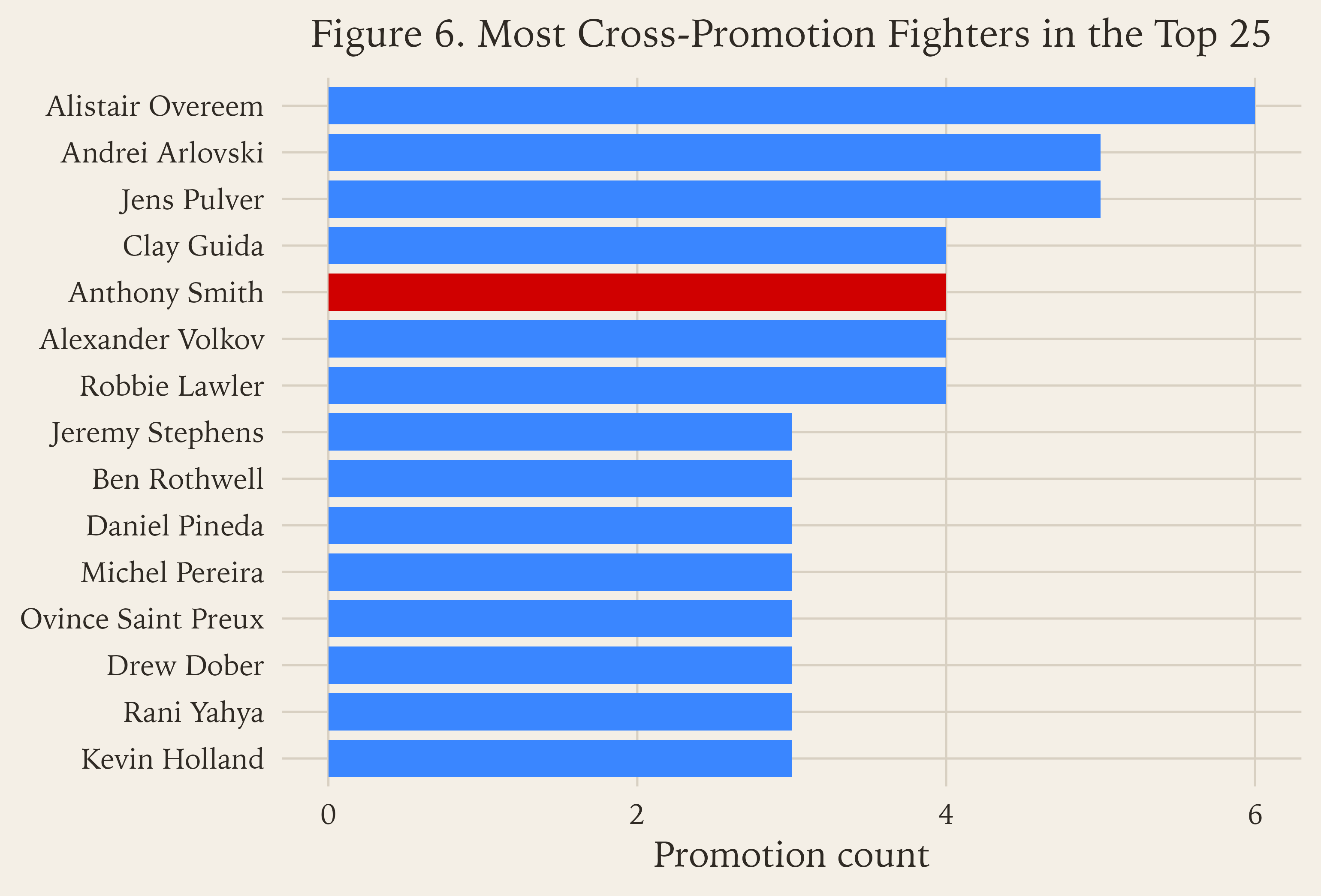
- He fought in 4 promotions in the dataset (that’s #7 out of 5,788 fighters, derived from event names).
- Removing him changes the final Elo of 1,298 other fighters by at least a tiny amount.
You can disagree with the premise. You cannot deny the chaos.
The list: the top 25 Elo ripple monsters
Figure 1 shows the leaderboard itself: Anthony Smith at #1, with Clay Guida and Gerald Meerschaert right behind him. This is not a “best fighters ever” list. It’s a “touches a lot of stuff” list.
How weird is Anthony’s score, really?
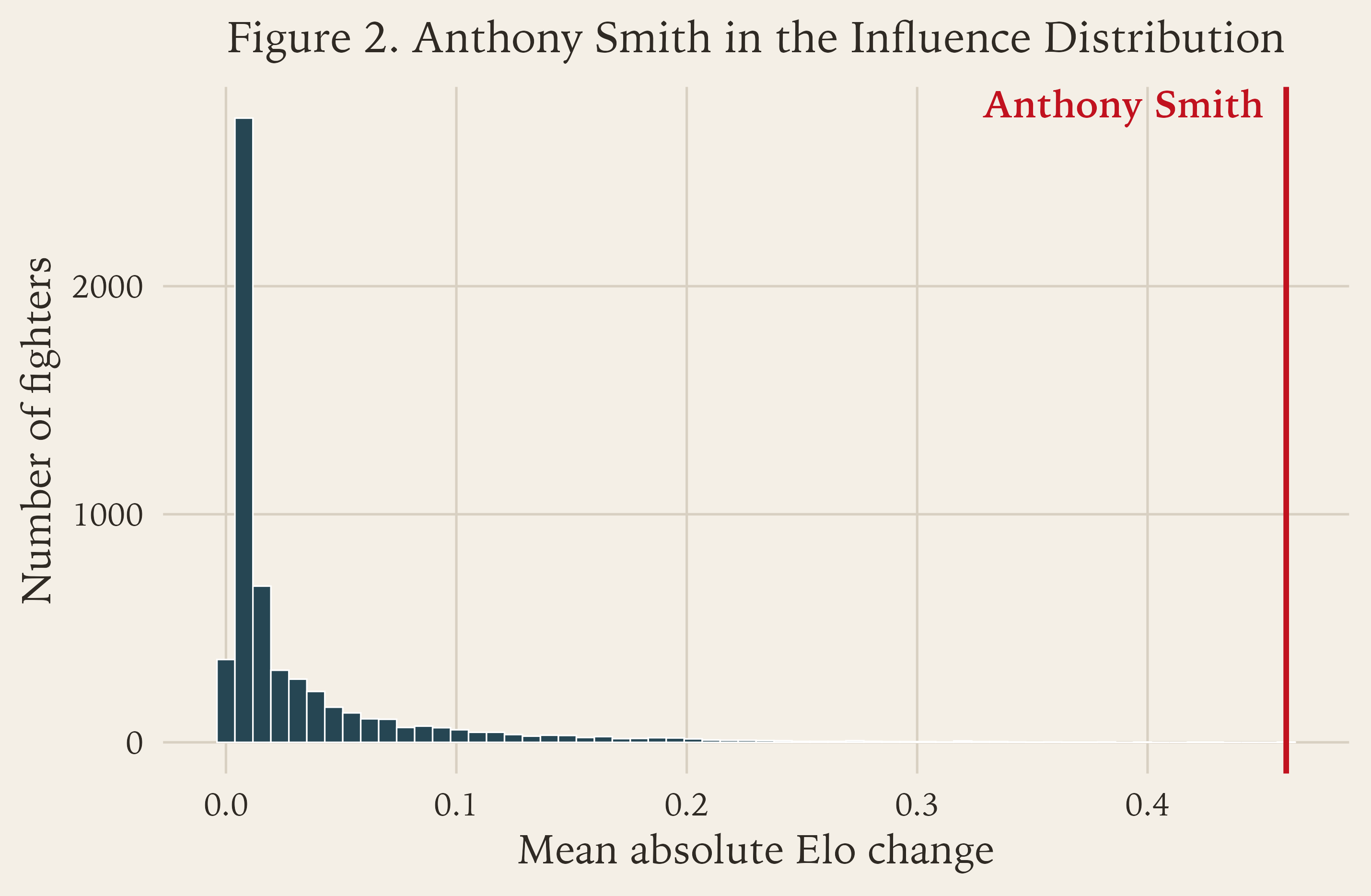
Figure 2 makes the point more clearly than the rank table does: most fighters barely move the system when removed, because their fights mostly live in local neighborhoods of the rating web. Anthony sits in the “if he sneezes, a bunch of ratings catch a cold” region.
That was one of the biggest surprises in this project. His score is not just high. It is way out in the tail.
Is it just because he fights a lot?
Partially. Volume gives you more connections. But it’s not only volume.
As Figure 3 shows, Anthony is high-volume *and* high-ripple, which is rare. He is the kind of fighter who somehow ends up as a “common opponent” across a lot of different storylines.
That is where opponent-network shape starts to matter. Two fighters can have similar fight totals, but the one who connects across contender tiers, eras, and divisions creates a much bigger downstream ripple.
Promotions: the underrated way to spread chaos
Fighters who appear across multiple promotions can serve as bridges between mini-ecosystems of MMA history. Bridges matter.
Figure 4 helps explain why. Anthony is not #1 in promotions, but he is high enough that he is clearly not confined to a single isolated pool of competition. Add in the weight-class movement, and you get a career that naturally stitches together different pools of opponents.
This was the part that changed my interpretation the most: his profile reads less like a single-lane specialist and more like a structural connector.
Among the top 25 influencers: who’s actually high-volume?
Figure 5 answers the depth question directly: among the top 25 ripple creators, who actually piled up the most fights? Anthony is near the top there too, which is part of the story.
Among the top 25 influencers: who traveled the most?
Figure 6 answers the breadth question: among the top 25 influencers, who spread those touches across the most separate ecosystems? That is where promotion mileage starts to look like bridge-building.
So… is Anthony Smith the most important fighter ever?
Here’s the honest, non-clickbait answer:
If you mean “best ever”: this says nothing about that.
If you mean “the guy whose presence most stabilizes this particular rating web”: he has a real argument.
This is the difference between:
“Who wins in a cage?” and
“Whose existence changes the map?”
And for this dataset, with this Elo setup, the map changes most when you delete Anthony Smith.
For MMA Fight Advisor readers, the practical angle is straightforward: fighters who behave like network nodes (high volume, cross-promotion, multi-weight-class careers) can create line value because casual markets often price the latest narrative while structure-aware models price long-run connectivity. A profile like Smith’s can produce asymmetric +EV spots precisely because it carries less superstar tax.
Fine print (kept short on purpose)
Ratings come from a fixed-K Elo system (
K = 110). Think ofKas the “volume knob” on how fast ratings move fight-to-fight.The influence test is leave-one-fighter-out: remove a fighter, rerun the full rating history, and compare final ratings.
Fight counts in the narrative/charts use cumulative records (
W + L + D + NC) when available, with deduped derived counts used as fallback.Promotions are inferred from event names to get a rough count of “where someone fought.” It’s directionally useful, not a museum-quality database of every promotion ever.
Different datasets or different Elo settings will change the leaderboard, which means we get to argue about it forever. (A feature, not a bug.)