
MMA FIGHT ADVISOR — UFC 327: PROCHAZKA vs. ULBERG
Full Card Analytical Breakdown

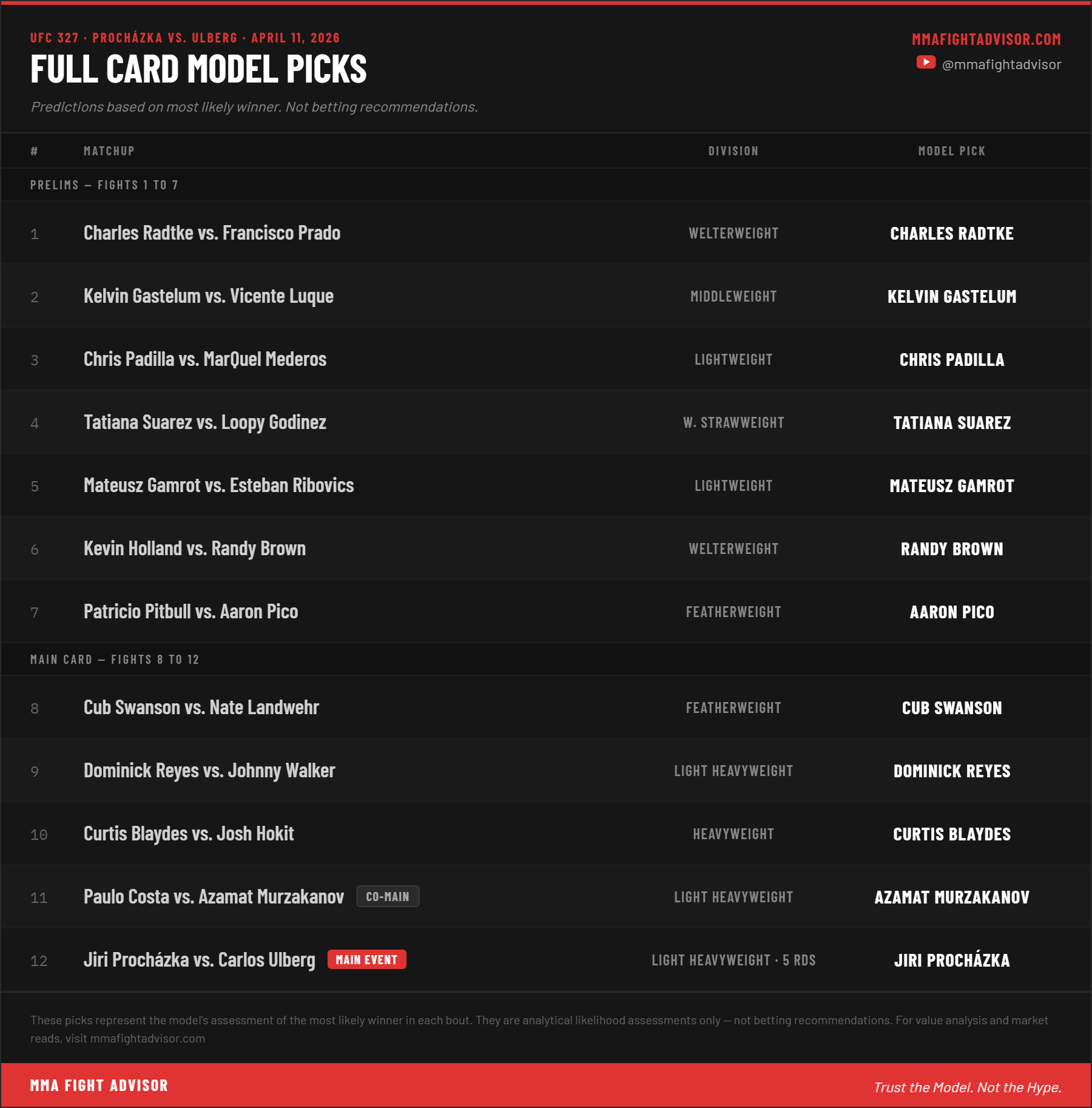
UFC 327 lands in Miami with something genuinely rare on the line: a vacant light heavyweight title and no clear favorite to claim it. Alex Pereira vacated the belt to pursue heavyweight gold. Magomed Ankalaev is sidelined. The UFC has turned to Jiri Prochazka — the man who never lost the championship in competition — and Carlos Ulberg, riding the division’s longest active win streak, to settle it. Beyond the main event, this is a card with real analytical depth from top to bottom. Several fights carry genuine finish potential, a few carry legitimate upset signals, and at least one carries something rarer than either — a retirement story worth watching regardless of how the numbers fall.
Here is where the model lands across all twelve fights.
CHARLES RADTKE vs. FRANCISCO PRADO Welterweight | Early Prelims
Prado is a 23-year-old brawler with an iron chin and genuine power, but his three-fight UFC losing streak has exposed a consistent problem: he cannot handle the size and reach of natural welterweights, and his defensive wrestling leaves him vulnerable to grapplers who want to control him. Radtke brings both of those problems to the table. He carries a BJJ black belt, a physical wrestling game, and the fight IQ to abandon the brawl when the brawl is not working — as he demonstrated with his third-round rear naked choke over Daniel Frunza. Prado’s durability will likely push this into the later rounds, but the model sees Radtke’s pressure and chain wrestling wearing him down.
The model’s pick is Radtke.
KELVIN GASTELUM vs. VICENTE LUQUE Middleweight | Early Prelims
This fight carries a significant asterisk: Luque is moving up from welterweight to middleweight, and the analytical implications cut both ways. Avoiding a brutal weight cut may marginally help his durability, but he will be the naturally smaller man absorbing shots from a fighter with Gastelum’s hand speed and physical thickness. The durability concerns around Luque are well-documented — he has looked hesitant and gun-shy under pressure in recent losses, and his front choke submission game, while genuinely dangerous, requires him to survive long enough to deploy it. Gastelum has never been knocked out in his career despite fighting elite competition, and his southpaw left hand down the pipe remains a legitimate weapon. The conditioning questions around Gastelum are noted, but the analytical case points clearly in his direction here. A stoppage is not out of the question if Luque’s durability breaks down under sustained pressure.
The model’s pick is Gastelum.
CHRIS PADILLA vs. MARQUEL MEDEROS Lightweight | Prelims
Padilla is one of the more analytically compelling fighters on this card. His performance against Ismael Bonfim — absorbing big shots without retreating, grinding forward, and finishing with ground and pound and a knee to the body in round two — revealed a fighter with genuine toughness and the pressure game to break athletic opponents who are not used to being tested. Mederos is fast, smooth, and effective at range with his calf-kicking game and lateral movement, but his recent fights have exposed a recurring grappling vulnerability: he gives up his back when scrambling to his feet, and he has been controlled by wrestlers at this level before. Padilla’s Muay Thai guard, clinch weapons, and offensive grappling create a structural problem Mederos has not yet solved. The model is as confident here as anywhere on the card. A finish in the later rounds via rear naked choke or ground and pound is a realistic outcome.
The model’s pick is Padilla.
TATIANA SUAREZ vs. LOOPY GODINEZ Women’s Strawweight | Prelims
Suarez’s road back has not been seamless. Her title fight loss to Zhang Weili exposed real questions about her explosiveness and takedown efficiency post-injury, and even her win over Amanda Lemos saw her tire in the third round and struggle to convert takedown attempts at the rate she once did. Those are legitimate concerns for a fighter whose entire game is built on physical dominance. Godinez, however, has a well-documented pattern of losing to elite grapplers — Mackenzie Dern and Virna Jandiroba both controlled her on the mat — and Suarez, even at a reduced level, remains the more physically imposing wrestler in this matchup. The model sees Suarez grinding out a decision, though the days of explosive early submissions may be behind her.
The model’s pick is Suarez.
MATEUSZ GAMROT vs. ESTEBAN RIBOVICS Lightweight | Prelims
This is a classic striker versus wrestler matchup with a clear analytical spine. Gamrot averages over five takedowns per fifteen minutes and has the chain wrestling to keep opponents pinned against the cage for extended stretches. Ribovics is a high-volume brawler with the cardio to maintain a blistering pace deep into a fight. The key question is whether Ribovics can keep the fight standing long enough for his striking volume to matter. His recent performance stuffing fourteen of fifteen takedown attempts against Elves Brener is encouraging, but his fight against Loik Radzhabov tells a different story: eleven takedowns conceded on twenty-one attempts against a truly persistent chain wrestler. Gamrot is that level of persistent. Ribovics’ chin is a genuine threat if he lands clean combinations on a fighter who has been dropped before, but the model sees Gamrot’s wrestling as the dominant force across fifteen minutes.
The model’s pick is Gamrot.
RANDY BROWN vs. KEVIN HOLLAND Welterweight | Prelims
Two 6’3” welterweights with matching reach and matching inconsistency. Brown is the cleaner, more technical outside fighter — his jab and distance management allow him to win rounds without absorbing punishment. Holland is the chaos agent, capable of looking elite and completely disinterested in the same fight. Brown’s durability has been flagged repeatedly, and his knockout loss to Gabriel Bonfim confirmed that a clean shot from a powerful fighter can end his night early. Holland’s grappling is underrated and his opportunistic front chokes are a legitimate finish threat. This is a genuinely close matchup, and the model’s lean toward Brown reflects his structural edge in clean outside boxing rather than any overwhelming analytical dominance.
The model’s pick is Brown.
PATRICIO PITBULL vs. AARON PICO Featherweight | Prelims
Pico is the obvious analytical favorite here on paper: younger, more explosive, elite wrestling credentials, and heavy hands. His UFC debut against Lerone Murphy confirmed he can be stopped, however, and Pitbull is precisely the kind of composed veteran counter-striker who can make Pico pay for reckless forward pressure. Pitbull’s guillotine choke is a genuine threat if Pico shoots desperately, and his timing on the counter right hand has finished fights at the highest level. The model does not bet this fight at the current price, which reflects how live the upset potential is. Pico’s clearest route to victory runs through his wrestling — use it to neutralize Pitbull’s striking and grind out a decision or TKO. Pitbull’s window is narrower but genuine — patience, composure, and one well-timed shot.
The model’s pick is Pico.
CUB SWANSON vs. NATE LANDWEHR Featherweight | Main Card
Cub Swanson has announced this is his last fight. At 42 years old, with a career stretching back to the WEC, he steps into the octagon against the kind of opponent who has ended careers: a relentless, high-volume brawler who will absorb damage to close distance and make the night miserable. Landwehr is dangerous in exactly the way that tests aging fighters. He does not give you clean, comfortable exchanges. He smothers and grinds and pressures until something breaks.
What the data says is this: something has been breaking in Landwehr’s own chin. Back-to-back third-round knockout losses against Morgan Charriere and Doo Ho Choi suggest his durability under sustained pressure is deteriorating. Swanson’s counter-boxing, timing, and stopping power remain intact as recently as his third-round finish of Billy Quarantillo. The model sees Swanson’s technical precision eventually finding the opening Landwehr’s aggression creates. A finish in the later rounds is the most analytically supported outcome. The model is as confident here as anywhere on this card.
The model’s pick is Swanson.
DOMINICK REYES vs. JOHNNY WALKER Light Heavyweight | Main Card
There is very little analytical certainty available in this fight, and the model reflects that. Both men carry genuine knockout power and genuinely fragile chins. Reyes is the cleaner technical boxer with a strong straight left hand and counter-striking instincts. Walker is the bigger, more physically explosive fighter with finishing power in either hand and the unpredictability that makes him dangerous from any position. Reyes was frozen and timid in his first-round loss to Ulberg, and the adjustment required is real. Walker’s recent win over Zhang Mingyang showed a slightly more measured approach, using calf kicks to break down his opponent before finding the finish.
This fight is unlikely to see the second round. The model lands on Reyes, but the margin is thin and the chaos factor is about as high as it gets on this card.
The model’s pick is Reyes.
CURTIS BLAYDES vs. JOSH HOKIT Heavyweight | Main Card
Hokit is genuinely intriguing. An undefeated two-time Division 1 All-American wrestler with fast hands and a relentless pace, he presents a legitimate athletic challenge even for a fighter with Blaydes’ credentials. The analytical concerns around Blaydes are real: a torn MCL in his last fight, consecutive knockout losses to elite heavyweights, and a declining speed that has made his wrestling less automatic. Hokit is undersized at around 230 pounds against a 260-pound Blaydes, however, and his UFC record is built against minimal competition. The gap in elite experience is significant. Blaydes’ size, reach, and wrestling pedigree remain formidable tools against an opponent at this level, and the model sees him weathering the early pressure and imposing his game over the course of the fight.
The model’s pick is Blaydes.
AZAMAT MURZAKANOV vs. PAULO COSTA Light Heavyweight | Co-Main Event
Murzakanov enters this fight undefeated at 16-0 with ten first-round finishes and a knockout power that does not require him to load up. His step-in jab recently put Aleksandar Rakic to sleep. Costa’s move to light heavyweight avoids a brutal weight cut that may have been affecting his conditioning, and he is actually the taller man in the cage at 6’1” against Murzakanov’s compact 5’10” frame. The iron chin and high volume that define Costa’s best performances are genuine assets.
The concern is how that chin holds up against true light heavyweight power for the first time. Costa has been finished by strikes only once in his career, but Murzakanov’s power operates at a different register than anything he has previously absorbed at middleweight. Costa’s most viable route runs through volume, body kicks, and surviving the early rounds to wear Murzakanov down — a fighter who has shown he can fade in extended fights. The model leans toward Murzakanov, acknowledging this is one of the more genuinely contested fights on the card.
The model’s pick is Murzakanov.
JIRI PROCHAZKA vs. CARLOS ULBERG Light Heavyweight Championship | Main Event | 5 Rounds
The light heavyweight title is vacant. Pereira is gone. Ankalaev is sidelined. What remains is the man who won the belt and never lost it in competition, and the fighter who has quietly built the division’s longest active win streak without anyone paying close enough attention.
Ulberg deserves genuine analytical respect. His first-round dismantling of Dominick Reyes was not a lucky punch. It was a composed, technical performance that showed how far he has developed since his debut loss to Kennedy Nzechukwu. He manages distance expertly, punishes overextension with his check left hook, and his strike absorption rate has dropped dramatically as his career has progressed. The case for an early Ulberg victory is analytically coherent: hunt Prochazka’s lead leg, manage range, and catch him lunging in the first or second round.
Prochazka’s entire career, however, has been built in the space where that plan falls apart. He absorbs damage without going out. He builds pressure relentlessly. He gets more dangerous, not less, as fights deteriorate into chaos in the championship rounds. His finish rate borders on absurd. He has never seen a UFC judges’ scorecard. Against Khalil Rountree, he lost the first two rounds convincingly before walking through damage to secure a third-round finish. That is not an anomaly. It is the pattern.
Ulberg has never been in a five-round fight. Championship rounds are uncharted territory. Prochazka lives there.
The model sees Prochazka getting his title back tonight. A finish in the championship rounds is the most analytically supported outcome.
The analysis and picks presented here are for informational and entertainment purposes only. Nothing on this page constitutes betting advice or a recommendation to wager. Always bet responsibly and only within your means.
For more in-depth analysis and further advice, head over to mmafightadvisor.com on Substack.
Trust the Model. Not the Hype.