
The Model Goes to Macau for UFC Fight Night: Song vs. Figueiredo
A card built on debutants, reset stories, and one heavyweight read the model is leaning into hard.

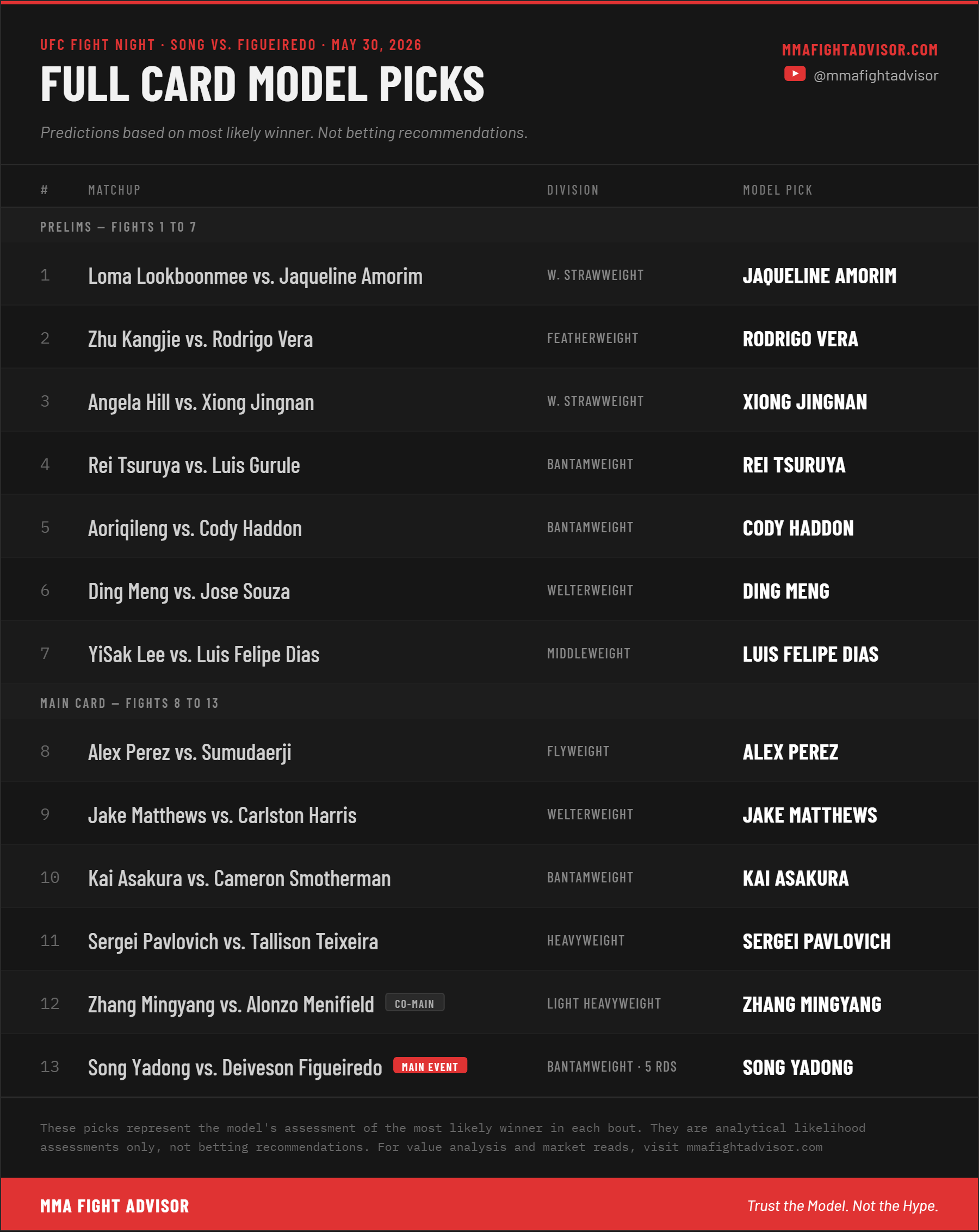
The model went 11-2 at UFC Vegas 117 last time out. Both misses came on sub-60% reads where the model itself flagged the variance. Every higher-conviction call held. That kind of calibration alignment is what the model is built for, and it lands at the right moment, because UFC Macau is a card where the conviction tiers do a lot of the talking.
Locked. Drafting now.
The Model Goes to Macau
A card built on debutants, reset stories, and one heavyweight read the model is leaning into hard.
[PREDICTIONS CARD GRAPHIC — Horizontal version]
The model went 11-2 at UFC Vegas 117 last time out. Both misses came on sub-60% reads where the model itself flagged the variance. Every higher-conviction call held. That kind of calibration alignment is what the model is built for, and it lands at the right moment, because UFC Macau is a card where the conviction tiers do a lot of the talking.
Lookboonmee vs. Amorim
The opener at women’s strawweight is the closest call on the card. The model is essentially at coinflip range here, and the published pick lands on Jaqueline Amorim. The stylistic split is clean: Loma Lookboonmee has 200-plus Muay Thai bouts and nine championships in her background, with a UFC profile built around clinch volume and decision pace. Amorim is a BJJ black belt out of American Top Team Coconut Creek with 8 of her 10 career wins by submission and a 3.8 sub-attempt-per-15 UFC rate. The path for Amorim is closing distance, hitting the mat, and finding a finish before her cardio question shows up. Lookboonmee gassed Amorim early in their last reference points, but Lookboonmee’s bouts almost always reach the third round.
Zhu Kangjie vs. Rodrigo Vera
This is where the model gets loud on the prelims. Rodrigo Vera is the pick, and he arrives as the strongest regional resume of any UFC debutant on the card: 21-1-1, a 5-fight win streak, FFC champion at featherweight with title defenses against Varela, Martinez, Zenidim, and Eduardo, plus a recent LFA win over Caetano. He’s “El Gato Loco,” a national no-gi jiu-jitsu champion training out of Peru and Brazil. Zhu Kangjie won his Road to UFC season and has the home-crowd lift in Macau, but the matchup hinges on his takedown defense. Against Shin Haraguchi in the RTU final, Zhu was taken down 16 times across the bout. If Vera can impose grappling pressure under fight-week-replacement conditions, the path narrows fast for Zhu.
Angela Hill vs. Xiong Jingnan
The most historically distinctive bout on the card. Angela Hill walks in as the longest-tenured strawweight in division history: 29th UFC strawweight bout, 12 divisional wins, 6 hours 42 minutes of total UFC strawweight fight time, all divisional records. Her 2,242 UFC significant strikes rank third all-time behind Holloway and Strickland. Xiong Jingnan arrives as a two-time ONE strawweight champion, 19-2, seven title defenses, dropping down from her ONE flyweight title days. The gap between them is the biggest UFC experience discrepancy in any female fight in UFC history at 30 bouts. The model favors Xiong, and the stylistic case rests on her 53% career KO rate against a Hill who is 41 years old, on a two-fight skid, and has seen her defensive numbers erode. The wildcard is Xiong’s activity question — she’s fought once in the last three years.
Rei Tsuruya vs. Luis Gurule
The model has Tsuruya in a thin lean, and the matchup explains why. Tsuruya is the higher-ceiling prospect: Pancrase featherweight champion, Road to UFC Season 2 winner, with a UFC profile built around takedowns and submission attempts. His one UFC fight was a competitive decision loss to Joshua Van at UFC 313 in March 2025. Luis Gurule is in on roughly two weeks’ notice after a UD win over Barez on May 16, fighting at bantamweight when both fighters are natural flyweights. The 135-lb question is real for Tsuruya, who relies on grappling pressure that depends on size parity. Gurule has been finished and outpointed at his natural division. The short-notice, off-weight, 14-month-layoff combination makes this the bout where the analytical case is least clean on the prelims.
Aoriqileng vs. Cody Haddon
Cody Haddon is the pick, and the editorial spine is the return story. Haddon hasn’t fought since October 2024. Two consecutive injury-driven withdrawals — UFC 312 against Aleksandre Topuria after a broken foot in sparring plus a partially torn LCL, then UFC 322 at Madison Square Garden after another fight-week foot fracture — cost him roughly 18 months. He told ESPN that during the knee injury recovery, the only thing he could do was box, so he trained boxing for the entire layoff, and people have been complimenting his hands on his return. He’s 1-0 in the UFC with a 9.20 SLpM clip and 83% takedown defense. Aoriqileng is the veteran test: 26-12-1, mostly a decision fighter at ~62%, but he scored a 21-second R1 KO of Cody Gibson at UFC Vancouver in October 2025 that earned a $50,000 Performance bonus. If he lands that same right hand on a rust-shaking Haddon early, the path opens. If not, Haddon’s output should walk him through.
Ding Meng vs. José Souza
Both fighters make their UFC walks for the first time. The model leans Ding at moderate conviction, and the case rests on the activity gap and weight-class familiarity. Ding is 35-9 with 30 career stoppages, the former A1 Combat welterweight champion who took the title via R2 KO over Mirali Huseynov in October 2025. Two scheduled defenses since then were cancelled, so this is Ding’s return after a six-month layoff. José Souza is the story of accumulated delay: a 2023 UFC signing whose debut has been booked and unbooked three times — failed dates against Eric Nolan, Nikolay Veretennikov (postponed when Souza was injured), and Charles Radtke at UFC Vegas 114 — before this one finally landed. He’s 8-1 with all eight wins by stoppage and significant length at 6’3” with a 79-inch reach, but his last MMA bout was November 2024 at middleweight. He’s cutting down to welterweight and fighting on 18 months of inactivity. The matchup math leans Ding on activity and division comfort; Souza’s path is leveraging his reach and finding a finish before rust shows.
YiSak Lee vs. Luis Felipe Dias
The middleweight prelim opener at the top of the undercard pits a Korean direct UFC signing against a Brazilian DWCS finisher. YiSak Lee is the “Tank,” a judo black belt out of Korean Top Team with an 8-1 record, whose only career loss came via R2 RNC to Agilan Thanigasalam in December 2024. Luis Felipe Dias is the higher-output finisher: 17-5 with 16 of 17 career wins by stoppage, a Dana White’s Contender Series Season 9 sign who finished Donovan Hedrick via R2 RNC in his audition. The model favors Dias at moderate conviction, and the matchup is grappler-versus-grappler-finisher where both fighters want the same fight but only one has the deeper finishing-rate sample. Lee has a 17-month layoff to shake off; Dias arrives on momentum.
Alex Perez vs. Sumudaerji
The main card opens at flyweight with the thinnest model lean on the slate. Alex Perez is the pick, but barely. He arrives off a R1 KO of Charles Johnson at UFC 324 — a fight where he missed weight by 2.5 lbs, weighing 128.5 pounds, which cost him 25% of his purse and the $25,000 finish bonus under the updated UFC rule. He’ll be 34 in March, called this “the last fight on his contract” in the UFC.com feature, and publicly committed to a stand-and-bang gameplan despite being the structural wrestling advantage in the matchup. Sumudaerji is on a clean three-fight UFC win streak (UD over Aguilar, Borjas, Raposo) trained out of Team Alpha Male under Faber, with Song Yadong as a stablemate. The stylistic question is whether Perez’s wrestling closes the distance against Sumudaerji’s length and pace. Perez’s average UFC flyweight fight time is 6:25, the second-shortest in divisional history behind only Daniel Lacerda — his bouts tend to end early when he wins. Sumudaerji’s UFC wins have all gone the full 15 minutes. The cleanest binary on the card: Perez by finish or Sumudaerji by decision.
Jake Matthews vs. Carlston Harris
The model has Matthews at moderate conviction in a welterweight bout where his opponent showed up on roughly two weeks’ notice. Matthews’s 24th UFC appearance is the most by any Australian-born fighter in UFC history — he debuted at 19 in 2014, and at age 31 he carries a 15-8 UFC record into Macau. His last fight was the Neil Magny controversy at UFC Perth, where he locked a mounted guillotine that referee Jim Perdios waved off just before the horn of Round 1 thinking Magny was unconscious, then restarted the fight when Magny protested. Matthews adrenaline-dumped, and Magny rallied to a R3 brabo choke submission at 3:08. Carlston Harris arrives in on the Salikhov-replacement booking after originally being scheduled to face Michael Chiesa in March 2026, which fell through due to Chiesa’s visa issues. Harris is on a two-fight KO skid (R1 to Khaos Williams, R3 to Santiago Ponzinibbio) and a 16-month layoff. His finishing specialty is the front choke — anaconda wins over Aguilera and Wells. If Harris doesn’t find a choke in the first half of the fight, the cardio question becomes the dominant variable. Matthews’s recent run and the layoff-plus-short-notice math run in his favor.
Kai Asakura vs. Cameron Smotherman
This is the bout where the analytical case sharpens significantly with new context. Kai Asakura arrives 0-2 in the UFC but both losses came at flyweight against grappling-heavy opponents who closed the distance and submitted him in Round 2 — Alexandre Pantoja by RNC at UFC 310 in his title-shot debut, then Tim Elliott by guillotine at UFC 319. Asakura has said publicly that the flyweight cuts felt unnatural and bantamweight is “more natural” for him. This is his first UFC bout at 135, the division where he held the RIZIN bantamweight title twice with wins over Kyoji Horiguchi and Manel Kape. Cameron Smotherman is 1-2 in the UFC with both losses coming by decision against more disciplined strikers (Sidey and Simon), and his last scheduled bout at UFC 324 was cancelled when he collapsed at the weigh-ins after making 135.5 — though Smotherman himself has stated he cut very little weight and isn’t sure what caused the fainting. The model lands on Asakura at confident-tier conviction, and the case is built around the weight-class reset and the pedigree gap. The path for Smotherman is heavy hands and unorthodox pressure early before Asakura settles into his bantamweight rhythm.
Sergei Pavlovich vs. Tallison Teixeira
This is the model’s strongest read of the weekend. Sergei Pavlovich is the analytical anchor at heavyweight: 19-3 career, 8-3 UFC, currently ranked #3 in the division. His six-fight UFC first-round KO streak — ended only by Tom Aspinall at UFC 295 — is tied with Don Frye for second-longest in UFC history behind Chuck Liddell’s seven. Each of those six finishes came in Round 1: Blaydes at 3:08, Tuivasa at 0:54, Lewis at 0:55, Abdurakhimov at 4:03, Greene at 2:11, Golm at 1:06. His 2025 evolution shifted him from a R1-or-bust knockout hunter to a more composed boxer with takedown threats, and his back-to-back decisions over Waldo Cortes-Acosta and Jairzinho Rozenstruik confirm the toolkit expansion.
Tallison Teixeira walks in as the rising prospect: 9-1 career, 2-1 in the UFC, ranked #15. His UFC arc has been turbulent — a 35-second R1 TKO of Justin Tafa earned him Performance of the Night at UFC 312, then a 35-second R1 TKO loss in the main event against Derrick Lewis in July 2025, then a bounce-back KO of Tai Tuivasa at UFC 325 in January 2026. He’s 6’7” with an 83-inch reach, training out of Cornerman in São Paulo after leaving Team Lucas Mineiro, with Glover Teixeira as head coach and Alex Pereira as a sparring partner. He called it “the best camp of my life.”
The matchup math is brutal. Teixeira’s striking defense sits at 42% — exactly the profile that gets exposed against a fighter with Pavlovich’s accuracy and power. The path to a Teixeira upset is single-moment, height-and-power dependent against a fighter who has built his career on never giving the single moment back. The Pereira-Glover camp is real confidence work, but it doesn’t change the structural numbers. The model is reading this as the cleanest case on the card.
Zhang Mingyang vs. Alonzo Menifield
The co-main pits a divisional finisher against a divisional veteran in a fight the model reads at moderate conviction. Zhang Mingyang is “The Mountain Tiger”: 19-7 career, all 19 of his career wins by stoppage, every single one in Round 1. He’s a Muay Thai striker with 7.71 SLpM and three UFC R1 KOs to open his promotional run, including a finish of former title challenger Anthony Smith at UFC 312 in April 2025. His setback came in his August 2025 UFC Shanghai main event against Johnny Walker, where two stiff calf kicks dropped Zhang in Round 2 and Walker finished with ground-and-pound at 2:37 — the first time in 16 fights, dating back to 2018, that Zhang had been past the first round.
Alonzo Menifield is 17-6-1 with a documented pattern of winning fights in pairs after losses, and he’s coming off a R1 KO loss to Volkan Oezdemir in November 2025. His Von Flue submission at UFC 260 is one of only eight in UFC history. He sits at 78% takedown defense with grinding durability that has historically dragged opponents into rounds they don’t want to fight.
The matchup is bimodal. If Zhang lands clean early, this looks like every other Zhang win on his record. If Menifield survives Round 1 and the Walker template plays out — calf kicks, lateral pressure, dragging Zhang into deep water — the analytical edge shifts. The model has Zhang on home soil with the finishing pressure advantage, but the conviction is measured precisely because that Walker fight exists.
Song Yadong vs. Deiveson Figueiredo
The main event is where the analytical center of the card lives, and where the model holds its confident read. Song Yadong is the model’s pick, and the case is built across striking output, divisional positioning, and a stylistic matchup that runs in Song’s favor more than the surface numbers suggest.
Song competes in his fifth UFC headliner with a 3-1 record in previous main events. He’s 22-9-1 career, 11-4-1 in the UFC, ranked #5 at bantamweight. His striking sits at 4.42 SLpM with 55% defense — significantly higher output than Figueiredo at 2.63 SLpM and 49% defense. His last five fights: a decision loss to Sean O’Malley at UFC 324, a technical decision win over Henry Cejudo at UFC Fight Night Seattle in February 2025 that he called “the biggest win of my career,” a decision loss to Petr Yan, and wins over Chris Gutierrez and Ricky Simon. The O’Malley loss is the most analytically useful data point — O’Malley used reach and length to thwart Song’s pressure and counter-strike, which is the diagnostic for what beats Song.
Deiveson Figueiredo arrives as a flyweight legend in the bantamweight division. He’s one of six UFC flyweight champions in history. He and Brandon Moreno are the only opponents in UFC history to face each other four times. He still holds the fastest title-fight turnaround in UFC history at 21 days, between UFC 255 and UFC 256. His 7 UFC flyweight stoppage wins tie for second-most in division history with Demetrious Johnson, behind only Alexandre Pantoja’s 8. His 11 flyweight knockdowns are tied for most in division history. Since moving to bantamweight in December 2023, he’s gone 4-3: wins over Rob Font (UD), Cody Garbrandt (R2 submission at UFC 300), Marlon Vera (UD), and Montel Jackson; losses to Petr Yan, Cory Sandhagen (knee injury TKO), and Umar Nurmagomedov. The pattern in his BW losses tells you exactly what beats him: rangy strikers and wrestling pressure. Song brings both.
Figueiredo holds a one-inch reach advantage despite the three-inch height differential. He arrived at 147 lbs on Monday before weigh-ins and trained with Fighting Nerds plus Pitbull Brothers camp. He told Sherdog he expects a “late finish” of Song — Round 4 submission specifically — and his framing tells you exactly what he believes: that Song’s cardio fades, that the fight stretches, and that a submission opens late. The contrarian read on Song, surfaced in deeper analytical pieces this week, aligns with that thesis: Song’s last KO came in 2023, his cardio reportedly drops in Round 3, and he telegraphs strikes when he’s pressing for a finish.
The model still lands on Song at confident conviction. The case rests on the activity gap, the divisional fit, and the structural matchup. Song is 28; Figueiredo is 38. Song is fighting in his third UFC main event in China. Song’s striking volume and defense numbers are simply better than Figueiredo’s, and his height advantage matters even when reach is a wash. The Figueiredo path is real — he has finishing power, championship-level finishing pedigree, and the patience to find a late submission. But the diagnostic is whether Figueiredo, who has lost his most consistent bantamweight tests against fighters with Song’s toolkit, finds a different answer in Macau.
The pick is Song.
This card carries its analytical weight at the top. Pavlovich is the cleanest read of the weekend at heavyweight. The main event delivers the kind of divisional question that rankings genuinely turn on. The historic experience gap at women’s strawweight makes Hill-Xiong a fight that won’t be replicable. And the prelim slate is a stress-test of how regional credentials translate to the Octagon, with seven debutants carrying very different stories of how they got here.