
UFC 328: WHERE THE MODEL LANDS
Two title fights anchor a stacked Newark card built on grappler-versus-striker matchups

There are two ways UFC 328 plays out. Either the striker-versus-grappler matchups running through this card produce a string of highlight finishes, or the grapplers win those matchups and the night gets long. The model leans toward the latter on most of them, but the editorial story of this card is bigger than any single fight. Two title fights in Newark. A youth movement at flyweight that becomes official the moment Joshua Van and Tatsuro Taira touch gloves. A middleweight grudge that needed extra hotel security and a cancelled face-off. Thirteen bouts, top to bottom. Here is how the model reads them, prelims first.
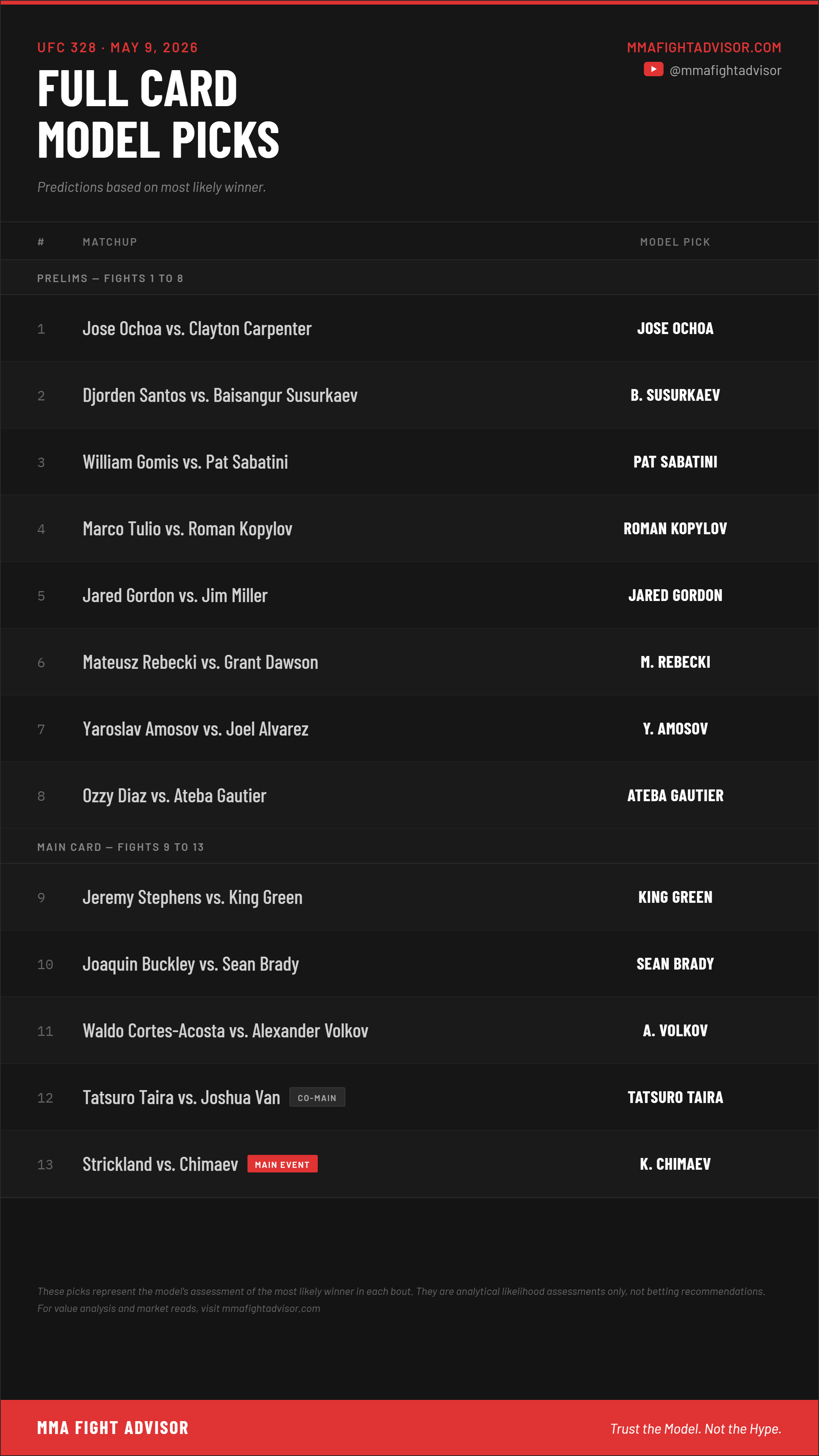
Jose Ochoa vs. Clayton Carpenter (Flyweight) The model lands on Ochoa. Carpenter has a deep BJJ background, but his most recent UFC sample says the elite flyweight body has caught up with him. He was submitted by Jafel Filho and handled clearly by Tagir Ulanbekov. Ochoa has faced higher-grade flyweight competition in Asu Almabayev and Lone’er Kavanagh and survived both. He brings volume kickboxing and the durability to keep this on the feet long enough for that volume to compound. Ochoa wins this on output.
Djorden Santos vs. Baisangur Susurkaev (Middleweight) The model takes Susurkaev. The 11-0 Chechen prospect, and Chimaev training partner, has shown he can be dragged into rougher fights than his record suggests, but Santos does not have the offensive horsepower to capitalize on Susurkaev’s openings. Santos is durable. He is also the kind of opponent who eats damage to land his own. Susurkaev’s striking and grappling layers are both a step above. Susurkaev finishes inside two rounds.
William Gomis vs. Pat Sabatini (Featherweight) The pick is Sabatini. This is a clean stylistic match for him: a Division I wrestler and BJJ black belt against a rangy, back-foot point fighter who lacks the power to deter takedown entries. Sabatini is chinny on the feet, which is the only path that opens this up. If he gets his hands on Gomis, the fight goes where Sabatini wants it. He wins by submission or decision.
Marco Tulio vs. Roman Kopylov (Middleweight) Kopylov gets the call here. This is the closest the model came to a true toss-up on the prelims. Tulio is a high-volume Chute Boxe brawler with real pressure, and Kopylov has shown a tendency to mentally fold when he is being walked down. The counter is that Tulio’s defense was visibly absent in his last step up against Christian Leroy Duncan, where he was knocked out cleanly. Kopylov’s southpaw counter-kicking remains the more technical weapon. He catches Tulio coming in.
Jared Gordon vs. Jim Miller (Lightweight) Gordon by decision. Miller is a UFC institution, but his striking defense is gone, he stands square, and he absorbs heavy damage in later rounds. Gordon’s edge is hand speed, cardio, and a willingness to mix in takedowns. The only equalizer is Miller’s veteran craft and his guillotine, both of which can flip a round. The model still favors Gordon’s pace over fifteen.
Mateusz Rebecki vs. Grant Dawson (Lightweight) The model takes Rebecki, which is the contrarian read on paper. Dawson’s wrestling is the clean argument for the favorite. The argument against him is what happened the last time he stood across from a real puncher: Manuel Torres knocked him out in 33 seconds. Rebecki has lost three of his last four against upper-tier lightweights, but the manner of those losses tells the story. He is durable, he is heavy-handed, and he forces opponents into wars they did not sign up for. If Dawson cannot get this to the mat early, his chin is the variable that decides the fight.
Yaroslav Amosov vs. Joel Alvarez (Welterweight) Amosov gets the call. Alvarez is dangerous off his back. The problem is everything that has to happen before he gets there. Amosov’s wrestling is positionally elite, and he has the technical discipline on top to avoid Alvarez’s submission threats while accumulating control time. Alvarez was thoroughly grounded and bloodied by Arman Tsarukyan. Amosov is the cleaner version of that test. Amosov by decision.
Ozzy Diaz vs. Ateba Gautier (Middleweight) Gautier finishes this in the first round. The case against him is that his last fight was a flat, low-output decision against Andrey Pulyaev, where his cage-cutting was poor and he leaned on a single right hand. Diaz is a different problem. He is a smart pressure striker, but he is not athletic enough to make Gautier work for the opening. Gautier lands the right hand early.
Jeremy Stephens vs. King Green (Lightweight) Green by decision. Both fighters are 39. Stephens has lost eight of his last nine and is now reliant on a one-shot puncher’s chance. Green’s chin has eroded against the sharper end of the lightweight division, but Stephens does not move at the speed required to consistently land the shot that exposes it. Green’s volume and reflexes still hold up against this version of Stephens. He wins on the cards.
Joaquin Buckley vs. Sean Brady (Welterweight) The model lands on Brady, and this is one of the tighter reads on the main card. Both fighters are coming off losses that exposed them. Brady’s loss to Michael Morales showed a chin question and severe striking deficiencies when he could not get the takedown. Buckley’s loss to Kamaru Usman showed a defensive grappling problem against a smothering wrestler. The model gives the edge to Brady’s chain wrestling on the basis that Buckley’s ground vulnerabilities are deeper than Brady’s striking ones. Brady gets it down, controls top position, and finds a finish or rides out the decision.
Waldo Cortes-Acosta vs. Alexander Volkov (Heavyweight) The pick is Volkov. Cortes-Acosta is on a real run. He has knocked out Derrick Lewis and Shamil Gaziev, and he has fought at a frequency almost no heavyweight matches. The level-of-competition flag is the cleaner read here. The one true elite he faced, Sergei Pavlovich, picked him apart at range over fifteen minutes. Volkov is a different kind of problem at distance: 6’7”, a stiff jab, hard kicks, and 50 fights of veteran composure. The hamstring issue Cortes-Acosta reportedly dealt with in camp is a flag, but not a deciding one. Volkov fights the fight he wants and takes the decision.
Tatsuro Taira vs. Joshua Van (Co-Main, Flyweight Title) Taira is the call. Van’s striking is real and his durability is established. The structural problem is that Taira is, by a meaningful margin, the best grappler Van has ever fought. Tsuruya tested Van’s takedown defense with funky judo entries; Taira will test it with methodical body locks and the best back control in the division. Once Taira gets to a dominant position, he holds it. The flag worth surfacing is that Van’s title win came in 26 seconds via a Pantoja elbow injury, which leaves a real sample-size gap on what a title-rounds Joshua Van actually looks like under championship pressure. Taira gets the takedown, gets the back, and finishes the fight in the middle rounds.
Sean Strickland vs. Khamzat Chimaev (Main Event, Middleweight Title) Chimaev wins this on the mat. Strickland’s takedown defense, listed at 84% for his career, has held up against most of the division and broken down against the elite. Du Plessis took him down six times in their first title fight. Kamaru Usman took him down at will. Chimaev is a more aggressive wrestler than either, with chain-wrestling layers Strickland has not had to solve before. The argument for Strickland is the fifth round. Chimaev’s pace did fall off against Du Plessis at UFC 319. He landed only 37 significant strikes over five rounds and won that fight on positional control rather than damage. The path is real. It also requires Strickland to survive 20 minutes of a wrestler who has never been close to losing. The model takes Chimaev by submission, almost certainly inside three rounds.
The card overall
UFC 328 is the most stacked numbered card of the year, and the analytical character of it is unusual. The night will likely be defined less by close, evenly matched fights than by a series of clean stylistic mismatches resolving in the favorite’s direction. The model’s read is that the grapplers win most of their matchups: Sabatini, Brady, Amosov, Taira, Chimaev. The exceptions, where the model leans striker, are the fights where the favored grappler has a real defensive hole or the striker has a level-of-competition edge. Two title fights, two passing-of-the-torch storylines (one literal at flyweight, one strategic at middleweight), and a deep undercard where the prospects mostly do their jobs. If chalk holds, the night is heavy on grappling and decisions. If it breaks, the breaks land in places that change divisional pictures.