
UFC FIGHT NIGHT 271: ADESANYA VS. PYFER
The MMA Fight Advisor Analytical Preview

The main event carries genuine legacy weight. A former two-time champion on the first three-fight losing skid of his career, facing a freight train finisher who has been knocking and submitting middleweights on his way up the rankings. The co-main is a five-year rematch between two flyweights who have evolved in opposite directions since they last met. Below them, the undercard is stacked with Pacific Northwest fighters fighting at home, a retirement walk for one of the sport’s most respected veterans, and at least two analytical spots where the model sees something the market has not fully priced.
Seattle also matters contextually in a way that most venues do not. The Climate Pledge Arena is a full-size octagon, not the Apex. That distinction is worth more than it sounds, and we will return to it in the main event section.
Five Washington state fighters are on this card. Michael Chiesa is making his last walk in his home state. Terrance McKinney, who Chiesa coached in high school in Spokane, opens the same show. Chase Hooper is fighting in Washington for the first time in his UFC career. Ricky Simon knocked someone out in this exact building last February. Lance Gibson Jr. was born in Seattle. This is not just a fight card. It is a homecoming for a significant portion of the roster.
ISRAEL ADESANYA vs. JOE PYFER
Middleweight | Main Event | 5 x 5
The public narrative on this fight is straightforward. Adesanya is 36, on a three-fight losing skid for the first time in his career, coming off a knockout loss and a 13-month layoff. Pyfer is 29, on a three-fight win streak, riding momentum, and hitting harder than almost anyone in the middleweight division. The narrative says the torch is being passed.
The analytical picture is more complicated.
Start with what the numbers actually say about Adesanya. He averages 4.02 significant strikes landed per minute with a 55-56% striking defense. His striking differential sits at plus 0.82. Those are not the numbers of a fighter in terminal decline. They are the numbers of a technically elite counter-striker who has been beaten by the three best middleweights of his era — Strickland, Du Plessis, and Imavov — in succession. Context matters enormously here.
The Imavov loss, the most recent and the most damaging to public perception, is worth examining carefully. Before the finish, Adesanya was winning the first round by 15 significant strikes. His technical game, his distance management, his fight IQ — all of it was functioning at championship level. What ended the fight was a specific defensive habit that has become his primary vulnerability: when threatened by a faked takedown or a lead hook, Adesanya extends his hands outward to parry, leaving his chin exposed to overhands and uppercuts. Imavov timed that habit perfectly. So did Strickland and Du Plessis before him. The question for Seattle is whether City Kickboxing has found a counter to that pattern, and whether the 13-month layoff has sharpened or dulled his reaction speed.
Now consider Pyfer. His profile is deceptively simple on the surface. He hits extraordinarily hard, finishes fights at an 87% career rate, and has seven first-round stoppages in 15 wins. His UFC run has been built on explosive early-round performances. But there is one data point that complicates the narrative of inevitability around him: the Hermansson fight. In his only five-round UFC bout, Pyfer was outlanded 86 to 46 in the final three rounds. He won the early rounds convincingly, then faded badly as the fight went long. That cardio cliff is not a rumor. It is on film.
The analytical case for Adesanya runs through that cardio cliff and through the venue. The full-size Seattle octagon is the most underappreciated factor in this matchup. Adesanya’s entire game is built on space and angles. The Apex format compresses his movement and rewards aggressors who can cut off the cage quickly. Seattle gives him the canvas his style requires. Pyfer needs to close distance, cut off angles, and convert early. In a full-size octagon against a fighter with an 80-inch reach who is five inches longer, that task becomes considerably harder.
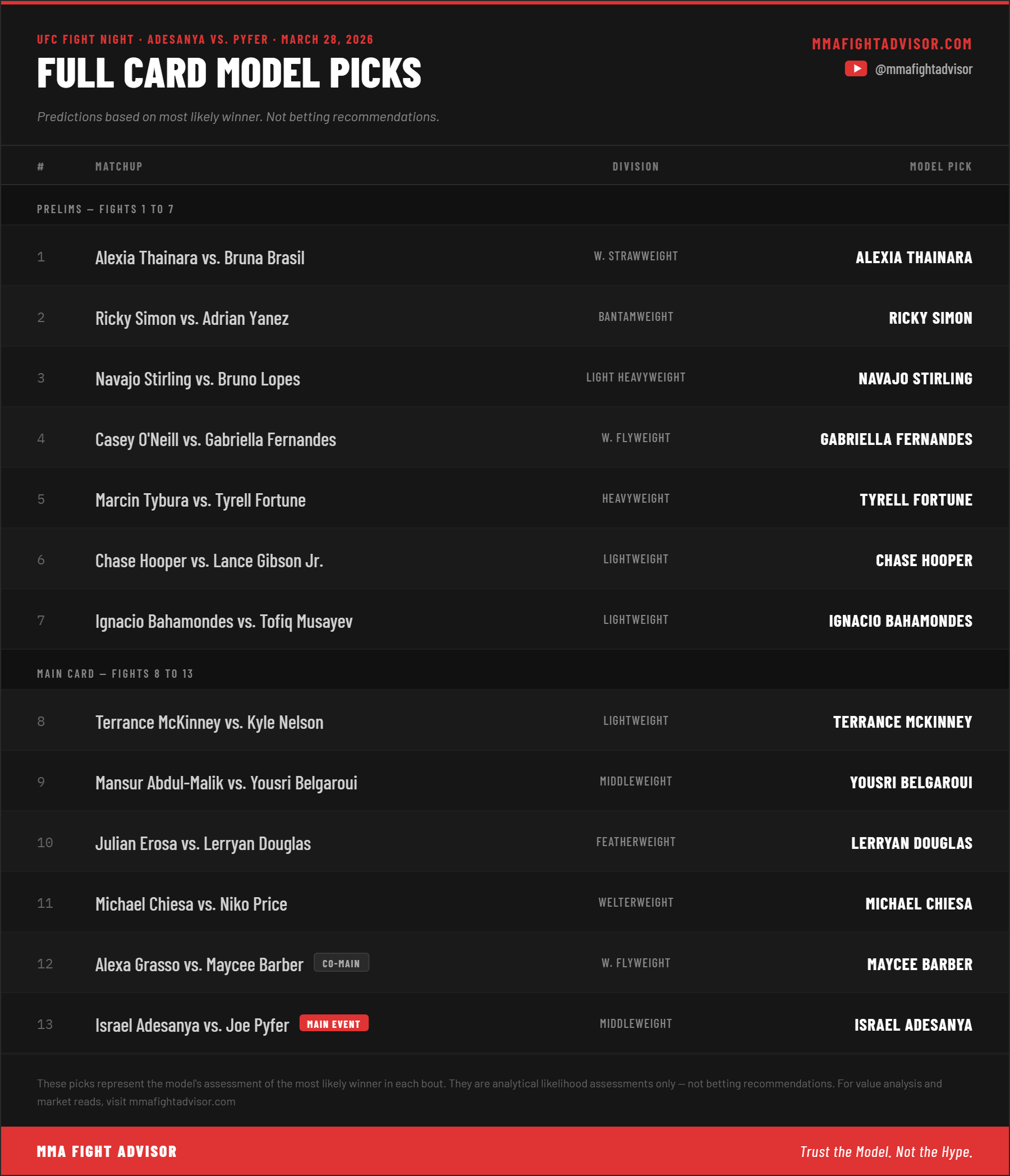
The model picks Adesanya. The analytical path is decision, or a late stoppage if Pyfer’s cardio fails in the championship rounds as it did against Hermansson. The danger zone is rounds one and two. If Pyfer cannot convert early against a fighter who was winning the first round against Imavov before the finish, the structural case points toward the former champion as the fight deepens.
This is not a lock. The Emp model sits barely above a coin flip on this fight, reflecting genuine analytical uncertainty. The rust concern is real and unquantifiable. The chin question is legitimate. But the pick is Adesanya, and the case for it is grounded in data rather than sentiment.
ALEXA GRASSO vs. MAYCEE BARBER
Women’s Flyweight | Co-Main | 3 x 5
Five years is a long time in a fighter’s career. When these two last met at UFC 258 in February 2021, Barber was 22 years old, coming off a torn ACL, and cutting from strawweight. She landed 18 of 119 significant strikes that night, a 15% accuracy rate that tells you everything about how effectively Grasso neutralized her. Grasso won clearly and the result felt decisive.
Neither fighter is that version of themselves anymore.
Barber has been on a seven-fight win streak since that loss, and the evolution has been genuine rather than cosmetic. She now averages 4.61 significant strikes per minute, carries real offensive wrestling at 1.58 takedowns per 15 minutes, and has developed a brutal clinch game built around elbows and forward pressure. She has also grown physically into the flyweight division in a way she simply had not in 2021. Her assessment of that first fight is revealing: she believes the fighter who dominated round three that night represents her true level, and that the first two rounds reflected her depleted physical state.
Grasso’s trajectory has moved in the opposite direction. The former champion is on a three-fight winless skid — two losses and a draw — against the absolute elite of the flyweight division. Her loss to Natalia Silva at UFC 315 exposed a specific vulnerability: dynamic speed and lateral movement gave her fits. Silva’s in-and-out footwork did not allow Grasso to find a rhythm with her flat-footed, boxing-heavy approach. That is a relevant data point because it suggests Grasso’s current form is not purely a question of competition level. There are stylistic problems that persist.
The analytical read leans toward Barber. Her wrestling gives her a structural path that bypasses Grasso’s strongest weapon, her striking defense and counter-punching. Grasso’s 54% takedown defense is not a strong number against a fighter who has added genuine offensive wrestling to her game. The counter-threat is Grasso’s submission game off her back — she threatened armbars and triangles in the first fight and her BJJ is legitimate. If Barber gets sloppy with top control, Grasso can threaten from the bottom.
The honest analytical position on this fight is that the direction leans Barber but the uncertainty is genuine enough that no strong conviction is warranted. This is one to watch rather than one to lean on analytically. The rematch dynamics in women’s MMA are genuinely hard to price — the adjustment variable cuts both ways and Grasso has beaten Barber before.
MANSUR ABDUL-MALIK vs. YOUSRI BELGAROUI
Middleweight | Main Card | 3 x 5
This is the analytically most interesting fight on the main card outside the top two bouts, and it is worth giving it the space that the signal demands.
Yousri Belgaroui is unlike most fighters the UFC signs at middleweight. He is 6’6” with a 79-inch reach, a former three-time Glory Kickboxing Middleweight title challenger who has shared the ring with both Israel Adesanya and Alex Pereira in kickboxing. He has never been finished in MMA. All three of his losses came by decision. He recently relocated to Connecticut to train with Pereira and Glover Teixeira at Teixeira MMA, and according to pre-fight reporting his camp has specifically prepared for the wrestling threat Abdul-Malik brings — using his frame to defend takedowns against the cage, employing two-on-one wrist control, and landing slicing elbows in the clinch.
Abdul-Malik is a legitimate threat. He is 9-0-1, holds seven knockout wins, and carries Division I wrestling credentials that make his takedown game genuinely dangerous. He finished Antonio Trocoli in 69 seconds most recently, which demonstrates real finishing ability. The flags in his profile are specific rather than general: in recent fights against Cody Brundage and Nick Klein he was out-landed at distance when opponents were willing to engage at range, suggesting his striking urgency and output at distance do not match his athleticism and power.
That flag is the analytical foundation of the Belgaroui case. A 6’6” kickboxer with elite technical credentials who lands at high volume at range is a structurally difficult matchup for a fighter whose distance striking has shown vulnerability. The reach and height advantages compound the problem. Abdul-Malik must close distance to use his wrestling or his power, and Belgaroui’s front kick and jab are designed to prevent exactly that entry.
The risk in this pick is real and worth acknowledging. If Abdul-Malik gets the fight to the mat, his ground-and-pound threat is serious against a kickboxer whose primary game is at range. Belgaroui will need his improved takedown defense to hold up under pressure from a dedicated wrestler. The camp preparation specifically for this scenario adds credibility to his readiness, but takedown defense in the gym and takedown defense against an explosive Division I wrestler in the Octagon are different propositions.
The model picks Belgaroui. Both models agree on the direction. At plus money. The analytical case is among the cleanest on this card.
TERRANCE McKINNEY vs. KYLE NELSON
Lightweight | Main Card | 3 x 5
There is one analytical fact about Terrance McKinney that makes everything else in this fight secondary: he has never once gone to a decision in 25 professional fights. Every single one has ended in a finish, wins and losses alike. His average UFC fight time is two minutes and twenty-five seconds. Seven of his wins have come in under a minute.
That is not a stylistic tendency. It is a structural fact about how McKinney operates, and it frames the only analytical question that matters in this matchup: not who wins on points, but how the fight ends and when.
The complication, and the reason the model does not take a strong directional position here, is that the volatility cuts both ways. McKinney does not just finish people. He also gets finished, and when his early blitz does not land he gasses badly. Kyle Nelson has quietly rebuilt his UFC career with four wins in his last five fights. He is durable, patient, and experienced enough to absorb early pressure and let the fight come to him. If Nelson survives the opening exchange, the fight changes structurally in his favor.
The model leans McKinney on direction but the finish probability angle is where the real analytical interest lives on this fight. The round one market is strongly supported by McKinney’s historical data. The method market is interesting given his 53% submission rate in wins alongside his KO ability.
MICHAEL CHIESA vs. NIKO PRICE
Welterweight | Main Card | 3 x 5
Michael Chiesa is making his last professional walk to the Octagon in his home state of Washington, ending a 14-year UFC career that began when he won TUF Live as a shaggy kid from Spokane. The retirement narrative is the dominant story here and it is a genuine one.
Niko Price is a volatile, dangerous brawler who has been involved in some of the sport’s most chaotic fights. He is also stepping in on short notice, coming off a knockout loss, and carrying a 50% takedown defense rate against one of the most committed chain wrestlers in the welterweight division. Chiesa averages over three takedowns per 15 minutes and has built his entire UFC identity around suffocating opponents on the mat.
The analytical case is straightforward. Once this fight reaches the mat, which it almost certainly will given Price’s takedown defense numbers, Chiesa’s submission game should be the decisive factor. The retirement context adds an emotional layer but the structural read does not change because of it.
Worth noting: Terrance McKinney, who opens this same card, was coached by Chiesa during his high school wrestling days in Spokane. McKinney has spoken publicly about Chiesa inspiring him to pursue MMA. The coach closes out his career. The student opens the show.
JULIAN EROSA vs. LERRYAN DOUGLAS
Featherweight | Main Card | 3 x 5
Lerryan Douglas arrives in the UFC on a five-fight knockout streak, most recently finishing Cam Teague in 36 seconds on the Contender Series to earn his contract. He is a calculated counter-striker with serious one-punch power built around a devastating left hook. His defensive grappling credentials are more substantial than his striking-first profile suggests — he is a Brazilian wrestling national champion and a BJJ black belt, carrying an 80% takedown defense rate.
Julian Erosa is in his third distinct UFC stint, having been cut and scratched his way back twice. He brings relentless volume and forward pressure to every fight, which is both his greatest asset and his most exploitable liability. He has been officially knocked out seven times in his professional career and fights with his hands low. Against a patient counter-puncher with Douglas’s power, that combination is a serious structural problem.
The model picks Douglas. The analytical case is clean. The odds make this a pass on signal terms but the direction is the most lopsided on the main card outside of Chiesa.
PRELIMS
Alexia Thainara vs. Bruna Brasil
This is a rematch six-plus years in the making. Brasil handed Thainara the only loss of her professional career via guillotine choke in the third round in November 2019. Thainara was a different fighter then. She is now 13-1 with an 11-fight win streak, ranked thirteenth in the strawweight division, and has submitted Molly McCann and decisioned Loma Lookboonmee in her UFC run. Eight of her 13 wins have come by submission — 62% of her victories end on the mat.
Brasil’s recent form tells a different story. She has alternated wins and losses in the UFC and looked tentative and low-volume under pressure in recent outings, including a loss to Ketlen Souza earlier this year. The physical and skill gap between these two fighters has widened significantly since 2019.
The model picks Thainara. The analytical case is among the clearest on the card, which makes the prohibited odds understandable. The revenge narrative is real but the analytical case would hold without it.
Navajo Stirling vs. Bruno Lopes
Stirling is 8-0 and represents one of the clearest analytical cases on the prelims. The City Kickboxing product out of Auckland is 6’4” with a 79-inch reach, technically precise, and high volume. His training environment alongside Adesanya and Carlos Ulberg under Eugene Bareman gives structural credibility to the level of his preparation.
Lopes was knocked out by Dustin Jacoby via a left jab at 1:50 of round one in his last fight. Jacoby stiffened him with a straight jab, Lopes’s legs went, and it was over against the fence. The chin vulnerability and flat-footed retreat in straight lines are confirmed on film. Stirling is precisely the kind of precise, accurate striker who can exploit both tendencies.
The model picks Stirling. The analytical path to a finish is real — Lopes makes a reckless forward charge, Stirling times the counter.
Chase Hooper vs. Lance Gibson Jr.
Hooper is fighting in his home state for the first time in his UFC career. The Enumclaw, Washington native brings three consecutive submission wins at lightweight into this fight and one of the most relentless ground games in the division. The UFC confirmed him as top five among active fighters in submission attempts per 15 minutes during his featherweight run, and his move to lightweight has only sharpened that identity.
Gibson Jr. was born in Seattle, adding a genuine regional derby dimension to the matchup. His UFC debut loss to King Green on short notice revealed two flags worth noting analytically: he was taken down by a fighter known primarily as a striker, and he looked tentative on the feet throughout. Against Hooper’s grappling on a full camp, those flags matter.
The model picks Hooper. The analytical path runs through the ground game, which is where Hooper’s advantage is most pronounced.
Gabriella Fernandes vs. Casey O’Neill
Fernandes is on a three-fight win streak and riding genuine momentum into this fight. Her counter-striking is technically sharp, her lateral movement gives opponents problems, and she has improved her takedown defense steadily. Across her win streak she has handled varied opposition — strikers, grapplers, volume fighters — without facing serious peril in any of those fights.
O’Neill is a dangerous grappler when healthy and active. The concern is that she has dealt with back-to-back lengthy layoffs for knee injuries and enters this fight with real questions around ring rust and physical conditioning. She is 1-2 in her last three bouts.
The model leans Fernandes. The trajectory of both fighters and the activity differential are the analytical foundation. The conviction level is measured given O’Neill’s genuine finishing ability when she is right physically.
Ignacio Bahamondes vs. Tofiq Musayev
Bahamondes brings real physical advantages — six inches of height, 6.5 inches of reach, and among the highest striking volumes on the card at 6.55 significant strikes per minute. The analytical flag worth noting is that he has landed zero takedowns in his UFC career, which means he cannot credibly mix levels and Musayev can focus entirely on the striking lane.
Musayev is 36, has limited UFC tape, and was submitted in his only UFC appearance. The power is real — his 81% career KO rate is not fiction — but the question of whether he is past his best is genuinely open.
The model picks Bahamondes. The physical and volume advantages at range are the foundation of the pick, held with appropriate uncertainty given how thin the tape is on Musayev at this level.
Marcin Tybura vs. Tyrell Fortune
Fortune is an athletic heavyweight making his UFC debut with genuine physical tools — a former Division II national wrestling champion with serious right-hand power. The analytical concern in his profile is that he has a tendency to force wrestling even when his striking advantage does not require it, and he has struggled when placed on his own back.
Tybura is a 40-year-old veteran grinder who was recently knocked out himself. The model leans Fortune. Thin sourcing on Fortune given his regional circuit background means this is held loosely.
Ricky Simon vs. Adrian Yanez
Simon brings chain wrestling and home crowd energy — he knocked out an opponent in this exact building last February. Yanez brings crisp high-volume boxing and an 81% takedown defense rate that looks strong until you examine the opposition. He has never faced a dedicated wrestler at this level. The last time he was matched with a true wrestler, on the regional circuit against Miles Johns, he was taken down and lost.
The analytical flag on Simon is his 18% takedown accuracy across his last six fights, which is low for a fighter whose game plan is built entirely around getting to the mat. If he cannot execute that game plan against Yanez’s boxing, the fight becomes harder for him.
The model leans Simon but the conviction level is low. This one is genuinely contested.
For more in-depth analysis and further advice, make sure you are subscribed and explore more at mmafightadvisor.com.