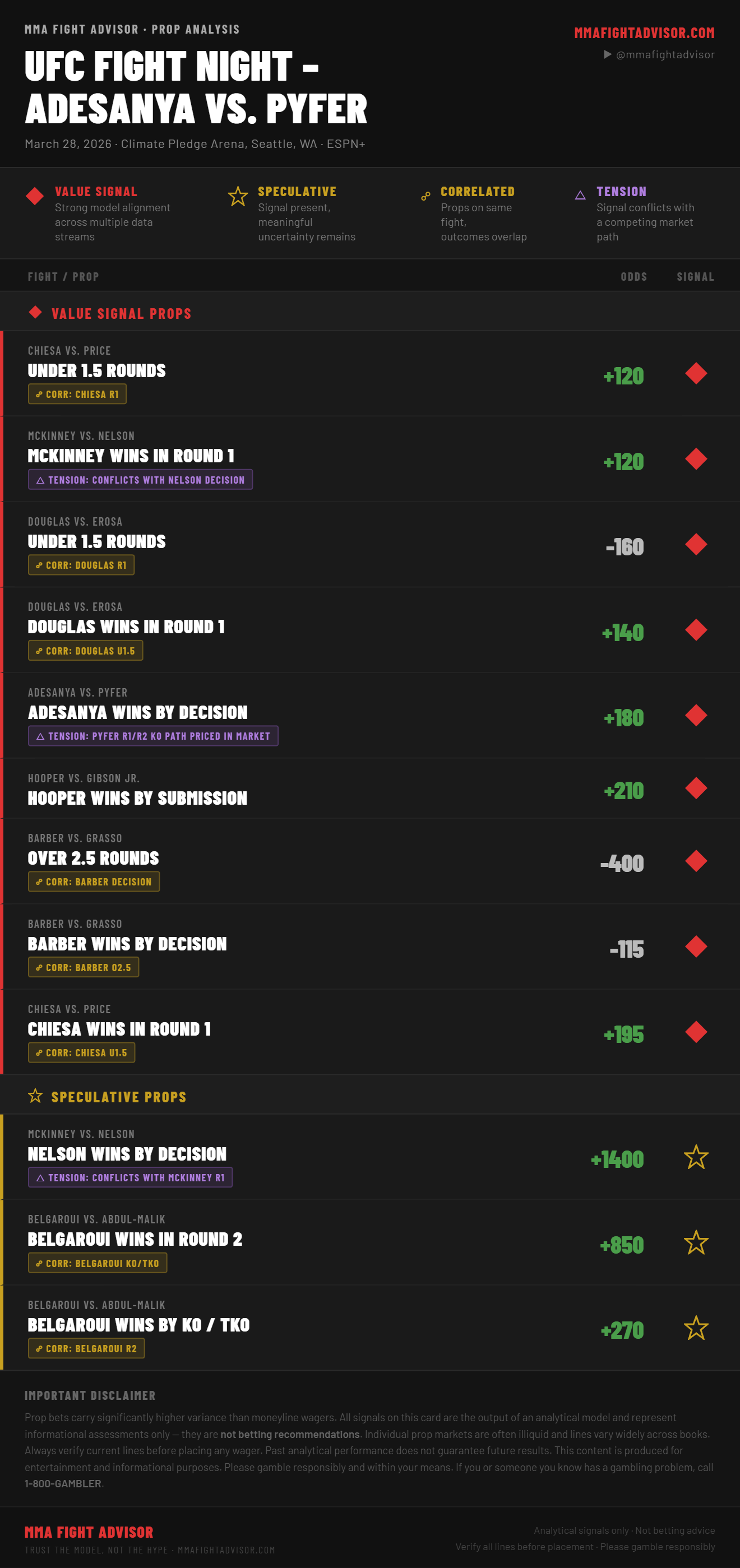
UFC Fight Night: Adesanya vs. Pyfer — Prop Signal Card
Nine value signals and three speculative flags identified for Saturday's card in Seattle. Trust the model, not the hype.

All prop signals in this report are speculative and experimental in nature. This content represents analytical signal output only and is not betting advice. Please gamble responsibly. If you or someone you know has a gambling problem, call 1-800-GAMBLER.
Prop betting is not moneyline betting. That distinction matters more than anything else on this page.
The signals below are the output of a multi-stream analytical model combining win probability, pundit consensus, and historical fighter data. They represent what we believe are identified pricing inefficiencies, not guarantees. Prop markets are thinner, less liquid, and more volatile than moneylines — lines move faster, limits are lower, and variance is higher across the board. A signal that looks clean on paper can lose for reasons that have nothing to do with the analysis being wrong.
If you choose to act on any signal here, sizing discipline is the single most important variable you control.
A few principles worth keeping in mind: Value Signal props at shorter odds, things like a -160 or -115 line, carry lower variance by nature and can be sized closer to your normal unit. The edge can be higher or lower in absolute terms but the outcome distribution is tighter, meaning it’s implied probability of outcome is higher.
Value Signal props at longer odds, anything in the +120 to +210 range on this card, carry more variance even at the Value Signal tier. These should be sized at a fraction of a standard unit, not treated as equivalent to a moneyline play.
Speculative props are a different category entirely. The +270, +850, and +1400 signals on this card exist because the price compensates for genuine uncertainty and there is perceived value that justifies the variance. At +850 the implied probability is roughly 10%. Even with a meaningful analytical edge, you will lose this bet the large majority of the time. If you are sizing a +850 prop anywhere near what you would put on a standard moneyline, you are sizing incorrectly. These are small-unit, high-upside plays. A reasonable starting point for speculative props is 25 to 50 percent of whatever you would consider a normal unit, and for the longest odds plays, smaller still.
Correlation also affects sizing. Several props on this card share the same underlying outcome. Chiesa Under 1.5 and Chiesa Round 1 are not two independent signals — they are the same fight path expressed twice. Treating them as separate bets and sizing each at full value doubles your exposure to a single outcome. The correlation flags on the card exist precisely for this reason.
The model is a tool. Use it like one.