
UFC Fight Night: Burns vs. Malott, Full Card Breakdown
Saturday, April 18, 2026 | Canada Life Centre, Winnipeg | Paramount+

The UFC returns to Winnipeg for the first time since December 2017, and the card that’s walking into Canada Life Centre this Saturday is genuinely different from the one that left eight years ago. Nine Canadians on the lineup. Three making their Octagon debut. A Canadian-born headliner, just the third in UFC history to headline a card on home soil.
Analytically, this is a card with unusual distribution. Five fights carry extreme model conviction. A handful sit in honest toss-up territory. And the main event, for all its noise about one fighter being written off and another being crowned, has a much more textured path than the line suggests.
Here’s the full read, bout by bout.
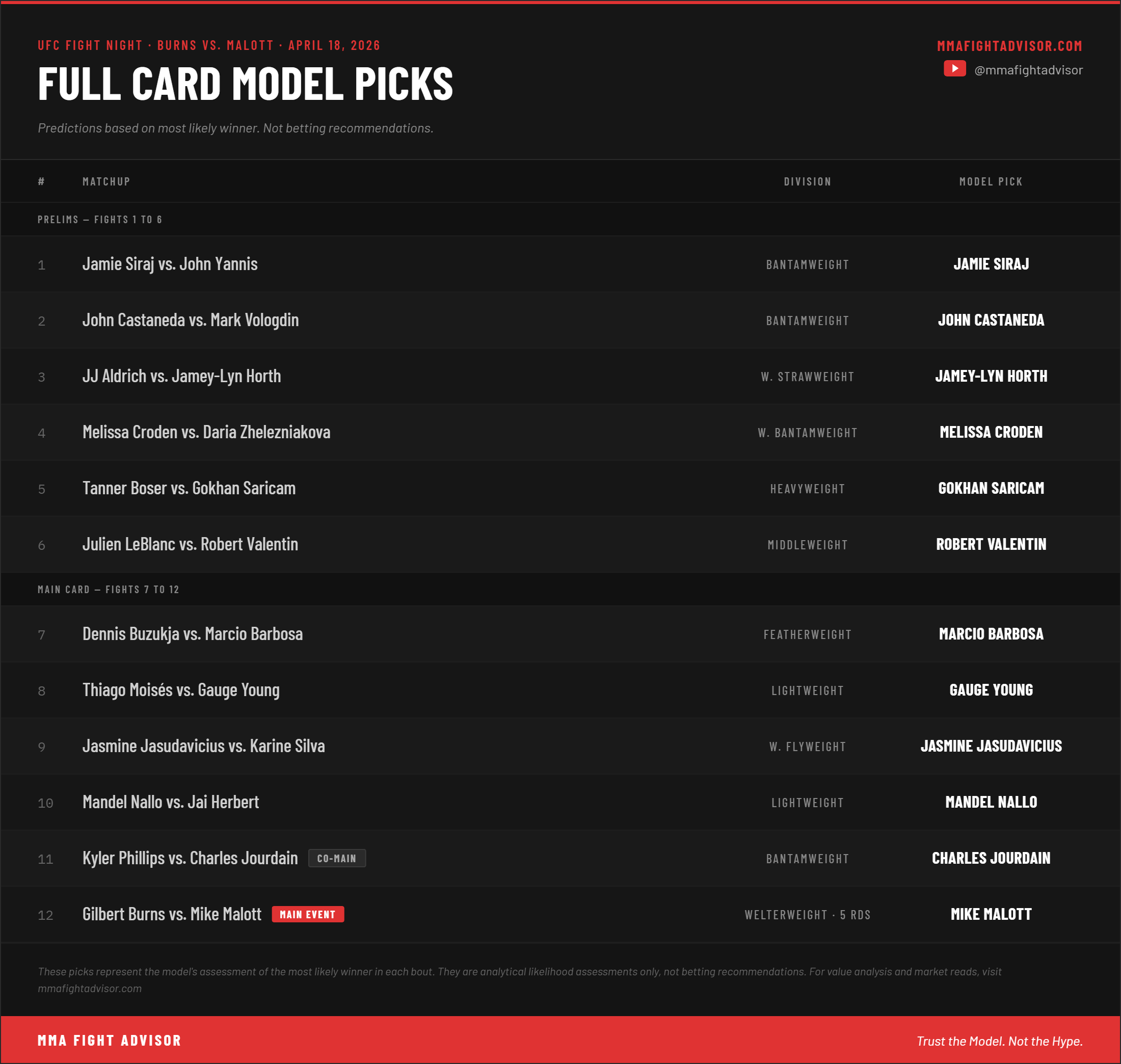
Fight 1, Jamie Siraj vs. John Yannis (Bantamweight)
The opener is a short-notice affair on both sides, with Jamie Siraj stepping in to make his UFC debut against John Yannis. Siraj brings 14 pro wins with 11 finishes and a submission-heavy game built on forward pressure and chain-wrestling. Yannis lost his UFC debut to Austin Bashi via rear-naked choke in the first round, and that’s the template that matters here. Yannis’s defensive grappling was exposed badly in that fight, and Siraj is walking in with the exact toolset to exploit it.
The one real unknown: Siraj is cutting to 135 for the first time in roughly eight years. Weight cuts of that scale at the UFC level are genuine X-factors, and the weigh-in result is the number to watch.
The model takes Siraj.
Fight 2, John Castaneda vs. Mark Vologdin (Bantamweight)
One of the genuine toss-ups of the card. John Castaneda is the veteran, 21-8 pro, 4-4 in the UFC, a volume striker with a six-inch reach advantage and the cardio to push three rounds. Mark Vologdin makes his UFC debut after a decision loss to Luna Martinetti on the Contender Series, a fight widely called one of the best in DWCS history despite the result.
The tactical wrinkle: Vologdin absorbed over eleven significant strikes per minute in that DWCS fight and still stood in the pocket swinging. His striking defense is a real concern, but his durability and output are legitimate. Castaneda’s path is experience, reach, and a steadier pace over fifteen minutes. Vologdin’s path is chaos.
The model takes Castaneda. Fight of the Night is on the table.
Fight 3, JJ Aldrich vs. Jamey-Lyn Horth (Women’s Flyweight)
Jamey-Lyn Horth is trending up. Back-to-back wins capped by her first UFC finish, a TKO of Tereza Bledá in December 2025. She’s a BJJ black belt training out of Niagara Top Team, and she’s described by teammates and coaches alike as having grown into her physicality. She’s taller, stronger, and operates from the clinch with real intent.
JJ Aldrich is the veteran, 14-7 pro, 10-6 in the UFC, ranked at flyweight. But her losses follow a pattern. Blanchfield submitted her off a guillotine. Hardy outworked her on the cards. Barber finished her with strikes. The common thread is physicality and pressure, both of which Horth brings in abundance.
The model takes Horth. Momentum, size, and a stylistic mismatch that favors the Canadian.
Fight 4, Melissa Croden vs. Daria Zhelezniakova (Women’s Bantamweight)
Melissa Croden is the grinder. Third UFC start in seven months, heavy clinch pressure, wrestling-forward at 5’9”, a physical profile that plays well at bantamweight. Daria Zhelezniakova is a sharp kickboxer with 2-1 in the UFC, but her loss came by first-round arm-triangle submission to Ailin Perez. The moment the fight hit the mat, it was over.
Croden’s game is exactly what Zhelezniakova struggles with. If this stays standing, Zhelezniakova can outpoint her. But Croden’s forward pressure and clinch game make “staying standing” a difficult proposition across fifteen minutes.
The model takes Croden. The fight is won in the clinch, and that favors Croden.
Fight 5, Tanner Boser vs. Gokhan Saricam (Heavyweight)
Tanner Boser returns to the UFC after a two-year absence, one regional fight in UAE Warriors, and a career reset. He’s the Canadian with homecoming energy, and his striking numbers (SLpM 4.70, SApM 2.75) remain respectable. But takedown defense at 63% and a long layoff against a wrestler with finishing upside is a difficult matchup.
Gokhan Saricam comes in on three straight wins, two by first-round stoppage, with a kickboxing base and a developed wrestling game from his Bellator run. If he closes distance and gets Boser to the mat, the gatekeeper shift finishes the job.
Boser’s path is real. Outland Saricam on the feet and use his mobility to stay off the cage. The crowd will be behind him.
The model takes Saricam. Wrestling is the separator.
Fight 6, Julien Leblanc vs. Robert Valentin (Middleweight)
One of the most honest toss-ups on the card, and a fight where the analytical case cuts both ways. Julien Leblanc is the Canadian debutant, 34 years old, five-fight win streak, three straight finishes, Samourai MMA middleweight champion, training alongside Marc-André Barriault out of Kill Cliff FC. His narrative is a decade of setbacks finally paying off with a UFC contract.
Robert Valentin is the other side of the ledger, 0-3 in the UFC, a TUF 32 finalist who hasn’t been able to translate that run into an Octagon win. Tall, rangy, submission threat, but exposed against wrestlers.
Valentin has the UFC-level tape. Leblanc has the regional momentum and home crowd.
The model takes Valentin by the thinnest margin.
Fight 7, Dennis Buzukja vs. Marcio Barbosa (Featherweight)
Marcio Barbosa is a first-round finisher. 16 of his 17 career wins have come in round one, fourteen of them by KO or TKO. He’s 27, fresh off a Contender Series finish of Damon Wilson, and he walks in throwing short, violent combinations at extreme volume.
Dennis Buzukja is returning from an eighteen-month layoff that included a nine-month suspension from a backstage fan altercation at UFC 310. His statistical profile shows him absorbing more than he lands, and his lone UFC stoppage loss came on a short hook, the exact punch Barbosa throws as his primary weapon.
But here’s the reason to pump the brakes. Barbosa’s entire UFC-captured statistical profile is built on one fight, his DWCS appearance against Damon Wilson. That’s a small sample to build an 8.27 significant strikes per minute read on, and it’s an even smaller sample to assume he can replicate that output against an Octagon veteran. Buzukja has 75% takedown defense, UFC reps, and the kind of pace that tends to drag explosive first-round finishers into uncomfortable second and third rounds.
If Buzukja weathers the first five minutes, the later rounds start tilting his direction. That’s the live underdog case.
The model takes Barbosa, with Buzukja as the live underdog if he survives the first round.
Fight 8, Thiago Moisés vs. Gauge Young (Lightweight)
The model leans Young on pace and volume. Moisés absorbs over four strikes a minute and Young lands nearly six. Moisés is the veteran, 31 years old, with seven career submission wins and a history of calf-kick-heavy gameplans. But his last outing ended in a first-round knockout loss to Jared Gordon, and his striking absorption numbers have gotten worse over time.
Young is 25, coming off a unanimous decision win over Maheshate at UFC Shanghai, and his 71% UFC takedown defense neutralizes Moisés’s reactive wrestling. The tactical question is whether Young’s chin holds up to Moisés’s power. He’s been hit clean by every UFC opponent so far and kept coming.
The model takes Young.
Fight 9, Jasmine Jasudavicius (#7) vs. Karine Silva (#9) (Women’s Flyweight)
The cleanest stylistic mismatch on the card. Karine Silva is a submission finisher, 17 stoppages in 19 career wins, 1.5 submission attempts per fifteen minutes, a BJJ black belt with heel hooks, guillotines, and D’Arce chokes in her history. Her problem is that she needs the fight on the mat in her favor to win, and her takedown defense sits at 21%.
Jasmine Jasudavicius is the grinding wrestler with 75% takedown defense, strong top control, and the kind of active ground-and-pound that turns dominant position into damage. She’s coming off the first stoppage loss of her career, a Manon Fiorot KO in October 2025, and took a deliberate six-month layoff to reset. She’s a Canadian fighting in Canada, sharing a gym with the main event headliner.
Silva’s path is a first-round submission off a scramble. If that window closes, Jasudavicius controls the remaining ten minutes.
The model takes Jasudavicius with real conviction.
Fight 10, Mandel Nallo vs. Jai Herbert (Lightweight)
Mandel Nallo’s UFC debut is one of the compelling stories of the card. Thirty-six years old, a Vancouver native now training at Tristar Gym under Firas Zahabi, he’s the oldest fighter ever to earn a Dana White’s Contender Series contract. His record is 14-3 with a no-contest, his last five wins are all first-round finishes, and his career finish rate is 100%.
Jai Herbert is the UFC veteran stopgap. 3-5-1 in the Octagon, thirteen months since his last fight (a split-decision loss to Chris Padilla), and a reach-and-range striker with a history of getting finished when pressured. Nallo’s best performances have come against strikers who let him get inside. His worst have come against wrestlers who took him down. Herbert is not a wrestler.
The model takes Nallo. A UFC debut under the brightest lights of his career is the only variable worth flagging.
Fight 11, Kyler Phillips vs. Charles Jourdain (Co-Main Event, Bantamweight)
The co-main is the clearest read on the card.
Charles Jourdain is a different fighter at his natural bantamweight. Two fights at 135, two first-round guillotine finishes, one over Victor Henry (a fighter who had never been finished prior) and the next over Davey Grant. That’s four career wins by guillotine in total, alongside Lando Vannata and Ricardo Ramos earlier in his career. The pattern is not a coincidence. It’s a specialty.
Kyler Phillips walks in on a two-fight losing streak after decision losses to Rob Font and Vinicius Oliveira. His 75% takedown defense is real. Jourdain isn’t going to put him on his back. But Phillips’s own wrestling is the problem here. Jourdain’s takedown defense sits at 47%, which means Phillips can score takedowns, but every sloppy level change against a guillotine specialist is a live trap.
Add the rest. Jourdain has 5.48 significant strikes per minute to Phillips’s 5.04. He’s been more active recently, more confident, and publicly stated he’d be the first fighter to finish Phillips. Phillips has never been finished across sixteen pro fights, but Jourdain’s momentum, pace, and finishing pattern fit this matchup tightly.
The model takes Jourdain.
Fight 12, Gilbert Burns vs. Mike Malott (Main Event, Welterweight, 5 rounds)
The model lands on Mike Malott, and the case is genuine, but it is not the closed book the market treats it as.
Malott’s case is straightforward. He’s eight years younger at 34, he’s sharper on the feet, his differential is positive (3.93 significant strikes landed per minute against 3.06 absorbed), and he’s never been knocked down in the UFC. He’s fighting in Canada for the sixth straight time, fighting under his own home-gym roof, and stepping into his first UFC main event with the analytical profile of a fighter who’s earned it.
Gilbert Burns’s case is harder. He walks in on a four-fight skid, all against elite competition (Morales, Brady, Della Maddalena, Muhammad) but a skid nonetheless. He has ten knockdowns absorbed across his UFC career. His last fight was a first-round TKO loss to Michael Morales eleven months ago, and questions about his chin at 39 are fair.
Here’s the honest counter. Malott’s takedown defense sits at 14%. His one UFC loss came when Neil Magny took him down four times on four attempts and finished him in round three of a fight he was winning. Burns is a four-time World Jiu-Jitsu champion with nine career submission wins. He has never been submitted across twenty-two pro fights. And Malott has never fought past the third round in the UFC. A 25-minute championship round cardio test is genuinely untested territory.
Burns’s path exists. It requires surviving the striking phase early, dragging Malott into deep water, and either winning late rounds on cards or finding a finish on the mat. It’s a narrower path than the 9-1 pro record of Malott suggests, but it’s real.
The model takes Malott. His path is sharper striking, youth, and solid cardio that Burns no longer has. If Burns wins, it’s through his grappling, not his chin.
Closing Read
This card has depth in unexpected places. The co-main carries the clearest read of the night. The main event is genuinely more textured than the market treats it. The prelims have a genuine sleeper angle in Buzukja, and the Canadian debut wave, Nallo, Leblanc, Siraj, means three storylines worth following regardless of outcomes.
Subscribe for every card, every read. Trust the Model. Not the Hype.