
UFC Fight Night: Emmett vs. Vallejos — Prop Betting Signal Report
What the model flagged, and why the market may be mispriced. *Note - this is experimental and for information only.

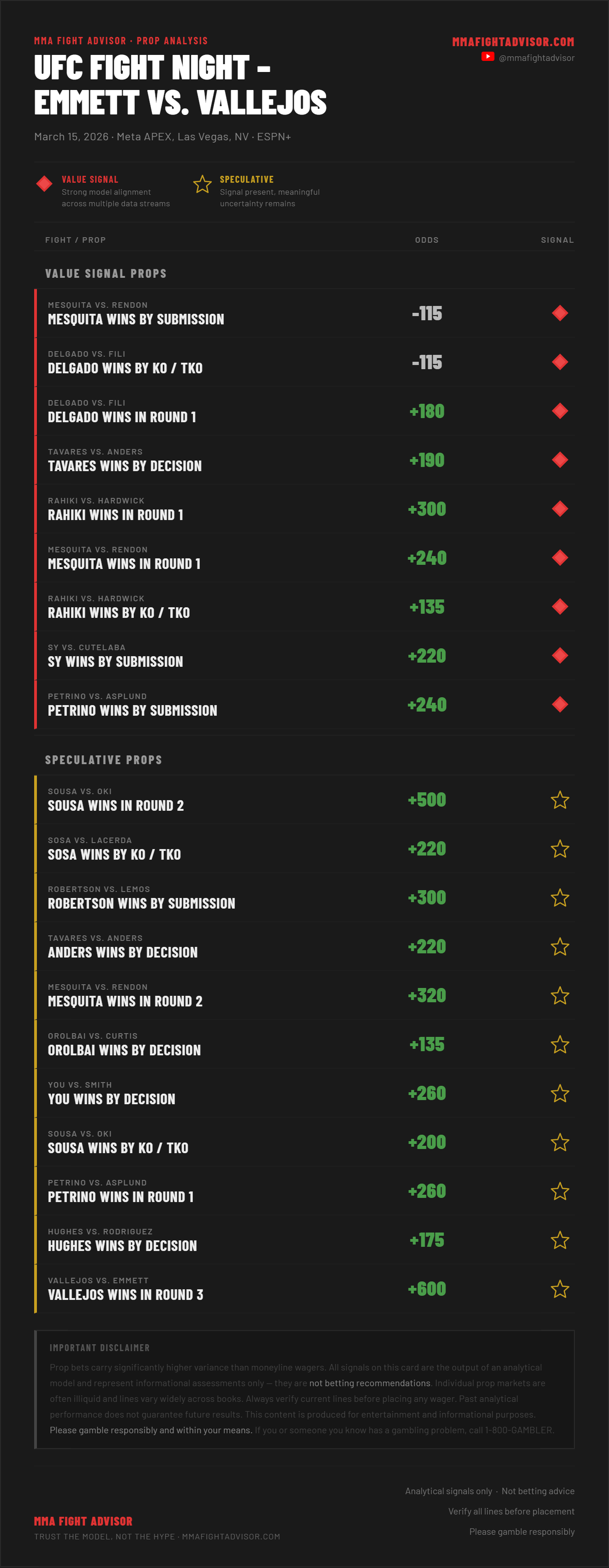
Important disclaimer: All prop signals in this report are speculative and experimental in nature. Prop bets carry significantly higher variance than moneyline wagers — individual markets are often illiquid and lines vary widely across books. This content represents analytical signal output only and is not betting advice. Always verify current lines before placing any wager.
UFC Vegas 114 is structurally one of the more prop-friendly cards of the year. The smaller APEX octagon limits movement and escape routes, historically producing higher finish rates and more decisive action. Combine that with a card stacked with specialists — BJJ world champions, 100% finish-rate prospects, and a veteran grinder headliner past his prime — and the market has left some notable gaps between implied probability and what the data actually suggests.
Below we break down the props our model flagged as mispriced, starting with the strongest signals and working down to the speculative tier.
Value Signal Props
Beatriz Mesquita wins by submission (-115) This is the most glaring pricing anomaly on the card. At -115, the market implies roughly a coin flip on Mesquita finishing via submission — against an opponent who has never been finished in her professional career and whose primary vulnerability is takedown defense. Mesquita is one of the most decorated BJJ competitors in the history of the sport. She has never reached the third round as a professional mixed martial artist. The submission path here is not one of several outcomes; it is the overwhelming most likely path. A price of -115 on a near-certainty method is a market inefficiency worth noting.
Beatriz Mesquita wins in Round 1 (+240) A companion signal to the above. Pundit consensus splits roughly evenly between a first and second round finish for Mesquita, which means the R1 window is a legitimate cluster — not a long shot. At +240, the market prices this as a 29% probability. Our read is meaningfully higher. Note that R2 (+320) also carries signal for those who want exposure to the finish without specifying the round.
Jose Delgado wins by KO/TKO (-115) Delgado enters with a 100% professional finishing rate and a recent string of first-round knockouts. Andre Fili is 35 years old, has absorbed significant punishment over a lengthy UFC career, and analysts have consistently flagged his durability as a liability. The market pricing Delgado’s KO/TKO path at -115 — implying only a 54% probability — undersells a fighter whose entire profile points toward a stoppage by strikes. Our read is closer to 75%.
Jose Delgado wins in Round 1 (+180) The first-round finish is the modal outcome in pundit consensus for this matchup, not a secondary scenario. At +180 — implying just 36% — the market is pricing it as an unlikely outcome for a fighter who has made a habit of early finishes against opponents with Fili’s durability profile. The price creates meaningful edge relative to our read.
Brad Tavares wins by decision (+190) This is a pricing inconsistency hiding in plain sight. The rounds market on this fight is heavily juiced toward the Over — the book is essentially saying it goes the distance. Yet Tavares winning by decision is priced at +190, implying only 34.5%. If the fight is near-certain to go past round one, and Tavares wins 63.5% of the time per our model, then the intersection of those two things — Tavares, by decision — should not be priced at a plus-money underdog. He has not finished an opponent since 2018. His entire game is built around distance management and point-fighting. The decision is the path, and the market is selling it cheaply.
Marwan Rahiki wins in Round 1 (+300) Rahiki enters with a 100% finish rate and 86% of his wins coming by knockout. He has never seen a third round professionally. The R1 cluster is real — though R2 is equally valid — and +300 implies only a 25% probability for a fighter whose profile screams early finish. The market is likely pricing in Hardwick’s toughness, which is legitimate, but the edge remains.
Marwan Rahiki wins by KO/TKO (+135) Tighter odds on the method alone. 86% KO rate, aggressive striker, opponent who was stopped by calf kicks on his UFC debut. At +135, the implied probability sits at 43%. Our read is closer to 54%. Modest edge, but clean signal.
Oumar Sy wins by submission (+220) The narrative structure of this fight is well-established: Cutelaba blitzes in round one, burns his gas tank, and fades badly if he fails to finish. His submission defense off his back has been exploited multiple times at this level — by Johnny Walker, Ryan Spann, and Glover Teixeira among others. Sy holds four career submission wins and has a significant physical advantage at 6’4” with an 83-inch reach. At +220, the market implies a 31% probability on what our model reads as a 40%+ outcome once Cutelaba’s cardio factor is accounted for.
Vitor Petrino wins by submission (+240) Context matters here. Petrino is widely reported to be carrying a hand injury into this fight, which accelerates his pivot toward grappling rather than striking. Asplund’s grappling defense at this level is essentially non-existent — he was submitted on the regional circuit and steps in on short notice. When a 77% finisher with BJJ credentials is specifically incentivized toward the ground game, and his opponent cannot defend it, the submission path at +240 represents meaningful value.
Speculative Props
These props carry real signal but meaningful uncertainty remains — treat them as elevated interest, not strong conviction plays.
Manoel Sousa wins in Round 2 (+500): The modal predicted outcome for this fight. Oki comes out blazing in R1, Sousa weathers it, finishes in R2. The +500 price is generous for what most analysts see as the primary narrative, though R1 uncertainty is real.
Hecher Sosa wins by KO/TKO (+220): Sosa keeps this fight standing, and Lacerda fades hard after approximately 7.5 minutes due to documented cardio issues. If Sosa survives the early submission attempts, a late KO is the logical outcome.
Gillian Robertson wins by submission (+300): Robertson has more UFC submissions than any other female fighter in strawweight history. She attempts takedowns relentlessly, and Lemos has been submitted before. The R2-R3 timeline makes this speculative rather than a strong signal, but +300 is a fair price for the path.
Myktybek Orolbai wins by decision (+135): Chris Curtis carries elite takedown defense (82%) that suppresses Orolbai’s primary finishing tool. If the fight stays standing, the case for a grinding decision is real. Our model rates this a NO BET on the moneyline, which tempers conviction — but the method prop has logic.
Eryk Anders wins by decision (+220): Both fighters are aging, both are cautious, and this fight screams mutual survival rather than finishing instinct. If Anders pulls the upset, the decision path is how it happens.
Mesquita wins in Round 2 (+320): Valid companion to the R1 signal — pundit consensus splits evenly between the two rounds. If you want finish exposure without round commitment, this is the cleaner expression.
Manoel Sousa wins by KO/TKO (+200): Sousa’s primary finishing tool is the knockout. If Oki gasses after R1 as expected, Sousa’s striking output should find a home against deteriorating defense.
Vitor Petrino wins in Round 1 (+260): Plausible early finish window. R2 is the more common predicted timeline, but the price creates a small edge on the R1 outcome.
Sam Hughes wins by decision (+175): This rematch is viewed as more competitive than the first encounter. Hughes has improved her grappling and cardio. The market prices Rodriguez as a moderate favorite, but the decision path for Hughes is real.
Kevin Vallejos wins in Round 3 (+600): The most commonly predicted specific KO round across the analyst field. Emmett’s durability is legendary, but Vallejos’s volume should accumulate damage through the championship rounds. Highly speculative — Emmett’s chin complicates everything.
For full model output, unit sizing recommendations, and complete card analysis, subscribe at mmafightadvisor.com. All analytical signals are produced for informational purposes only. Trust the model, not the hype.