
UFC FIGHT NIGHT: STERLING VS. ZALAL — THE MODEL'S FULL CARD ANALYSIS

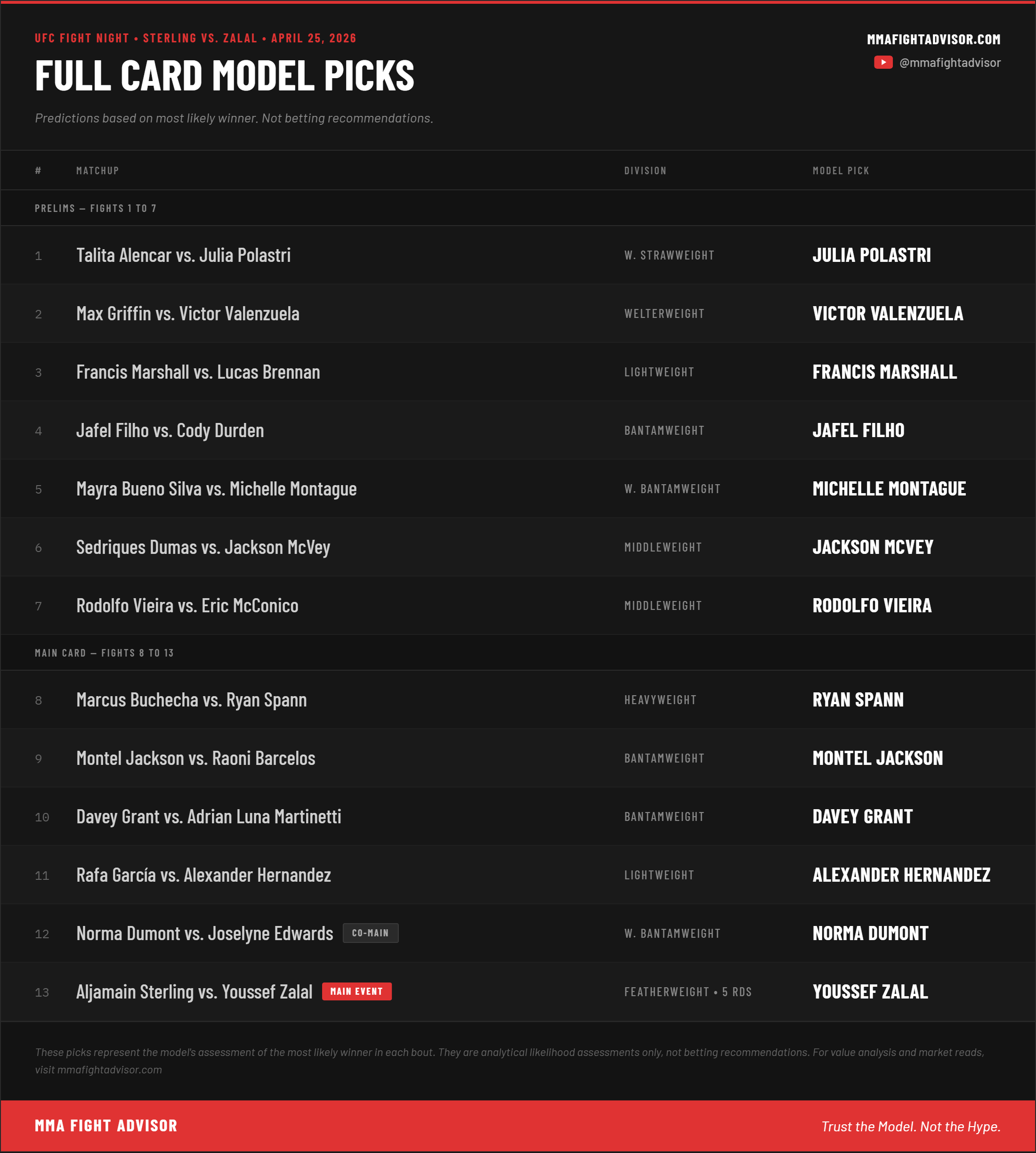
Thirteen fights at the Meta APEX on Saturday night, with the featherweight main event carrying real title implications and a women’s bantamweight co-main that could decide the next challenger. Below those two bouts, the card thins into mid-tier divisional matchups, several short-notice replacements, and four debutants. The model has weighed in on every fight. Here is where it lands and why.
Polastri vs. Alencar (Strawweight)
The model takes Julia Polastri. This is a stylistic puzzle Talita Alencar cannot solve cleanly. Alencar is a six-time BJJ world champion, but her takedown accuracy sits at 26 percent, and Polastri defends takedowns at 60. The math does not favor the grappler when she cannot reliably get the fight to the mat. Polastri’s recent third-round TKO over Karolina Kowalkiewicz showed real striking development, with sharp jab-cross-knee combinations and a willingness to commit to high kicks against durable opponents. Alencar absorbs 3.36 significant strikes per minute and defends at 55 percent, numbers that get worse against a striker landing 6.40 per minute. The path to victory for Alencar exists if she can replicate the body-lock takedowns Lupita Godinez used to drag Polastri down five times last year, but Godinez is a far more explosive wrestler than Alencar has ever been. Pick: Polastri.
Griffin vs. Valenzuela (Welterweight)
The model favors Victor Valenzuela in his UFC debut. Max Griffin is 40 years old and has lost three of his last four bouts, with the most recent submission loss to Michael Chiesa exposing his declining ability to recover from adversity. Valenzuela brings genuine kickboxing pedigree, a WGP Challenger Grand Prix title, and seven knockouts in 13 wins. The caveat is real: Valenzuela’s finishing rate was built against regional competition, and his Contender Series knockout loss to Michael Oliveira showed defensive holes. Griffin’s path is to use veteran footwork to neutralize the power and outpoint Valenzuela on volume. The model takes the younger, faster fighter to land cleaner shots in a striking exchange. Pick: Valenzuela.
Marshall vs. Brennan (Lightweight)
The model takes Francis Marshall in a fight that should not have been close to even money on paper. Lucas Brennan is making his UFC debut on five days notice, at lightweight rather than his natural featherweight, against an opponent who specifically counters his strengths. Brennan is an elite BJJ player with eight submission wins, but his standup is awkward and flat-footed, and he has lost both of his fights against step-up competition outside Bellator. Marshall counters him on every level: 54 percent striking defense, 66 percent takedown defense, and five submission wins of his own. Marshall has shown his grappling sharpness in past UFC outings. Brennan’s path requires forcing the fight to the mat against a wrestler who does not want to go there. Pick: Marshall.
Filho vs. Durden (Bantamweight)
The model takes Jafel Filho in the most lopsided spot on the card. Filho’s UFC pattern is exact: every win has been a first-round submission, with three different finishing holds across kimura, arm triangle, and rear-naked choke. Cody Durden is stepping in on six days notice, at a higher weight class, on a four-fight losing skid. He has been finished in six of his nine career losses, including four submissions. The transitive read through Allan Nascimento, who finished Durden and decisioned Filho, is informative but undermined by the report that Filho fought Nascimento with a staph infection. Durden’s only path is to grind out a sprawling, cardio-heavy decision against a fighter whose finish window is concentrated in the first round. The short notice undermines that path. Pick: Filho.
Bueno Silva vs. Montague (Women’s Bantamweight)
The model takes Michelle Montague in what looks like a passing-of-the-torch fight. Mayra Bueno Silva is on a four-fight skid against ranked opposition, and her game has visibly declined since the no-contest against Holly Holm. The 18-fight veteran has never been submitted, and that is the central tension here. Montague has won six of seven by rear-naked choke and brings genuine physical pressure, but her UFC debut against Luana Carolina revealed she can be hit cleanly on the feet, with 41 percent striking defense and visible moments of being rocked in round two. The former teammate dynamic favors Montague, who claims to know exactly how Bueno Silva strikes and sets up submissions from their American Top Team sparring. The model favors on the younger, hungrier fighter to overwhelm a faded veteran. Pick: Montague.
Dumas vs. McVey (Middleweight)
The model takes Jackson McVey, which is a notable call given McVey is 0-2 in the UFC. The case rests on Sedriques Dumas looking checked out in his recent loss to Donte Johnson, where he tapped instantly to a weak front choke. Both fighters are oversized middleweights who fail to use their reach effectively, and both bring all-offense styles that produce chaotic exchanges. McVey has stopped every professional opponent he has beaten, all in the first round. The path for Dumas is real if he commits to his front-headlock series and exposes McVey’s aggressive entries to a guillotine. The model thinks that McVey’s offense overwhelms a Dumas who has not looked himself in over a year. Pick: McVey.
Vieira vs. McConico (Middleweight)
The model takes Rodolfo Vieira to close the prelims. The Black Belt Hunter has nine of his eleven wins by submission, with a heavy preference for arm triangle chokes when he can establish top position. Eric McConico’s takedown defense sits at 64 percent, and his striking defense is suspect against fighters who can drag him into grappling exchanges. The Bo Nickal head kick KO showed Vieira’s striking defense remains a liability, but he is not facing a striker of that caliber here. McConico’s path is to survive the early grappling onslaught, drag Vieira into a slow-paced grind, and capitalize if Vieira’s cardio fades in round three. The model expects Vieira to find a finish before that happens. Pick: Vieira.
Buchecha vs. Spann (Heavyweight)
The model is on Ryan Spann at plus-money. This is the contrarian read of the card. Marcus Buchecha is a 15-time BJJ world champion with elite submission credentials, but his MMA transition has been rocky. He lost his UFC debut to Martin Buday and drew with Kennedy Nzechukwu, two fights that exposed his rudimentary striking and unreliable takedown technique. Spann is 6-foot-5 with genuine knockout power and a guillotine choke that has finished better grapplers than Buchecha has ever fought. Spann’s pattern of not winning a fight outside the first round since 2020 is a real concern, but the model reads this as a window where his striking advantage and physical frame create a finish opportunity before Buchecha’s ground game becomes a factor. The risk is real. Buchecha’s BJJ pedigree is the highest on the card, and Spann has been known to make poor decisions when his early offense fails. Pick: Spann.
Jackson vs. Barcelos (Bantamweight)
The model takes Montel Jackson. This is a structural matchup where reach and power favor the bigger fighter. Jackson is a 5-foot-10 southpaw with a 75-inch reach in a division where most fighters operate at 5-foot-7 with 68-inch reaches. He has 11 UFC knockdowns and the most lethal one-shot power in the division, with a sniper left hand that lands straight down the pipe. Raoni Barcelos is on a four-fight win streak that includes Cody Garbrandt and Ricky Simon, and he has the wrestling pedigree to follow the Deiveson Figueiredo blueprint that beat Jackson last year. The concern for Barcelos is durability. He was knocked out by Umar Nurmagomedov and dropped by Kyler Phillips, and his closing-distance approach involves looping punches that could walk him directly into Jackson’s straight power. The model bets on the reach and power. Pick: Jackson.
Grant vs. Luna Martinetti (Bantamweight)
The model takes Davey Grant. Adrian Luna Martinetti earned his UFC contract on Dana White’s Contender Series with a brutal war against Mark Vologdin, attempting 329 strikes and showing genuine heart and volume. The analytical concern is what that record was built against. Twelve years of regional competition with a heavy concentration of opponents holding losing records is not a profile that translates cleanly to UFC level. Grant is a 10-year veteran who has shared the Octagon with Marlon Vera, Jonathan Martinez, and Raphael Assuncao. His recent guillotine loss to Charles Jourdain exposed a vulnerability to chaotic club-and-sub sequences, and Luna Martinetti has six career submission wins to threaten that. But Grant’s technical boxing, calf kicks, and underrated grappling are a level Luna Martinetti has not seen. The model sides on the veteran. Pick: Grant.
García vs. Hernandez (Lightweight)
The model takes Alexander Hernandez. This is the strongest analytical call in the lower main card. Hernandez is on a four-fight win streak with knockouts of Chase Hooper and Diego Ferreira, and his recent run against Austin Hubbard and Kurt Holobaugh shows he is operating at a higher level than García has tested himself against. García’s recent wins have come against aging veterans in Jared Gordon, Vinc Pichel, and Clay Guida. The cancelled UFC 324 bout against Michael Johnson and the betting irregularity controversy that followed has been a public stress on Hernandez, and he has not fought since September 2025. The model projects that his speed, lateral movement, and counter-striking outpoint García’s pressure over fifteen minutes. García’s Mexican chin keeps him in fights but rarely wins them at this level. Pick: Hernandez.
Dumont vs. Edwards (Women’s Bantamweight, Co-Main)
The model takes Norma Dumont in a fight that should determine the next title challenger at women’s bantamweight. Joselyne Edwards is on a four-fight finishing streak and brings real striking advantages: a three-inch reach edge, faster hands, and harder power. The problem is her takedown defense, which sits at 61 percent against fighters who commit to the wrestling. Dumont averages 1.56 takedowns per 15 minutes with a 56 percent accuracy rate, and her pressure-and-clinch style is built specifically to neutralize rangy strikers. The Ailin Perez fight is the relevant comparison. Perez took Edwards down six times and controlled her with smothering top game, and Dumont is a stronger version of that profile. Edwards’ path is real if she can keep the fight at distance and use her three-inch reach to land first, but Dumont’s footwork and authoritative jab have been good enough to walk through similar advantages, including Irene Aldana’s distance striking last year. Pick: Dumont.
Sterling vs. Zalal (Featherweight, Main Event)
The model takes Youssef Zalal. The Moroccan Devil is on an eight-fight win streak with four submissions in his last five wins, and he brings a 100 percent finish rate inside the distance against an opponent who has historically dropped late rounds in five-round fights. Aljamain Sterling is the more decorated fighter and the better wrestler, and he has gone 2-1 at featherweight with decision wins over Calvin Kattar and Brian Ortega. The case for Sterling is structural. He is the better grappler, the Apex small cage limits Zalal’s lateral movement, and his chain wrestling has historically been good enough to take any fight to the mat. The case for Zalal is that he has never been finished, his takedown defense has held up, and his cardio in five-round fights is unproven but his pace in three-rounders has been excellent. Sterling’s gas tank is the central question. He visibly faded against Petr Yan twice, against Henry Cejudo, and against Brian Ortega in his most recent five-round bout. The model reads Zalal’s youth, size advantage, and finishing instinct as the structural edge. The path for Sterling is to wrestle Zalal early and grind out three rounds before fatigue arrives. The path for Zalal is to make Sterling chase, sting him on the way in, and find a finish window in rounds four or five when the former champion’s output drops. Pick: Zalal.
The Card in Summary
The model has thirteen picks but identifies seven bouts where it sees no analytical value play and six where it does. The contrarian read is Spann at plus money against Buchecha, the only underdog the model takes on the card. The strongest analytical signal is on Hernandez over García, where the model sees a meaningful gap in recent form and quality of opposition. The main and co-main carry title implications regardless of model conviction, with Zalal and Dumont representing the model’s read on where the divisions are heading.