
UFC FREEDOM 250: THE MOST HISTORIC CARD IN UFC HISTORY
Seven fights. Two titles. The South Lawn of the White House. The model has the full card.

The UFC has done a lot of things in 33 years. It has never done this.
On Sunday night, seven of the best fighters on the planet compete on the South Lawn of the White House in Washington, D.C., as part of America’s 250th anniversary celebration. Two title fights anchor the card. Every single bout sits on the main card. There are no throwaway fights, no filler prelims, and no margin for a quiet night.
The model has gone through all seven bouts. Here is the full breakdown, from first fight to last.
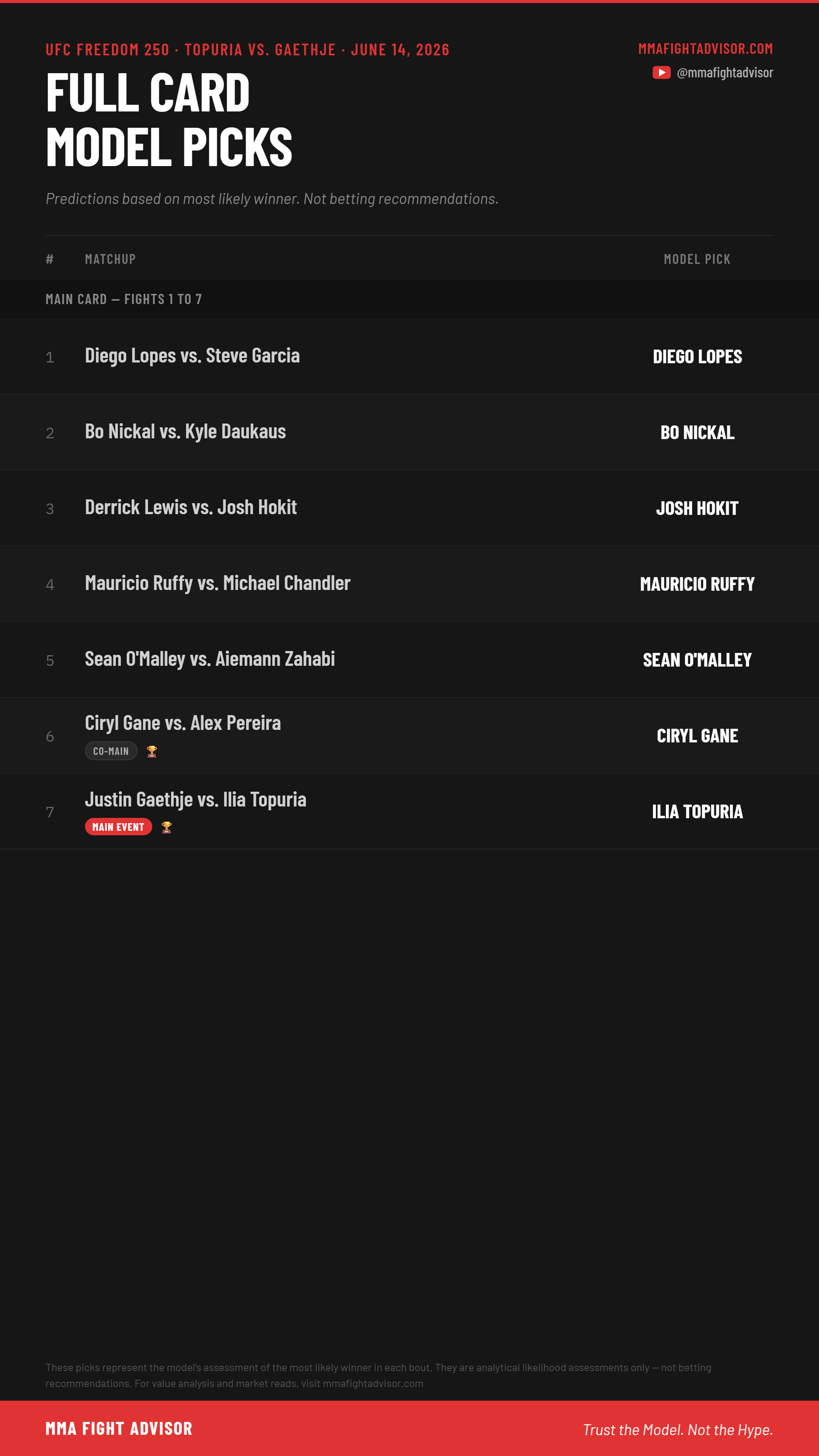
Diego Lopes vs. Steve Garcia | Featherweight
On paper this is the clearest mismatch in terms of resume. In reality, it is the closest call on the card.
Diego Lopes is one of the most complete fighters at 145 pounds. His BJJ is legitimate black belt quality. His striking comes in combinations and builds toward power shots rather than just opening up from the jump. He has been in wars, finished elite competition, and earned two title shots against the best featherweight of his generation. The Volkanovski losses are on the record, but Volkanovski’s distance management and footwork is a very specific problem that few fighters in the world can replicate.
Steve Garcia is one of those fighters who has quietly become terrifying. Seven straight wins, six finishes, a style that is unorthodox enough to disrupt timing, and genuine knockout power for the featherweight division. He is big for 145 pounds and comes forward with intent. Garcia has been dropped before by being too aggressive, but that aggression is also exactly what makes him dangerous.
The model reads Lopes as the pick, and the analytical case supports it. If Garcia’s power doesn’t land clean early, Lopes’s grappling takes over and Garcia has no answer on the ground. But Garcia is as live an underdog as exists anywhere on this card. The model sees this fight essentially at a coin flip. If you find yourself watching Garcia cracking Lopes in the first two rounds, do not be surprised.
The pick is Lopes. But this is one the model is holding loosely.
Bo Nickal vs. Kyle Daukaus | Middleweight
Bo Nickal is the most hyped prospect the middleweight division has seen in years, and the hype has mostly been earned. Three NCAA Division I national wrestling championships. Fast hands. A head kick finish over Rodolfo Vieira that showed real striking development. His one professional loss, a knockout at the hands of Reinier de Ridder, taught him something. He came back and looked sharper.
Kyle Daukaus earned this spot. His second UFC run has produced two first-round finishes, and he is a legitimate grappler with length and solid submission instincts. The problem is that his recent wins came against Michel Pereira, who was not at his best, and Gerald Meerschaert, who is as finishable as anyone on the roster. Daukaus has not been tested at this level on his second run.
For Daukaus to win this fight, he needs to do what de Ridder did. Step in knees, use his height, make Nickal uncomfortable. He does not have the same physical tools de Ridder had, but the blueprint exists. The challenge is executing it against a wrestler who has now seen the approach firsthand and has had months to prepare.
The model takes Nickal. The finish path runs through wrestling and ground-and-pound or his improving striking on the feet. A comfortable win here likely earns him a top-ten opponent and puts the title conversation back on the table.
Mauricio Ruffy vs. Michael Chandler | Lightweight
Michael Chandler is a genuinely great fighter who, inside the octagon, consistently makes decisions that work against him. He is a four-time NCAA qualifier and a Division I All-American who almost never uses his wrestling. He has power, pressure, and cardio. He also has three straight losses, including a TKO to Paddy Pimblett, and a pattern of absorbing damage he does not need to absorb in pursuit of the highlight reel finish.
Mauricio Ruffy is one of the most dangerous strikers in the lightweight division. Twelve stoppages in thirteen professional wins. His arsenal is creative and varied. Heavy one-two combinations. Kicks up the middle. Spinning techniques that actually connect. He dismantled Rafael Fiziev with a second-round knockout earlier this year, which is not a soft win. Fiziev is fast, technical, and hard to time. Ruffy timed him anyway.
The concern with Ruffy has always been takedown vulnerability. He was frozen and then submitted by Benoit Saint-Denis. But Chandler is not going to wrestle his way to a win here. His track record says he will stand and trade.
That is exactly where Ruffy wants this fight.
The model picks Ruffy. Chandler’s durability may take this past the first round, but the Brazilian’s power carries deep into fights. If Chandler goes out there and entertains, Ruffy gets the finish. And Chandler almost always goes out there and entertains.
Josh Hokit vs. Derrick Lewis | Heavyweight
Derrick Lewis is the all-time UFC knockout leader. He has more knockout wins in the promotion’s history than anyone who has ever competed in it. He is also 41 years old, has quit in at least two notable fights when the knockout was not coming, and was stopped by Waldo Cortes-Acosta earlier this year in a performance that raised real questions about where his career stands.
Josh Hokit is 9-0, a two-sport collegiate athlete with All-American wrestling credentials and NFL-level athleticism for a heavyweight. He beat Curtis Blaydes in a fight that was genuinely competitive and showed he can take a serious shot and keep pressing. His hand speed is unusual for a 265-pounder. His conditioning does not fade.
Lewis carries one punch that can end any heavyweight fight on earth. That threat is real in the early rounds and needs to be respected. But if Hokit can survive the early danger, manage distance, and keep pace, the path to a finish becomes clearer with every passing round. Lewis historically stops trying when the knockout is not materializing.
This is the model’s most confident call on the card. Hokit wins. The only real question is whether Lewis lands something clean enough to change the story first.
Sean O’Malley vs. Aiemann Zahabi | Bantamweight
Aiemann Zahabi has quietly put together one of the better runs in the bantamweight division. Seven straight wins. He has reinvented himself as a striker, abandoned his wrestling entirely, and beaten recognizable names in Jose Aldo and Chito Vera. The Vera win came after Zahabi was dropped, which tells you something about his chin and his fight IQ.
But Sean O’Malley is a different problem. His accuracy is his defining trait. He does not throw wild. He sets up shots and lands them with precision that creates disproportionate damage relative to his output. He uses his reach well. He has power that does not look like power until someone goes down. Zahabi has been dropped in his last two fights by fighters who are not O’Malley.
This is a title eliminator in everything but name. The winner is likely next in line behind whoever walks out of Petr Yan versus Merab Dvalishvili later this year.
The model takes O’Malley. A decision is the most defensible path given Zahabi’s durability and fight IQ, but the finish is not off the table. O’Malley is the cleaner, more accurate striker in this matchup, and Zahabi has demonstrated he can be put down.
Alex Pereira vs. Ciryl Gane | Heavyweight Interim Title
This fight is uncomfortable to analyze if you love Alex Pereira, because the analytical case points one direction and the emotional case points another.
Pereira is a generational talent. He knocked out everyone at middleweight and light heavyweight who stood in his way, moved up in weight twice, and arrived at heavyweight chasing something no fighter in UFC history has ever achieved. Three divisional titles. If he gets Ciryl Gane out of there on Sunday, he stands alone.
The problem is structural. Pereira will not have size on his side for the first time in his UFC career. He will not have the speed advantage. Gane is a technical heavyweight with footwork that sets him apart from anyone Pereira has faced before. His striking differential reflects genuine defense, not passive avoidance. He will not stand in front of Pereira and trade. He will work from the outside, counter when Pereira commits, and bail before the combination completes.
Pereira needs to trap him. Gane needs to not be trapped. The fight comes down to whether Pereira can close the distance and land something clean before Gane accumulates enough on the scorecards.
The model picks Gane. The line has been essentially a coin flip throughout fight week, which reflects the genuine uncertainty here. Pereira’s knockout power travels with him regardless of weight class, and one clean shot ends this fight. But Gane has never been stopped by strikes, and his ability to stay disciplined under pressure is his most underrated quality.
This is the hardest fight to pick on the card. The model lands on Gane. It would not be surprised to be wrong.
Ilia Topuria vs. Justin Gaethje | Lightweight Title
Justin Gaethje walks into this fight as the BMF champion, the interim lightweight champion, and one of the most legitimately entertaining fighters the sport has ever produced. At 37, with every fight since his UFC debut delivering something worth watching, he is on the short list of fighters who have never wasted a night.
Ilia Topuria is 17-0 and has finished three consecutive former champions on his way to this moment. Alexander Volkanovski. Max Holloway. Charles Oliveira. He stopped all three. He has been described as a striker because of the knockouts, but he averages nearly two takedowns per fifteen minutes and holds a BJJ black belt. He does not have a fixed gameplan. He reads the fight and uses what works.
The case for Gaethje is narrow but real. He marches forward, throws heavy, and creates chaos. He has never been knocked out the way other lightweights have. The Holloway loss at UFC 300 was a last-second buzzer-beater after five rounds. Before that, Gaethje had never been stopped by strikes. His path to an upset is to put Topuria under enough pressure early that the champion has to work from behind for the first time in his professional career. We have never seen Topuria in that position for a sustained period.
There is also the personal dimension. Topuria is only months removed from a difficult divorce. Whether that affects his preparation is an open question, and one that only gets answered once the fight starts.
But the model’s read is clear. Topuria is better nearly everywhere. He controls which version of this fight happens. He can time Gaethje’s forward pressure and land counters the way Holloway did, or he can take the fight to the ground where Gaethje does not want to be. The pick is Topuria.
A Gaethje win at the White House, in what would almost certainly be his final fight, would be one of the greatest retirement moments the sport has ever seen. A Topuria win sets up what could be this generation’s defining lightweight rivalry against Islam Makhachev.
Either way, it happens on the South Lawn of the White House. There has never been a backdrop like this.