
UFC Perth: The Model Reads a Polarized Card
Della Maddalena vs. Prates is a true toss-up. Most of what comes before it isn't.

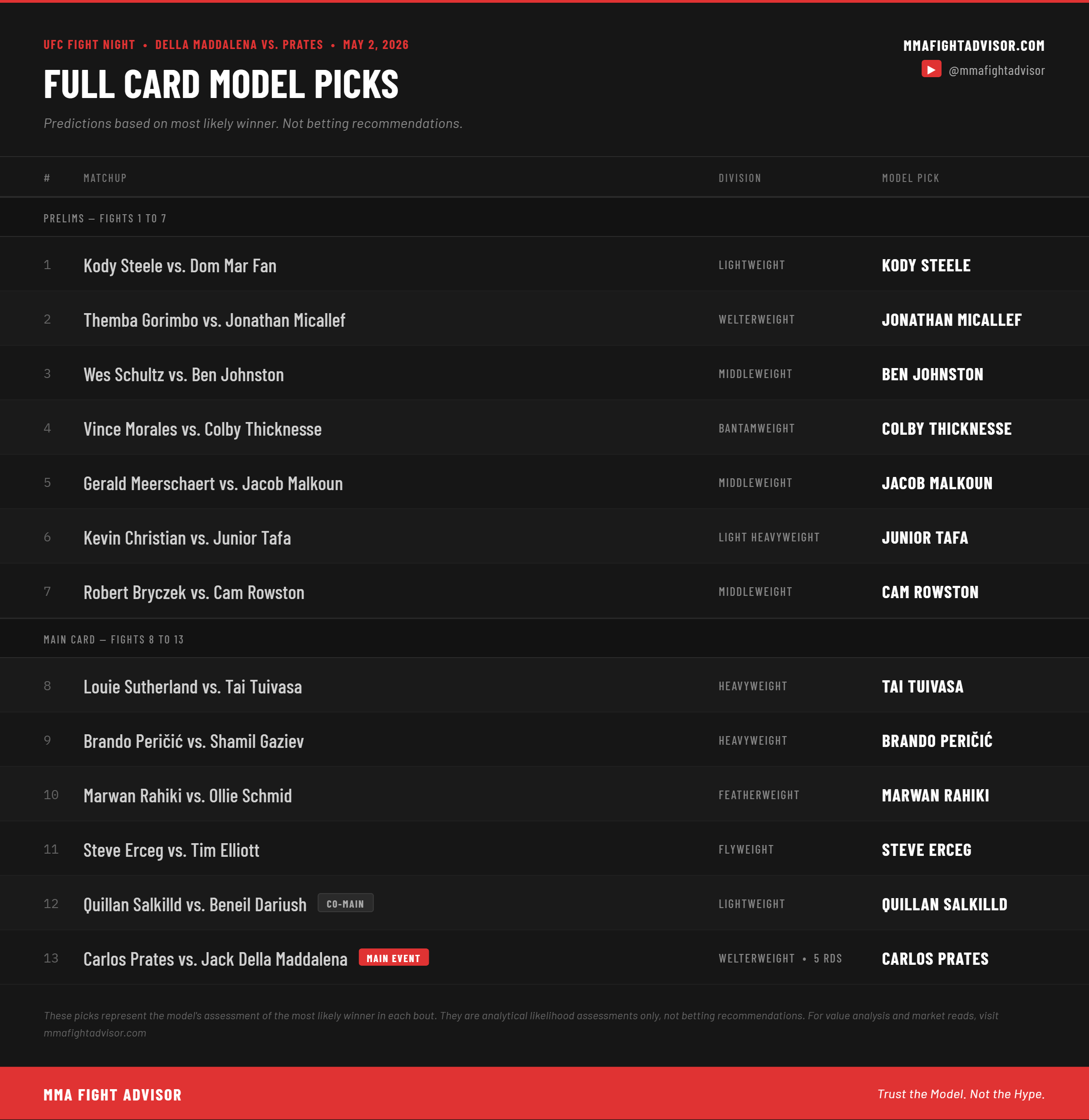
The May 2 card at RAC Arena seems uncommonly easy to read in the middle and uncommonly hard to read at the top. The matchmaking is built around the Australian and New Zealand contingent, with all twelve active matchups featuring a local fighter against a foreign opponent. The event runs in local Saturday-night prime time rather than the usual North American morning slot, which means the crowd dimension is going to be louder and earlier than most international cards generate. That matters more on a few specific fights than on others.
What the model sees overall is a polarized lineup. The top of the card is genuinely strong: a welterweight title eliminator, a co-main lightweight passing-of-the-torch fight, two heavyweight bouts where the unranked side can crack the rankings with a win. The middle and bottom run thinner, with a handful of heavily favored locals against opponents on long losing streaks or short-notice debutants. The model lands with the market on most of this card and isn’t picking against any major underdog. The contrarian reads aren’t here. What’s here instead is a tight cluster of high-conviction picks at the top, three honest toss-ups distributed across the lineup, and one fight where the model’s conviction is the highest on the card despite the late-notice scenario it’s built on.
Working from the prelims up.
Kody Steele vs. Dom Mar Fan
The model lands on Steele but the conviction here is moderate-low. This is genuinely close. Steele is the power-wrestler with a BJJ black belt who entered the UFC on a five-fight win streak before losing a Fight-of-the-Night decision to Rongzhu in his debut. Mar Fan is the technical kickboxer-grappler who won the Road to UFC tournament and beat Sangwook Kim by decision at UFC 325. The Mar Fan storyline running underneath this fight is the rich one: both of his career losses are to Quillan Salkilld, who fights in the co-main event of this same card. The same fighter Mar Fan couldn’t solve twice on the regional circuit is four hours up the running order in front of the same Perth crowd.
Stylistically, Steele’s path is power and pace either ending in a stoppage inside ten minutes or accumulating into a wrestling-led decision. Mar Fan’s path is range management, technical Muay Thai, and either out-pointing Steele over fifteen minutes or catching him in a scramble. The likely outcome is a decision either way, with Steele’s striking power leaving a credible KO path open. The pick is Steele, but the read on this fight stays restrained.
Themba Gorimbo vs. Jonathan Micallef
This is the cleanest stylistic read on the prelims. Micallef’s specific tactical strengths line up directly against Gorimbo’s specific weaknesses, and the model’s high conviction reflects that.
Micallef is a 2-0 UFC southpaw who blends long-range striking with technical grappling and opportunistic back-takes. Spencer Kyte’s “silent killer” framing in his UFC.com piece captures the read: this is a quietly complete fighter who hasn’t yet been in a fight that revealed his ceiling. Gorimbo is a thirty-five-year-old veteran whose recent losses to Vicente Luque and Jeremiah Wells exposed the same pattern: he leaves his neck exposed on takedown entries and gasses out as fights extend past the first round.
There’s important narrative context on Gorimbo’s side. He has spoken openly about taking the Luque fight a week after breaking his ankle, going against doctors’ orders. The injury context complicates how heavily we weigh the fifty-two-second loss. But the underlying stylistic problem against grappling-aware strikers remains. The model reads Micallef by submission in the second or third round. Gorimbo’s path to victory runs through an early takedown and finish before his cardio fades, which is a narrow window against a fighter who specifically punishes the entries Gorimbo relies on.
The model takes Micallef.
Wes Schultz vs. Ben Johnston
This is the most honestly uncertain fight on the card outside the main event. Source consensus calls it “by far the toughest fight on the entire card to call.” The model agrees, landing on Johnston by the thinnest margin.
Johnston’s story is the richest narrative on the prelims. He retired from MMA two years ago to focus on coaching, vacated his Eternal MMA middleweight title, recently got married, has a child on the way, and was called out of retirement when Darcy Vendy couldn’t compete. He underwent shoulder surgery during the retirement period, which he has acknowledged dulled his striking rhythm. He’s thirty-five, making his UFC debut on home soil, with a four-fight regional finish streak heavy on rear-naked chokes.
Schultz is on a nine-week turnaround from a brutal first-round knockout loss to Damian Pinas in his UFC debut. He earned his contract on Contender Series with a rare Suloev Stretch submission and his game is aggressive takedown wrestling — he changes levels across the cage and grinds along the fence. His debut showed atrocious striking defense and a tendency to wilt under pressure.
If Johnston’s striking holds up and his submission instincts show, this ends inside the distance. If Schultz’s wrestling lands and Johnston’s two-year layoff plus shoulder surgery shows in his takedown defense, this becomes a position-led decision or a Schultz finish off top control. Both paths have credible analytical support, which is exactly why the model’s conviction stays restrained. The lean is Johnston, but lean is the operative word.
Vince Morales vs. Colby Thicknesse
Another genuine toss-up. The model lands on Thicknesse, but barely, and the underdog path here is real.
Thicknesse trains at Freestyle MMA and City Kickboxing as a primary training partner of Alexander Volkanovski, who will corner him for this bout. He lost his short-notice UFC debut by decision to Aleksandre Topuria, then bounced back with a gritty decision win over Josias Musasa. His game is a grappling-heavy approach with relentless takedown attempts and a bouncy striking style.
The credible underdog path is what makes this interesting. Thicknesse’s takedown entries are reckless. Morales possesses a lethal front-choke and Peruvian-necktie series. The thirty-five-year-old veteran is on a three-fight skid against young prospects, which speaks to where his ceiling is, but also means the matchmaking has now placed him directly across from another reckless prospect. The fight could end with Thicknesse out-pointing Morales over fifteen minutes on takedown pace, or it could end with Morales catching Thicknesse on a sloppy shot. The model’s restrained conviction reflects that both paths are real.
The pick is Thicknesse, with caveats.
Gerald Meerschaert vs. Jacob Malkoun
The strongest signal on the prelim card. The model has very high conviction here, and source consensus aligns.
Malkoun’s identity is relentless freestyle wrestling pressure, top control, and elite cardio. Gracie Jiu-Jitsu black belt, ADCC regional credentials, undefeated as a professional boxer. He recently returned from a roughly two-year layoff for a back injury and looked sharp in a dominant decision over the previously unbeaten Torrez Finney. Meerschaert is a thirty-eight-year-old veteran who holds the UFC middleweight records for both submission wins and total finishes. He’s also on a four-fight losing streak with three of those losses coming inside the distance.
What keeps this from being a clean closeout is Meerschaert’s upset history. His comeback submission wins over Bruno Silva and Edmen Shahbazyan are part of the divisional folklore. His path is the one-window scramble, finding a small opening for a trademark submission. Malkoun himself acknowledged the threat in his pre-fight comments: “If you give him a small opportunity, a small window to win, he’s gonna take it. So I’ve gotta shut him out everywhere, so hopefully it’s a finish, but if it’s not a finish all I know is I win.”
That tonal note is the right one. Respect the threat without softening the case. Malkoun is the call.
Kevin Christian vs. Junior Tafa
The cleanest pure striker-versus-grappler binary on the card. Tafa is the former Glory kickboxer with elite power but a poor MMA win-rate, currently 2-5 in the UFC after moving down from heavyweight. He has fast hands and knockout pop. He also has a non-existent ground game, atrocious takedown defense, and a gas tank that fades after the first round.
Christian stands six-foot-seven with an eighty-inch reach and earned his UFC contract via Contender Series triangle armbar. Source consensus describes him as an unathletic, flat-footed striker with a weak chin and terrible defense, but a legitimate Brazilian Jiu-Jitsu threat off his back. He lost his UFC debut to Billy Elekana via first-round submission. Notably, Tafa’s most recent loss was also to Elekana, by second-round rear-naked choke at UFC 325. The shared opponent doesn’t change the read on this fight, but it does mean both fighters have known vulnerabilities in their losses.
Tafa’s path to the win is the kill shot, either landing on the feet or stuffing a Christian takedown into a striking exchange he wins. Christian’s only path is an early successful takedown into a submission window. The model takes Tafa, with the path likely ending in a first-round knockout. Both fighters are in must-win territory, which gives the fight an urgency that the prelim slot doesn’t fully convey.
Robert Bryczek vs. Cam Rowston
The model takes Rowston with moderate-high conviction. He’s part of the City Kickboxing rising-star cluster on this card alongside Pericic and the late-notice Schmid. He’s actively transitioned from his original “Battle Giraffe” submission-specialist identity to a knockout-focused approach, reeling off six straight wins including two consecutive UFC stoppages.
Bryczek is a Polish veteran who lost his UFC debut to Ihor Potieria by decision before bouncing back with a third-round knockout over divisional mainstay Brad Tavares. His game is boxing-heavy with a tendency to square his hips, leaving him vulnerable to rangy kickboxers and calf kicks. The upset path runs through Rowston’s “tall man defense” leaving his chin exposed in the pocket, but Bryczek’s negative striking differential is a real flag against that case.
Rowston’s path runs through range, calf kicks, and either a TKO accumulation by the second or third round or a points-led decision. Decision is the most likely outcome. The pick is Rowston.
That closes out the prelims. Onto the main card.
Louie Sutherland vs. Tai Tuivasa
The model takes Tuivasa, with the matchmaking working as designed.
Tuivasa enters with the longest losing streak in UFC heavyweight division history. Six fights, including grappling losses to Volkov and Tybura that revealed how exposed he is when fights extend. His last UFC win was a knockout of Derrick Lewis at UFC 271, on February 12, 2022. Exactly four years to the night before this fight. The crowd dimension and the timing layer are part of why the matchmaking exists.
Sutherland is the short-notice replacement for Sean Sharaf, eight days’ notice, coming off two consecutive first-round losses including a forty-eight-second knockout to Brando Pericic. He’s 0-2 in the UFC and his path here is narrow. Tuivasa’s striking advantage is overwhelming if he keeps it standing in the early minutes, which against a fighter with Sutherland’s chin profile is the most likely outcome.
The fight has clean Round 1 KO contours. The Sutherland upset path requires him to survive long enough for Tuivasa’s late-career chin to become the issue, and the prep timeline doesn’t favor that scenario. Tuivasa snaps the skid.
Brando Peričić vs. Shamil Gaziev
The model takes Pericic with strong conviction. The matchup is binary, and the data tilts the binary in his direction.
Pericic is a six-foot-five City Kickboxing kickboxer with a one hundred percent first-round finishing rate across his six pro wins. His UFC debut was a first-round knockout of Elisha Ellison at one minute fifty-five. His second UFC fight was a first-round knockout of Louie Sutherland at one minute forty-eight. Source consensus calls him “the future of the heavyweight division repping Australia in a big way.” A win over the fifteenth-ranked Gaziev officially vaults him into the rankings.
Gaziev is the ranked veteran with a well-rounded MMA approach, IMMAF amateur world bronze, strong wrestling, and heavy hands. He cuts more than forty pounds to make the heavyweight limit. His most recent fight was an eighty-two-second knockout loss to Waldo Cortes-Acosta in November, which exposed exactly the vulnerability Pericic is built to exploit. If Gaziev survives the first round, his cardio and IQ should carry the championship-rounds version of this fight. But Pericic has never been past the first round in any pro win, which means both directions of the read have unanswered questions on the same axis.
The path is a Pericic first-round finish. The model reads it that way, and the recent precedent supports it.
Marwan Rahiki vs. Ollie Schmid
The strongest signal on the entire card.
Rahiki is the twenty-three-year-old undefeated Moroccan-Australian featherweight whose UFC debut was a Fight-of-the-Night second-round corner stoppage of Harry Hardwick. His pro record is 8-0 with one hundred percent finishes; he’s only been past the first round once in his career. His style is high-paced and dynamic, with spinning attacks and explosive boxing combinations.
Schmid is the four-days-notice UFC debutant. He’s twenty-four, 4-2 as a pro, training out of City Kickboxing in Auckland, on a three-fight win streak that ended in a fifteen-second spinning backfist knockout. He was preparing for a different opponent on May 30 before getting the call. Source consensus calls him a “sacrificial lamb” running into a “buzzsaw.”
The matchup is fundamentally tilted, and the conviction here doesn’t soften because of the late-notice scenario. The Schmid upset path exists in his finishing instinct — the spinning backfist is real — but Rahiki’s pressure, pace, and full camp against a fighter who hasn’t trained for him specifically is the cleanest analytical setup on the card. The pick lands on Rahiki, and the finish narrative is loud.
Steve Erceg vs. Tim Elliott
The model takes Erceg with moderate-high conviction, and this fight matters more for him than the model’s confidence might suggest.
Erceg is the twelfth-ranked flyweight, a Perth resident who developed at Wilkes Martial Arts and was fast-tracked to a Pantoja title shot at UFC 301 after just three UFC wins. He came competitive in that title fight, lost the decision, and entered a three-fight stretch with one win. A loss here pushes him out of the title-picture conversation entirely. Elliott is the thirty-nine-year-old TUF 24 veteran whose career has been a series of surprise turns, most recently a second-round guillotine submission of touted prospect Kai Asakura on his return from a 2024 layoff.
Erceg’s path is clean and technical: stuff Elliott’s takedowns, win the boxing exchanges, accumulate over fifteen minutes. The submission game underneath gives him a secondary path against a fading Elliott in the later rounds. Elliott’s path is wrestling-led chaos: chain takedowns, scrambles, and a chance at a submission window.
The most likely outcome is Erceg by decision. Erceg gets the call.
Quillan Salkilld vs. Beneil Dariush
The co-main event. The model has very strong conviction here, and the matchup is the prototypical passing-of-the-torch pairing.
Salkilld is the twenty-six-year-old Perth-based lightweight on an eleven-fight win streak. RAC Arena is ten minutes from his home; he attended a UFC event there as a fan in 2018. His UFC run is 4-0 with three finishes including a head-kick knockout of Nasrat Haqparast and a face-crank submission of Jamie Mullarkey at UFC 325. He won UFC.com’s 2025 Newcomer of the Year and Debut of the Year awards. The Mar Fan symmetry from the prelim opener applies here too: Salkilld is the fighter who solved Mar Fan twice, and he’s the fighter the matchmaking is now positioning for a major divisional push.
Dariush is the thirty-six-year-old former top-five lightweight whose chin and durability have collapsed in his late career. Three first-round knockout losses in his last four fights, including a sixteen-second loss to Benoit Saint-Denis at UFC 322 where he missed weight and engaged recklessly. His grappling and BJJ remain elite. His striking has been the failure point.
In his pre-fight comments, Dariush told reporters: “Whether he wants to or I do, there will be some grappling exchanged because we both are grapplers.” He also openly questioned his own motivation. That self-aware uncertainty, against a finisher of Salkilld’s profile, is part of what makes the conviction land where it does.
The path runs through an early Salkilld knockout. Dariush’s grappling savvy could tie Salkilld up and drag the fight into the second round, which is the credible secondary read, but the underlying chin question is real. The torch passes.
Carlos Prates vs. Jack Della Maddalena
The closest call on the card. The model lands on Prates by the thinnest margin, and the read is honest about it. This is a true toss-up — a genuine coin flip with real paths to victory for both fighters and a stylistic chess match underneath.
Della Maddalena is fighting in his hometown for the first time since losing the title to Islam Makhachev at UFC 322. He’s spoken candidly about how much that loss weighed on him in the days after. He’s also been clear that the ultimate goal is the rematch. The boxing identity that built his nine-year unbeaten run before the Makhachev fight is intact: volume, pocket pressure, switch-stance combinations, body work, and what his Australian fans frequently call the cleanest hands in the division. The grappling vulnerability that Makhachev exposed isn’t relevant against Prates, who is a pure striker.
Prates enters on six knockouts since the start of 2024, more than any other UFC fighter in that span. The spinning back elbow finish of Geoff Neal at UFC 319 was a career highlight. The straight-left knockout of Leon Edwards at UFC 322 was the bigger signal: Edwards had never been knocked out before. Prates does this through a specific pattern. He starts slow in five-round fights, shells up defensively, makes striking reads while absorbing volume, and unleashes the kill shot in the middle or late rounds. The pattern has worked twice in a row against high-level competition. Whether it works a third time, in his opponent’s hometown, against a former champion who specifically wants to test the durability question, is the entire fight.
What makes this a toss-up rather than a lean is that the credible paths split cleanly. Prates wins by a second or third-round knockout via the straight left or a kick. Della Maddalena wins by out-volumng Prates over twenty-five minutes and either taking a decision or closing late once Prates gets hurt for the first time in his finishing run. The Prates cardio question across five rounds is real — he has never been past the third round in a winning fight at the highest level. The Della Maddalena durability question is real — Prates has finished two fighters in a row who had never been finished before him.
The model lands on Prates. But it lands there barely. Whoever wins takes the next welterweight title shot.