July 10, 2026
UFC 329: The Model's Full Card Breakdown
Thirteen years, two different fighters, and the most loaded International Fight Week card in a long time
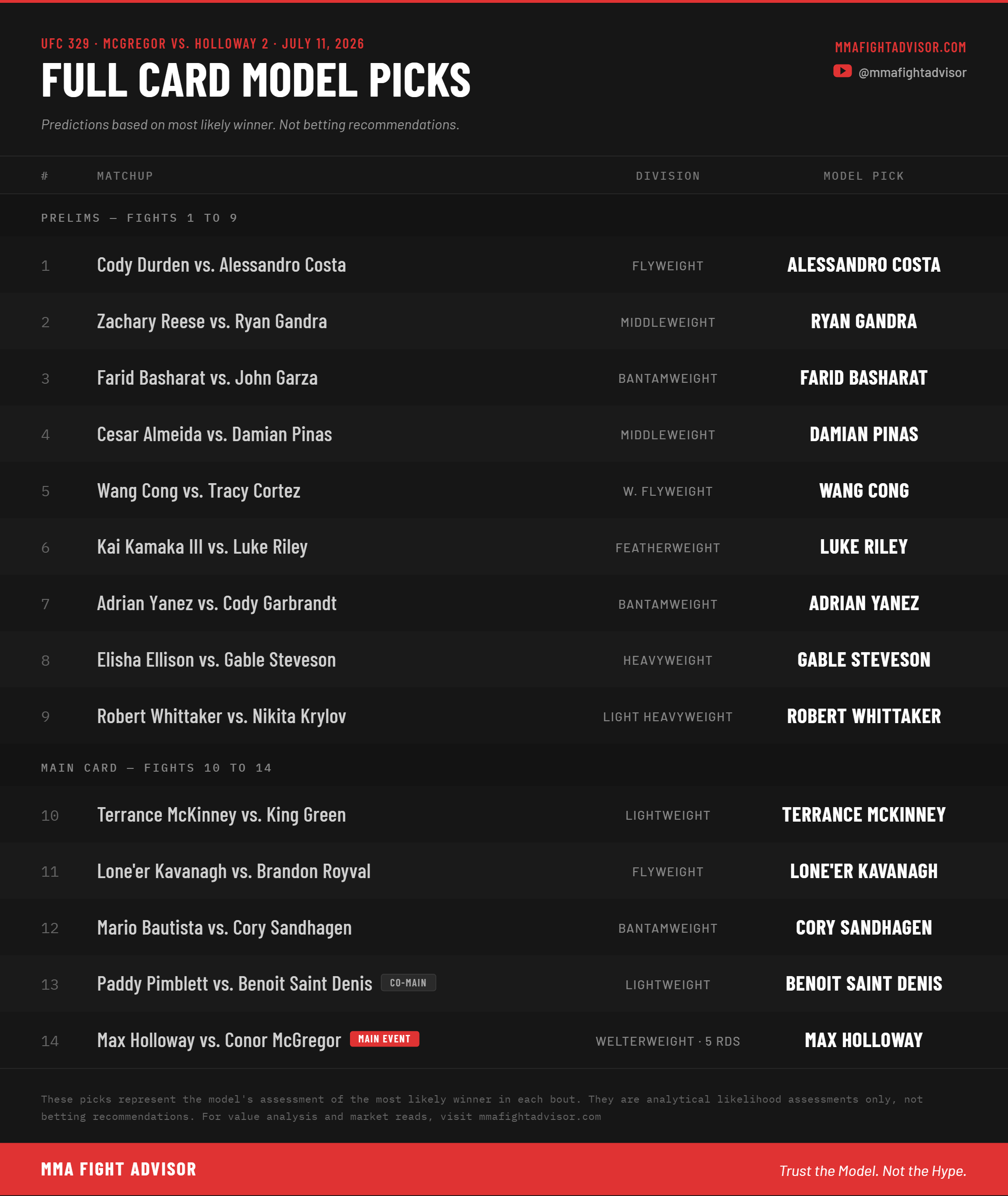
Saturday at T-Mobile Arena, Las Vegas, is the kind of card that gets built once a decade. The main event has the full weight of Conor McGregor's return from a five-year absence, but this card does not need the main event to be interesting. There is a co-main with a real contrarian read, a flyweight fight with one of the stronger directional signals on the card, a former middleweight champion making his light heavyweight debut as a small favorite, and the highest-confidence call the model has made all year sitting quietly on the prelims. Here is how the model reads it, fight by fight.
Farid Basharat vs. John Garza
Basharat comes into this fight 15-0 overall and 6-0 inside the UFC, the last undefeated bantamweight in the promotion. Every one of those UFC wins came by decision, which has been used as a knock against him, but the reality is that he has never been seriously threatened. He is a chain wrestler with elite fight IQ who simply does not give opponents anything to work with.
Garza is 6-1, a 23-year-old Fury FC product making his UFC debut on six days' notice after Ethyn Ewing withdrew with an injury. He has three recent knockouts in his last four fights at regional level and a crowd-pleasing style. The gap in experience and competition level is significant.
The model takes Basharat.
Ryan Gandra vs. Zachary Reese
Two middleweights with limited UFC profiles. The model takes Gandra. Thin analytical sourcing on both fighters means this one gets tight treatment here.
Gandra gets the call.
Damian Pinas vs. Cesar Almeida
Almeida is the ranked fighter in this matchup, a Brazilian middleweight with finishing credentials. The model reads against the market here and lands on Pinas. Sourcing at this stage of the card is limited, but the directional read is clear enough.
Pinas gets the call.
Alessandro Costa vs. Cody Durden
Costa stepped into this fight on approximately 13 days' notice after Ode' Osbourne withdrew with an injury. He is a Brazilian knockout artist who has finished his last two fights by TKO in 2026. Durden at 35 is a grinding veteran who has had a rough run in the division, though he did pick up a decision win in his last outing and reportedly signed a new four-fight deal.
The short notice does matter analytically. Costa's preparation window is real. But his finishing profile and the trajectory of his recent form are enough for the model to take him clearly.
Costa gets the call.
Wang Cong vs. Tracy Cortez
Wang Cong is one of the more unusual fighters in the division. She came to MMA late, carries world-level Sanda credentials, a silver medal in amateur boxing, and the kind of knockout power that produced the second-fastest finish in UFC women's flyweight history on her promotional debut. The Gabriella Fernandes submission loss in Macau was her first career setback and she has responded with three straight wins, including two at catchweight, which is a documented weight management flag worth noting.
Cortez is a grinder with a strong wrestling base and a consistent ability to make fights ugly for strikers over three rounds. Her path is taking Wang away from distance and neutralizing the striking advantage on the ground. It is a legitimate strategic threat.
The model reads Wang at close to even odds. Not a loud call, but a call.
Wang Cong gets the call.
Luke Riley vs. Kai Kamaka III
Riley is 13-0, a Next Generation Liverpool product, same gym as Paddy Pimblett. He is an undefeated English featherweight stepping into a prelim on the biggest card of the year. The model takes him with strong confidence against a market that already reflects a large favorite price.
Kamaka carries Hawaiian MMA lineage and an undefeated UFC run of his own. The model reads the gap as meaningful regardless.
Riley gets the call.
Adrian Yanez vs. Cody Garbrandt
This is the highest-confidence call on the entire card.
Garbrandt is a former UFC bantamweight champion and one of the most naturally gifted counter-strikers the division has ever seen. The timing, the footwork, the left hand, all of it was once elite. The durability questions that have followed him since the Dillashaw knockouts are well-documented, and the model takes them seriously here.
Yanez is a heavy-handed forward-pressure fighter who walks opponents down and ends fights. He is the kind of opponent that forces the chin question early and repeatedly.
The model reads this with full confidence and lands on Yanez. It is the clearest directional signal anywhere on this card.
Yanez gets the call.
Gable Steveson vs. Elisha Ellison
Steveson is the 2020 Olympic gold medalist in wrestling making his UFC debut. His pre-UFC record is 4-0 with all four wins coming in the first round. He trains under Jon Jones at Syndicate MMA. There is no UFC Stats data for him at this point, which is simply the reality of a debutant, and his competition level to date has been regional. What is not regional is his wrestling pedigree, which is as accomplished as any fighter who has ever stepped into the Octagon.
Ellison is a career heavyweight sitting at the bottom of the divisional depth chart. He was stopped in his UFC debut.
The model takes Steveson. The analytical question here is not the call but the manner and what it signals about his ceiling.
Steveson gets the call.
Robert Whittaker vs. Nikita Krylov
This is one of the more interesting analytical situations on the card.
Whittaker is making his light heavyweight debut at 35. The weight cut that had become increasingly punishing at middleweight is gone, replaced by questions about how a man whose entire career has been built at 185 handles the bigger, harder hands at 205. What transfers cleanly is everything mental: his boxing combinations, his movement, his composure under pressure, the fight IQ that made him a two-time UFC middleweight champion.
Krylov is a finisher. His UFC record shows five stoppages on each side of the ledger, and his average fight time suggests his fights almost never see round three. He has genuine knockout and submission power. He was stopped by Bogdan Guskov in July 2025 and by Dominick Reyes in April 2025 before winning two in a row since, which tells you everything about what Krylov night you are getting.
The model takes Whittaker, priced as a small favorite. The decisional profile, the experience gap at elite level, and the fight IQ differential are enough. It is not a loud call but it is a clear one.
Whittaker gets the call.
Terrance McKinney vs. King Green
McKinney holds the record for the fastest knockout in UFC lightweight history. Eight of his UFC wins came in under a minute. He is among the highest-volume strikers per minute in the division's history. He is also 8-5 in the UFC with submission losses to three different opponents, which is the other side of what he is: a first-round-or-bust fighter who becomes vulnerable the moment the opening round ends without a finish.
Green is 39 and on a three-fight UFC win streak, having knocked out Daniel Zellhuber and submitted Jeremy Stephens in his two most recent finishes. He is a multidimensional veteran who has been around long enough to know exactly what McKinney will try to do in the first 90 seconds.
The model takes McKinney, but this is a toss-up by the numbers. The directional read is McKinney; the confidence is not high.
McKinney gets the call.
Brandon Royval vs. Lone'er Kavanagh
Royval is 33, a former title challenger, a BJJ black belt with nine career submissions, and the owner of more Fight of the Night bonuses than any flyweight in UFC history. He is also on a two-fight losing streak heading in, with a decision loss to Joshua Van and a first-round KO loss to Manel Kape in his last two outings. His game is built on chaos: scrambles, unexpected submissions, and a pace that grinds opponents down. If this fight hits the mat early and often, his experience and submission hunting give him a legitimate path.
Kavanagh is 26 and 10-1. His last fight was a five-round unanimous decision win over former two-time champion Brandon Moreno in Mexico City, a statement result on a short UFC resume. He is a kickboxing black belt with a sports science degree, a cerebral striker who controls distance well and picks his shots. His only professional loss came by second-round KO in Shanghai, and he addressed it publicly before moving forward.
The model takes Kavanagh with strong confidence. The read is clear: keep it standing, manage the scrambles, let the striking advantage compound over rounds. Royval's path requires making the fight ugly and hoping Kavanagh follows him there.
Kavanagh gets the call.
Cory Sandhagen vs. Mario Bautista
Seven years separate these two from the first time they fought. Sandhagen submitted Bautista via armbar in the first round of Bautista's UFC debut in January 2019. Neither fighter from that night exists anymore in any meaningful sense.
Sandhagen is 18-6 overall and has fought for the UFC bantamweight title. He has never been finished by strikes in his career. His entire game is built around range, angles, and volume from a frame that is long for the division. His last meaningful defeat was a five-round loss to champion Merab Dvalishvili at UFC 320 in October 2025. He is a title-fight-caliber fighter.
Bautista at 32 is 17-3 with wins over Jose Aldo, Ricky Simon, and Patchy Mix. He is a BJJ black belt with seven career submission wins and a striking game that has improved steadily throughout his UFC run. He is also the betting favorite entering this fight.
The model takes Sandhagen in a close read. This is not a loud call; the numbers make it close to a toss-up. But the directional lean is Sandhagen.
Sandhagen gets the call.
Benoit Saint Denis vs. Paddy Pimblett
The popular read on this fight is Pimblett. The model reads it differently.
Saint Denis is 17-3 and has won his last four UFC fights, all by finish. His winning streak includes Dan Hooker, Beneil Dariush, Mauricio Ruffy, and Kyle Prepolec. Every single one of his 17 professional wins has ended before the judges were needed. He is a multi-dimensional threat: explosive striking, unorthodox takedown entries, submission hunting on the ground. He is ranked fifth at lightweight and this is the biggest fight of his career.
Pimblett is 23-4 with a world-class BJJ game and documented durability. He has survived early danger before and turned fights around with his grappling. His only UFC loss was a decision to Justin Gaethje in a five-round interim title fight at UFC 324. He is a dangerous opponent, especially if BSD does not finish him early. The longer this fight goes, the more Pimblett's submission game and experience at distance become relevant.
But the model reads BSD. The finishing rate, the multi-dimensional threat profile, and the analytical case around what happens when an opponent like this is on form point in one direction.
Saint Denis gets the call.
Max Holloway vs. Conor McGregor
There is no fight in the sport's history quite like this one.
McGregor is 37, returning from five years away. His last walk to the cage was in July 2021. Since then: a broken leg, a cancelled return against Michael Chandler, an 18-month USADA suspension that ended in March 2026. His record is 22-6. His game has always been timing, distance, and the left hand that knocked out Jose Aldo in 13 seconds and finished Eddie Alvarez in two. The honest question is not stylistic but empirical: what version of McGregor shows up after five years of inactivity at 37 years old?
Holloway is 34 and has spent the last several years becoming something different from the fighter who lost to McGregor in 2013. He is now among the highest-volume strikers in UFC history, has gone five rounds in more big fights than almost anyone on the active roster, and arrives having beaten Dustin Poirier for the BMF title and fought for it against Charles Oliveira in his last two outings. His last fight was a decision loss to Oliveira at UFC 326 in March. He is ranked fourth at lightweight and is making his welterweight debut, same as McGregor.
Both men are outside their natural weight class. Holloway is the larger, more recently active fighter. His pace profile, built on volume and accumulation over distance, is the kind of game that punishes opponents who cannot maintain their output.
The model takes Holloway. The directional signal is clear. The layoff is the most significant analytical variable on the entire card and the model accounts for it.
Holloway gets the call.
Every call is logged before the event. Every result tracked after.