August 13, 2026
UFC 330: Full Card Analysis, Makhachev vs. Machado Garry
Two titles, twelve fights, and a Philadelphia card that survived three withdrawals. Here is how the model reads every bout, first fight to last.
The Octagon returns to Philadelphia on Saturday for the first numbered event the city has hosted in fifteen years. The last time the UFC came through, in March 2019, Justin Gaethje knocked out Edson Barboza in the first round of the main event. Barboza is on this card again, seven years older, opening the main card against a man who was still fighting on the regional circuit in Argentina back then.
That is the kind of card this is. UFC 330 lost Erin Blanchfield to injury two weeks out, lost Geoff Neal in late July, and lost Jose Ochoa on Wednesday of fight week, three days before the doors open. What survived is a twelve-fight lineup with two championships on top and an undercard that reads better than its reputation, largely because of how tightly the fighters on it are connected to one another.
Three men competing Saturday have fought each other. Vicente Luque knocked out Jalin Turner in 2018. Turner knocked out Barboza last December. Joel Álvarez shut out Luque in October. Neil Magny lost every round of a fight to Ian Machado Garry in 2023 and now appears on the same card as the man challenging for the welterweight title. Antonio Trocoli has been guillotined in the first round by two different fighters here, thirteen months apart. Cody Brundage has lost split decisions to two of them. When a card is this interlaced, the shared tape tells you more than the records do.
Here is how the model reads all twelve, first fight to last.
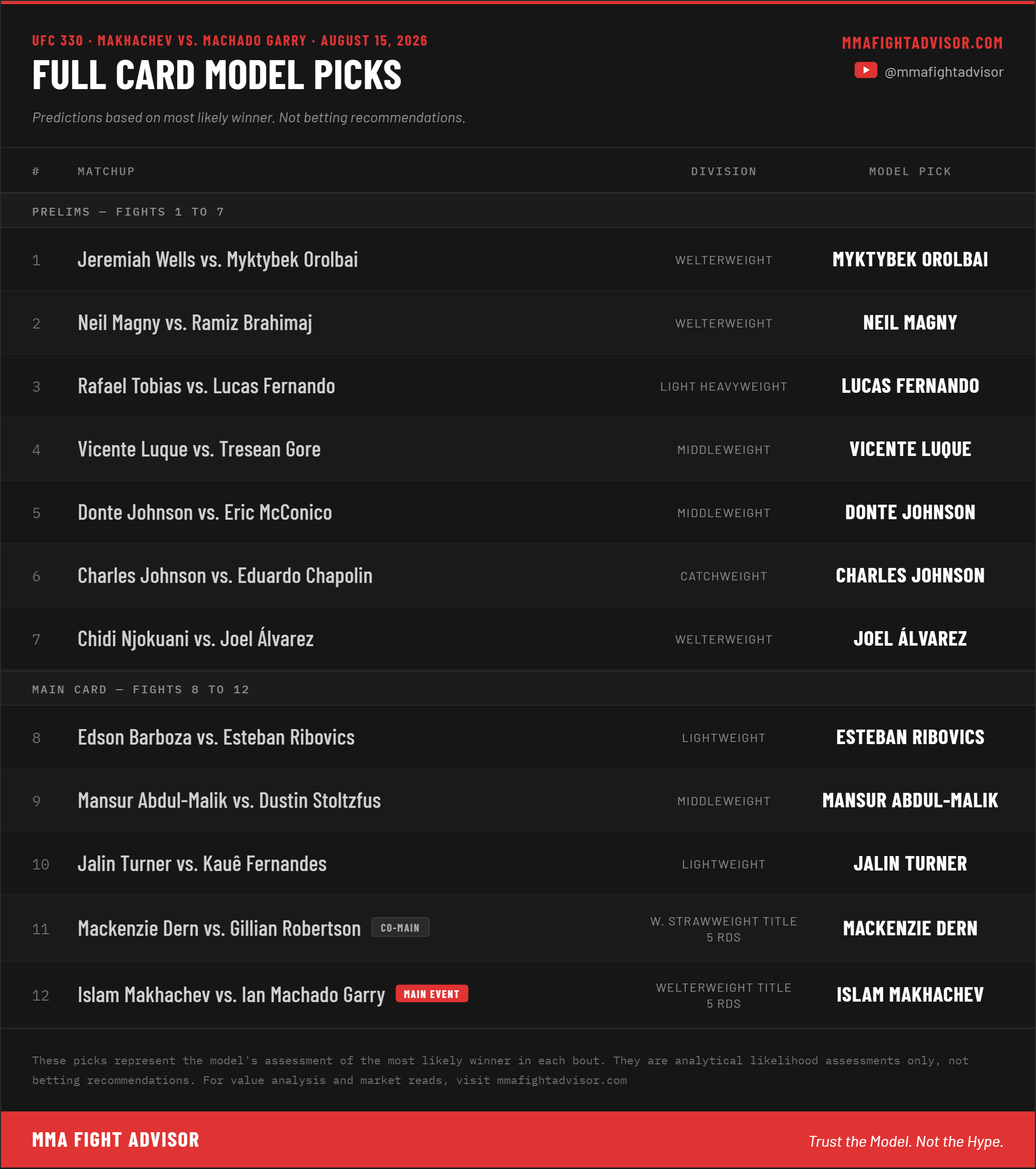
Prelims
Jeremiah Wells vs. Myktybek Orolbai
Welterweight
The card opens with the two highest control rates on it, facing each other. Orolbai holds position 53.6 percent of the time across his UFC run and Wells 53.1 percent, the top two figures on the card. Somebody is going to have to fight from underneath, and neither man has much recent experience doing it.
The separation is in how they get there. Orolbai has landed 36 takedowns on 61 attempts, a volume of entries nobody else here approaches, and his rate of 8.77 per fifteen minutes is nearly triple the next highest figure this weekend. Wells is the more selective operator, 14 on 30, and he is genuinely difficult to hit on the way in, absorbing 1.28 strikes per minute, the lowest mark of anyone competing Saturday. That number is the whole argument for him. If Orolbai has to work through a switch-stance fighter who does not get touched on entries, the shot gets expensive.
The problem is that Orolbai's own takedown defense sits at 40 percent, the softest figure in the bout, and Wells is 39 years old making only his third appearance since the start of 2024. He has been limited to seven Octagon fights in five years. Orolbai is 28, has won three straight, and beat Jack Hermansson and Chris Curtis back to back, the first by first-round knockout, which is not the résumé of a one-dimensional grappler.
Wells is fighting in his home city, in the building, in the opening bout, and there is a version of this where the crowd carries him through a scramble and into top position. The model sides with Orolbai anyway.
Neil Magny vs. Ramiz Brahimaj
Welterweight
Magny brings the largest reach advantage on the card into this one, 7.9 inches, and he has built a fifteen-year career out of exactly that. He makes his 38th Octagon appearance on Saturday, five more than anyone else fighting this weekend, and he holds the divisional record for welterweight wins. The template has not changed in a decade: length, volume, and a fight that gets harder for the other man in the third round than it was in the first.
Brahimaj is the cleaner puzzle. Every one of his five UFC wins ended inside the distance, four of them by submission, and he hunts the neck at a rate his cage time does not really justify, eight submission attempts across roughly 75 minutes. He has also never lost two fights in a row in his career.
What decides this is when the danger lives. Brahimaj's finishes come early and they come off the front headlock. Magny's ten Octagon finishes are almost all late, nine of them in the second round or beyond, with a single first-round knee against Craig White as the exception. The fight Brahimaj wants is over inside seven minutes. The fight Magny wants is a slow accumulation that only becomes decisive once the other man's output has dropped.
Magny is 39 and coming off a first-round anaconda choke from Yaroslav Amosov, which is precisely the finish Brahimaj specializes in, and that is the honest counterweight here. Magny gets the call, with the caveat that the first five minutes are the ones that matter.
Rafael Tobias vs. Lucas Fernando
Light Heavyweight
This is the thinnest read on the card and there is no point pretending otherwise. Tobias has one UFC appearance, a decision loss to Diyar Nurgozhay in March. Fernando has none. Between them they have produced fifteen minutes of Octagon tape, all of it Tobias, all of it a loss, and any rate figure drawn from a single fight is noise rather than signal.
What is left is the regional record, and there the two men diverge in a useful way. Tobias is 23, arrived on a six-fight winning streak with a heavy finishing rate, and earned his contract by submitting a previously undefeated opponent on the Contender Series. He is young enough that a debut loss says less than it would about someone else. Fernando is 29 and arrives as the reigning LFA light heavyweight champion, a former LFA middleweight champion, on four straight wins with finishes in the last two. He lost a Contender Series decision in 2023 and did not get signed, went back to the regional circuit, and won a belt in a second division before the call finally came.
There is one connecting thread worth noting. Fernando lost an LFA title fight to Azamat Bekoev. Tresean Gore submitted Bekoev in the third round in April and fights later on this same card. It is one step removed and it is not much, but on a bout with no Octagon tape it is more than nothing.
Fernando gives up nothing physically, holding roughly six inches of reach, and he is the more proven commodity at championship level outside the UFC. The model lands on Fernando, on a fight where the honest confidence is low.
Vicente Luque vs. Tresean Gore
Middleweight
This is the cleanest stylistic collision on the card. All three of Gore's Octagon wins are guillotine chokes. Seven of Luque's seventeen come from the same front headlock family, the D'Arce and the anaconda, including the one that finished Kelvin Gastelum in April. Two men who win fights the same way, in the same grip, and only one of them has been doing it at this level for a decade.
Luque's route runs through contact. Gore absorbs 7.00 strikes per minute, the highest figure on this card by a clear margin, and defends 40 percent of what comes at him. Luque has 11 knockdowns in his UFC career against Gore's zero, and he is willing to take one to land one, which is both the reason he has finished fifteen opponents and the reason he has been stopped three times.
Gore is not without a case. His takedown defense sits at 83 percent, tied for second best among everyone fighting Saturday, and his three finishes have all come from positions where the opponent was pressing forward. A fighter who wins by catching people coming in is a difficult night for a fighter who wins by coming in.
Their control rates are identical to the decimal, 14.4 percent each, which is a fair summary of the fight. Neither man wants to hold position. Both want the neck. The pick is Luque, on the strength of having lived in that grip against far better company.
Donte Johnson vs. Eric McConico
Middleweight
Cody Brundage is the shared frame. McConico beat him by split decision in August 2025. Johnson beat him by split decision in March 2026. Same result, same margin, seven months apart, and in Johnson's case it was the first time in eight professional fights that he had been taken to the judges at all.
McConico is the longer man by 3.2 inches of reach and 3.9 of height, a 36-year-old southpaw who did not debut in the Octagon until he was 34 and who has settled into a very legible pattern since: both of his UFC wins went to decision, and both of his losses ended by knockout. He wins on points or he gets stopped, and the mechanism showing up in the numbers is a 45 percent striking defense that is among the softest on this card.
Johnson is 8-0 with a 61 percent striking defense and 75 percent takedown defense, though all of it rests on 21 minutes of Octagon time across two fights, which is not enough to treat any of those figures as settled. What is clear is the direction. He came out of the Brundage decision publicly dissatisfied with his own performance and moved to Las Vegas to train, which is not what a fighter does when he thinks the win settled something.
Length and experience are real, and McConico has been the tougher out than his record suggests. But he has been stopped by pressure twice in four Octagon appearances, and Johnson is a finisher who has not yet met anyone able to hold him off. The model takes Johnson.
Charles Johnson vs. Eduardo Chapolin
Catchweight
Johnson lost his original opponent on Wednesday and gained one three days before the fight. Ochoa withdrew injured, Chapolin came in on short notice, and the bout dropped from the main card to the prelims and off the flyweight limit in the process. Everything that was analytically interesting about the original matchup is gone.
What remains favors the veteran heavily on paper. This is Johnson's sixteenth Octagon appearance and his fourth fight of 2026, an activity level nobody on the roster matches. He has 191 minutes of cage time, he lands 4.54 strikes per minute, and he is the only man to have beaten current flyweight champion Joshua Van in the UFC, a third-round knockout in 2024. He also arrives 49 days after being submitted by Asu Almabayev, the shortest turnaround on the card, and he has alternated wins and losses across his last six.
Chapolin makes his debut with no Octagon record at all. He is a former LFA flyweight champion at 15-2 who beat An Tuan Ho on the Contender Series last September to extend a five-fight streak and did not receive a contract for it. He appeared on The Ultimate Fighter and was submitted there. He has not competed in roughly eleven months and took this on a few days' notice, at a weight neither man was preparing for.
That combination normally points hard toward the established fighter, and the model does take Johnson. But it does so with less conviction than on any other fight this weekend, and the reason is worth stating plainly. Johnson's ground game has never been the strength, his takedown conversion is the lowest of anyone here who has landed one at all, and a fresh grappler with nothing to lose is exactly the profile that has troubled him. This is the lightest call on the card.
Chidi Njokuani vs. Joel Álvarez
Welterweight
Njokuani is a striker in the most literal sense the record allows. Across ten Octagon appearances he has attempted six takedowns and landed none. His offense happens on the feet, from 79.9 inches of reach, at 61 percent striking accuracy, the highest connect rate of anyone fighting Saturday. He also owns the fastest finish on this card, a sixteen-second knockout of Marc-Andre Barriault.
Álvarez matches him for height and gives up less than three inches of reach, which removes the structural advantage Njokuani usually enjoys. More to the point, he brings a broader toolkit. Seven of his eight Octagon wins ended inside the distance, four by strikes and three by submission, and the lone decision was a 30-26 shutout of Vicente Luque last October. He took this fight on eleven days' notice replacing Geoff Neal, and he is not moving up in weight to do it, having fought his last two at welterweight.
The case for Njokuani is that he has knocked people out cold from range and that a short-notice opponent may not be sharp enough to close it. The case against him is more durable. He has lost two straight, he was submitted in 69 seconds by Jake Matthews, and his pace has visibly dropped since moving down from middleweight. Álvarez wins fights in the clinch and off scrambles, both of which happen inside the range where Njokuani's length stops helping.
The model favors Álvarez, and the short notice is the main thing arguing the other way.
Main Card
Edson Barboza vs. Esteban Ribovics
Lightweight
Barboza returns to the arena where his last Philadelphia appearance ended in a first-round knockout, and he does so on a three-fight losing streak at 40 years old. He also has ten Fight of the Night bonuses, second most in company history, which tells you what kind of fifteen minutes this is likely to be.
Neither man grapples. Ribovics holds position 3.4 percent of the time, the lowest rate on this card, and Barboza 6.4 percent. This fight stays standing because both men want it there, not because either is being forced.
From there it is volume against power. Ribovics lands 7.27 significant strikes per minute, the highest output of anyone competing Saturday and more than three per minute clear of Barboza. He absorbs 5.83 in return, which is not a defensive profile so much as a willingness to trade. Barboza has 16 knockdowns in his UFC career, more than anyone else here, and his career has been built on the idea that one connection can end things regardless of what the previous nine minutes looked like.
The concern for Ribovics is that he was submitted by Mateusz Gamrot in April, which suggests a ceiling. The concern for Barboza is that he was stopped in his most recent outing, that his last win came in October 2023, and that his career averages describe fifteen years across three divisions rather than the fighter walking out on Saturday.
At some point the volume tells. Ribovics is the call.
Mansur Abdul-Malik vs. Dustin Stoltzfus
Middleweight
An all-Pennsylvania fight on a card where the local angle carries some weight. Abdul-Malik was born in Pittsburgh, Stoltzfus grew up in Lancaster County, and both came through the Contender Series.
The matchup itself is straightforward. Stoltzfus needs the fight on the mat. He shoots often, 39 attempts across ten Octagon appearances, converts about a third of them, and holds 27.7 percent control when he gets there. That is his path and it is essentially his only one, because his 47 percent striking defense against a man with 5.1 inches of reach is not a fight he wants for fifteen minutes.
Abdul-Malik defends 83 percent of takedowns, tied for second best on this card. If that number holds, Stoltzfus is left standing in front of a fighter whose three Octagon wins all ended inside the distance, two by strikes and one by first-round guillotine.
There is a soft spot. Abdul-Malik absorbs 4.49 strikes per minute, and he was stopped by a third-round knee from Yousri Belgaroui in March for the first loss of his professional career. He is also working from just 36 minutes of Octagon time across five fights, so the profile is sketched rather than drawn. Stoltzfus has not fought in eleven months and has dropped two straight, but he has been in with Kelvin Gastelum and Nursulton Ruziboev and made both of them work.
The model stays with Abdul-Malik, and the wrestling exchanges in round one will tell you quickly whether that holds.
Jalin Turner vs. Kauê Fernandes
Lightweight
Turner has never won a decision in the UFC. All eight of his Octagon wins are finishes and five came in the first round, which is why his average fight lasts 6.75 minutes, the shortest of anyone on this card. He is also 5.9 inches taller than Fernandes, the largest height advantage this weekend, with four and a half inches of reach on top of it. He is coming off a first-round knockout of Barboza, who opens the main card two fights earlier.
The counterargument is the most interesting defensive profile here. Fernandes absorbs 1.42 strikes per minute and defends 62 percent of what is thrown at him, the best mark of anyone competing Saturday. He defends 76 percent of takedowns. He has never been finished in the Octagon and he is 3-1 with the loss a split decision in his debut. Against a fighter whose entire model is early violence, a man who is genuinely hard to hit is the worst possible draw.
Two things push back on Fernandes. He has not fought in 343 days, the longest layoff on the card, and his entire UFC record spans 38 minutes, so the defensive numbers rest on a smaller sample than they appear to. Turner, for his part, has been stopped three times in six Octagon losses, which means the early violence runs both directions.
This is the tightest read on the card outside the catchweight bout. Turner is where the model settles, and the margin is thin enough that a competitive first round changes the complexion of everything after it.
Mackenzie Dern vs. Gillian Robertson
Women's Strawweight Title
Two grapplers, one belt, and a genuine asymmetry in how they get to the ground.
Dern is the more dangerous person to be on top of. She has attempted 16 submissions in the Octagon, more than anyone on this card, has finished five opponents that way, and has never been submitted herself. Her guard is a live threat in a division where most fighters treat top position as an unambiguous good. What she does not do reliably is take people down. Her conversion rate sits at 18 percent across 76 attempts, which is a great deal of effort for relatively little return.
Robertson converts at 41 percent and holds position better than anyone else in the strawweight division's recent history. Her career control rate reads 49.7 percent, but that figure understates where she is now by a wide margin. Across her current five-fight winning streak she has controlled 68.8 percent of the total fight time, including 83.8 percent against Michelle Waterson-Gomez and 75.2 percent against Marina Rodriguez. She owns the record for most submission wins by any woman in UFC history and is tied with Amanda Nunes for the most finishes on the women's side of the sport.
So the fight is this. Robertson will very likely get on top. The question is whether that is where she wants to be. Ten of her fourteen Octagon wins ended inside the distance and seven of those were submissions, so her instinct will be to work for the finish, and working for a finish inside Dern's guard is the single most dangerous thing anyone can do at 115 pounds.
Dern has her own problem. Her takedown defense reads 37 percent, and she has not fought since winning the vacant title from Virna Jandiroba in October, a fight she was losing on two cards entering the championship rounds.
The model keeps the belt with Dern, on the read that Robertson's greatest strength delivers her into Dern's best position. It is the narrower of the two title calls.
Islam Makhachev vs. Ian Machado Garry
Welterweight Title
The obvious question is whether Machado Garry can stop the takedown. The tape says he probably can, and that it may not be the question that matters.
In November he faced Belal Muhammad, who attempted seven takedowns and landed none. Machado Garry won on all three scorecards. In December 2024 he faced Shavkat Rakhmonov, who attempted ten and landed two, an 80 percent stuff rate that matches Machado Garry's career figure exactly. He lost on all three scorecards.
The difference was not takedowns. It was what happened after they failed. Rakhmonov accumulated eleven minutes and 41 seconds of control across twenty-five minutes, nearly half the fight, almost none of it from completed takedowns and almost all of it from the fence and the clinch. Machado Garry landed 42 significant strikes in the entire fight, roughly a third of his career rate.
The round-by-round pattern is a tendency rather than a rule, but it points one way. The round Rakhmonov controlled most heavily, the first at 3:20, produced Machado Garry's lowest output of the night at three significant strikes. The round he controlled least, the third at 1:11, produced his highest at fourteen. The fourth round is the exception, 2:55 of control against eleven strikes landed, and it is worth acknowledging rather than writing around. Even so, the two rounds where Machado Garry got room to work are the two where the control time collapsed.
Makhachev's career control rate is 51.2 percent, higher than what Rakhmonov managed across those twenty-five minutes and the highest of anyone fighting Saturday. He defends 91 percent of takedowns himself, converts 56 percent of his own, and has finished eleven of his seventeen Octagon opponents, eight by submission, from every round of a fight including the fifth. He has not lost since 2015 and has won sixteen straight.
Machado Garry's case is real and it is not small. He is 4.7 inches taller with 3.9 inches of reach on a champion who is undersized for the division, he nearly doubles Makhachev's striking output, and his average fight lasts 14.75 minutes, longer than anyone else on this card, because making fights long is what he does. He has never been finished. His five straight decision wins read as a knock to some, but they describe a fighter who has beaten Belal Muhammad, Carlos Prates, Michael Page and Geoff Neal by controlling how the fight was scored rather than by chasing an ending.
The one man who solved him did it by taking that control away. That is what Makhachev does better than anyone in the sport.
Summary
Twelve fights, and the shape of the card is a study in the difference between a good matchup and a readable one. Four of these reads carry real weight. Orolbai's control, Álvarez's completeness, Ribovics' volume and Abdul-Malik's takedown defense are all supported by enough tape that the analytical case and the model point the same direction without strain.
Four more sit close to even. Turner and Fernandes, Luque and Gore, Magny and Brahimaj, and the reworked catchweight bout are fights where a single early exchange flips the entire read, and where the honest position is a lean rather than a case.
Both titles land on the champion, and both for the same underlying reason. Robertson gets on top and finds Dern's guard. Machado Garry stuffs the takedown and gets held against the fence anyway. In each case the challenger's best attribute delivers them somewhere the champion is comfortable.