September 16, 2026
UFC 331: Full Card Analysis, Van vs. Pantoja 2
Joshua Van and Alexandre Pantoja meet again after a first fight that lasted twenty-six seconds. A bout-by-bout look at all twelve fights in Los Angeles, including where the numbers hold up and where the sample is too thin to trust.
UFC 331 lands at Crypto.com Arena in Los Angeles on Saturday, and the fight at the top of it has already happened once. Joshua Van and Alexandre Pantoja met at UFC 323 in December and the bout lasted twenty-six seconds, ending when Pantoja suffered an arm injury. The belt changed hands on a result neither man got to earn, and nine months later they are back in the cage to settle it properly.
The card lost a bout on Monday. Brian Ortega withdrew from his lightweight rematch with Renato Moicano with an injury, and rather than find a replacement the promotion moved Moicano to a Fight Night main event in October. That leaves twelve fights, with Gable Steveson against Sean Sharaf promoted out of the prelims to open the main card.
The rest of the lineup divides into two groups. There are fighters with long records here: Marlon Vera has twenty-six UFC bouts, and Alexandre Pantoja, Alonzo Menifield and Tai Tuivasa have eighteen apiece. Then there are fighters the record cannot yet describe. Four men on Saturday's card have under six minutes of total UFC cage time between the opening bell and the final one. Where a number rests on two minutes of fighting I have said so rather than presenting it as a career figure, because a rate built from a single knockout describes that knockout and nothing else.
Here is how the card reads, first fight to last.
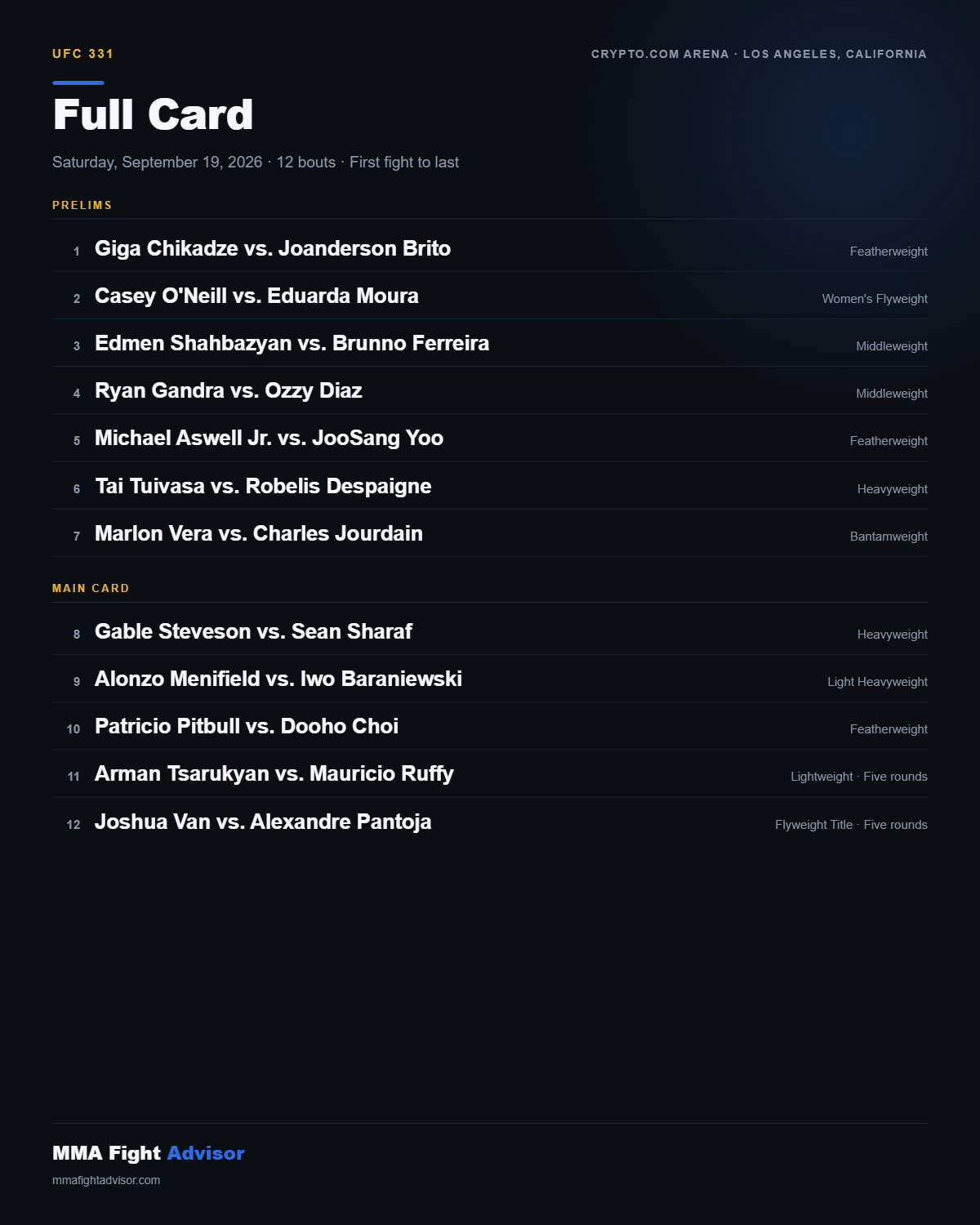
Prelims
Giga Chikadze vs. Joanderson Brito
Featherweight
This is a fight about whether Brito can get inside. Chikadze fights at the end of his range, working the body kick and the front kick, and he carries two inches of reach and four inches of height into the cage. Brito wants none of that. Six of his seven UFC wins came inside the distance and three of them were chokes.
The grappling numbers set the terms. Brito attempts 3.09 takedowns per fifteen minutes and lands 66.7 percent of the twenty-seven he has tried. Chikadze has stopped 68.8 percent of the thirty-two attempts he has faced. Brito controls 325.5 seconds per fifteen, which is roughly thirty-six percent of his total cage time, and Chikadze concedes 108.0. If Brito closes the distance he has shown he can keep the fight where he wants it. If he cannot, he is standing in front of a kicker while landing 2.15 significant strikes per minute of his own.
Chikadze is thirty-eight and has lost three in a row, the last of them a knockout by Kevin Vallejos in December that was the first time he had been stopped across twelve UFC appearances. His last win came against Alex Caceres in August 2023. Brito has won two straight and has never been finished in the UFC; all three of his losses are decisions. After dropping his debut he reeled off five consecutive finishes.
Casey O'Neill vs. Eduarda Moura
Women's Flyweight
Two fighters who want the same three rounds to look completely different. O'Neill throws 7.89 significant strikes per minute at 52.2 percent accuracy. Moura throws 2.63 at 37.7 percent. That is the fight in two numbers.
Moura's route runs through the mat. She attempts 3.57 takedowns per fifteen across forty-eight tries and holds 373.5 seconds of control per fifteen, about forty-one percent of her cage time. O'Neill has defended 70.0 percent of the twenty attempts she has faced, and she has finished twice from mount. Moura's defensive takedown mark is the better of the two in this bout at 80.0 percent, though it rests on ten attempts faced against O'Neill's twenty.
O'Neill returned in March after nineteen months away and knocked out Gabriella Fernandes in the first round. Moura has lost one of her last two, a decision in February contested at catchweight. Her five UFC bouts have come across three different weight designations, which makes her sample harder to read than the raw count suggests.
Edmen Shahbazyan vs. Brunno Ferreira
Middleweight
Two finishers with the same vulnerability. Shahbazyan has seven knockdowns across fifteen UFC bouts and has been stopped four times. Ferreira has three knockdowns across ten and has been stopped three times. Neither man has shown he can absorb a clean shot and keep going, which is why eight of Ferreira's ten UFC bouts have ended inside the distance and why Shahbazyan's average appearance runs 502 seconds against Ferreira's 440.
Their striking output is nearly identical. Shahbazyan lands 3.93 per minute at 48.6 percent accuracy, Ferreira 3.12 at 48.3 percent. The separation is defensive and it is on the mat: Shahbazyan has stopped 66.7 percent of fifty-seven takedown attempts faced, Ferreira 47.8 percent of twenty-three. Ferreira also concedes 189.7 seconds of control per fifteen, and Shahbazyan 180.1. Both of those figures are high for men who would rather be swinging.
Shahbazyan dropped a decision to Brendan Allen in June after three straight wins. Ferreira has lost two in a row, including a first-round knockout by Gregory Rodrigues in March that reversed their 2023 meeting, where Ferreira was the one doing the knocking out.
Ryan Gandra vs. Ozzy Diaz
Middleweight
This is a very thin read and there is no honest way to dress it up. Gandra has two UFC bouts and 116 seconds of cage time. Both were first-round knockouts, at 1:15 and 0:41. He has two knockdowns in under two minutes of fighting. What happens to him in round two is not visible anywhere in the record, because he has never been there.
Every per-minute figure attached to his name is a product of that sample rather than a description of how he fights, so I am not going to quote any of them. He has neither attempted a takedown nor faced one in the UFC, which means his grappling numbers are undefined rather than zero.
Diaz brings three UFC bouts across two divisions and about twenty-four minutes of cage time, which is thin but at least readable. His single win is a decision at middleweight. Both losses are knockouts, one of them at light heavyweight to Zhang Mingyang, who was knocked out in the first round by Alonzo Menifield in May. Diaz carries five inches of reach and three inches of height into the bout and is four years older.
Michael Aswell Jr. vs. JooSang Yoo
Featherweight
Aswell is twenty-five and 1-3 in the UFC, with all three losses by decision and the win a first-round knockout of Lucas Almeida last October. The pattern in his numbers is a fighter in close fights he is not quite winning: he lands 6.72 significant strikes per minute and absorbs 7.11, hitting at 39.5 percent. That is across four bouts and roughly forty-seven minutes, so it is a real sample rather than a fragment, but a small one. He has landed one takedown on four attempts and faced two.
Yoo has two UFC bouts totaling 349 seconds, one knockout in each direction. Both ended inside two minutes of round time. Any rate figure built on that is noise, so the useful facts are the ones that survive a small sample: he gives up an inch of height but carries two inches of reach, and he has been out for 350 days.
Tai Tuivasa vs. Robelis Despaigne
Heavyweight
Tuivasa's eighteen UFC bouts contain everything you would want from a heavyweight and, lately, everything you would not. He has eight knockdowns and seven of his eight wins came by knockout. He has also lost seven in a row, his last win coming against Derrick Lewis in February 2022, and two of those seven losses were submissions. He absorbs 4.61 significant strikes per minute against 3.37 landed, and his striking defense sits at 42.9 percent.
Despaigne is the physically larger man by a wide margin, carrying nine inches of reach and five inches of height. He has three UFC bouts and about thirty minutes of cage time, which is thin but usable. The line that stands out is what happens to him when the fight leaves the feet: he concedes 557.9 seconds of control per fifteen, meaning he has spent roughly sixty-two percent of his UFC cage time underneath someone. Both of his losses are decisions in which he was controlled for long stretches.
He has also been out for 700 days, since October 2024. Tuivasa has fought twice in that same span.
Marlon Vera vs. Charles Jourdain
Bantamweight
Vera has been in the UFC since 2014 and has never been finished. All eleven of his losses across twenty-six bouts went to a decision, which is the kind of durability that does not show up in a highlight reel and decides a lot of fights anyway. He has thirteen knockdowns and eighteen submission attempts, he has defended 71.7 percent of ninety-two takedown attempts faced, and he absorbs 5.34 significant strikes per minute while landing 4.18.
That absorption number is the opening. Jourdain lands 5.36 per minute at 49.4 percent accuracy and is the more active striker of the two. He has won three straight since dropping to bantamweight, two of them by guillotine, and he has eight submission attempts across seventeen bouts. Where he is exposed is the other direction: he has stopped only 47.0 percent of the sixty-six takedowns he has faced and concedes 171.8 seconds of control per fifteen.
Vera is on a four-fight skid, having lost to David Martinez, Aiemann Zahabi, Deiveson Figueiredo and Sean O'Malley in sequence. Both men fight from a switch stance. There is one thread worth pulling here: Jourdain knocked out Dooho Choi in December 2019, and Choi fights three bouts later on this same card.
Main Card
Gable Steveson vs. Sean Sharaf
Heavyweight
Steveson has one UFC bout and 151 seconds of cage time, a first-round knockout of Elisha Ellison in July. The entire analytical case for him is an Olympic gold medal in freestyle wrestling, and none of that lives in his UFC record. He has neither attempted nor faced a takedown in the promotion, so the skill everyone expects to decide his fights has produced no data at all.
Sharaf is 0-2 in the UFC and both losses came by knockout in round two, against Junior Tafa in October 2024 and Steven Asplund last December. Across those two bouts he absorbed fifteen significant strikes per minute, which is a real number from sixteen minutes of fighting and tells you what happens when he gets hit. He is the bigger man, with three inches of reach and four inches of height, and he is seven years older.
Worth noting on the crossover: Junior Tafa, who stopped Sharaf, was himself knocked out by Iwo Baraniewski in June. Baraniewski fights next on this card.
Alonzo Menifield vs. Iwo Baraniewski
Light Heavyweight
Baraniewski is 3-0 in the UFC and 9-0 as a professional. All three of his UFC wins are first-round knockouts, at 1:25, 0:28 and 1:29, which comes to 202 seconds of total cage time. He has four knockdowns inside three and a half minutes of fighting. What he looks like in round two is unknown, and his rate figures are unusable for the same reason Gandra's are.
Menifield gives us eighteen bouts to work with and they say something specific: he has defended 80.0 percent of fifty-five takedown attempts faced, he lands 3.83 significant strikes per minute at 53.5 percent accuracy, and he holds 209.8 seconds of control per fifteen. He also has four knockout losses among his six defeats, which is the relevant half of the picture against an opponent who has never needed more than ninety seconds.
Menifield is thirty-eight and Baraniewski is twenty-seven. Menifield carries three inches of reach and they stand the same height. He knocked out Zhang Mingyang in the first round in May, six months after being knocked out himself by Volkan Oezdemir in November.
Patricio Pitbull vs. Dooho Choi
Featherweight
Choi has won all six of his UFC victories by knockout. Not most of them, all of them. He lands five significant strikes per minute at 55.6 percent accuracy and has five knockdowns across ten appearances. He has won three straight and is unbeaten in his last four, the fourth being a majority draw with Kyle Nelson, and he sat out all of 2025.
Pitbull's UFC identity is still forming. Three bouts, all of which went to the judges, averaging 900 seconds apiece. He lands 2.69 significant strikes per minute and absorbs 4.82, and the more interesting part of his line is on the mat: six takedowns on thirteen attempts, 2.00 per fifteen minutes. Three bouts is a small sample and those figures should be read as such. His record before the UFC is substantial and sits entirely outside these numbers, which cover UFC bouts only.
Choi is the longer man by four inches of height and three of reach, and he is four years younger at thirty-five. Pitbull is 1-2 since arriving in the promotion, the win a decision over Dan Ige.
Arman Tsarukyan vs. Mauricio Ruffy
Lightweight, five rounds
The structural contrast here is unusually clean. Tsarukyan attempts 3.26 takedowns per fifteen minutes across eighty-five attempts and holds 381.1 seconds of control per fifteen, which is about forty-two percent of his total cage time. Ruffy has attempted one takedown in six UFC bouts. Their entire fight is whether Tsarukyan can get it to the floor and whether Ruffy can make him pay for trying.
Tsarukyan's defensive numbers are the deepest thing in this bout. He absorbs 1.80 significant strikes per minute across twelve appearances and roughly 147 minutes of cage time, and he has stopped 75.0 percent of the forty takedown attempts he has faced. Ruffy lands 4.00 per minute at 57.0 percent accuracy, has six knockdowns in forty-four minutes, and has defended 85.0 percent of the twenty takedown attempts against him.
That defensive takedown mark is the number to watch, because Ruffy's only UFC loss came by rear naked choke to Benoit Saint Denis a year ago. Four of his five wins are knockouts, the last two over Michael Chandler in June and Rafael Fiziev in January. Tsarukyan has won five straight since losing to Mateusz Gamrot in June 2022 and has been out for 301 days. Ruffy is the taller man by four inches with three inches of reach.
Joshua Van vs. Alexandre Pantoja
Flyweight Title, five rounds
The first fight told us almost nothing. Twenty-six seconds, an arm injury, a belt changing hands. It is the only stoppage loss on Pantoja's UFC record and it happened without either man landing anything meaningful.
What we do know is that these are two fighters built on opposite principles. Van throws 8.43 significant strikes per minute at 57.4 percent accuracy, which is an unusual pairing of volume and precision, and he has seven knockdowns across eleven appearances. Pantoja has landed forty takedowns on eighty-four attempts and thrown fourteen submission attempts across eighteen bouts, controlling 290.4 seconds per fifteen. Six of his fourteen UFC wins came by submission, and five of those by rear naked choke.
The number that matters most is Van's takedown defense: 75.7 percent across seventy-four attempts faced. That is a deep denominator and it is directly relevant, because Pantoja attempts 2.79 takedowns per fifteen and completes 47.6 percent of them. Van does concede 138.2 seconds of control per fifteen, so he is not untouchable there. Seventy-four attempts faced is what gives that 75.7 percent its weight.
Pantoja's other exposure is on the feet, where his 49.8 percent striking defense is the lower of the two marks in this bout against an opponent throwing well over eight strikes a minute. He absorbs 3.88 per minute and has fought 215 minutes in the UFC, so he has been in deep water repeatedly and kept working.
Van is twenty-four with one UFC loss, a knockout by Charles Johnson in July 2024, and seven straight wins since, the most recent a fifth-round finish of Tatsuro Taira in May. Pantoja is thirty-six, made four title defenses before the injury, and returns after 287 days out. There are twelve years between them, and Pantoja carries two inches of reach at identical height.
Summary
Saturday is a card of two halves that happen to be interleaved rather than stacked. Van against Pantoja, Tsarukyan against Ruffy, and Vera against Jourdain are fights where the record is deep enough to argue from. Gandra against Diaz, Steveson against Sharaf, and Menifield against Baraniewski are fights where at least one man's UFC sample runs to a few minutes, and anyone telling you what those numbers mean is telling you about a very small number of punches.
The main event is the one worth sitting through the rest for. A striker with volume and accuracy against a grappler with six submission wins and a title he lost without getting to defend it, over five rounds, with twenty-six seconds of shared history that settled nothing at all.
The model keeps updating as new data comes in. For the most current read on this card, visit mmafightadvisor.com/model, and for head to head comparisons on every fighter on it, visit mmafightadvisor.com/stats.