August 1, 2026
UFC Belgrade: Full Card Analysis — Medić vs. Rodriguez
Serbia hosts its first UFC event, and the model backs the local fighters in six of nine bouts. The three exceptions are where this card gets interesting.
Belgrade Arena on Saturday marks the first time the UFC has ever staged an event in Serbia, and the promotion has stacked the card accordingly. Nine of the 28 fighters have Serbian or neighbouring regional ties. Five are Serbian nationals. The main event, the third bout on the main card, and three of the eight prelims feature a hometown fighter.
It is also, by some distance, the least statistically legible card of the year. Nine fighters walk in with no UFC record whatsoever, and three more have never won inside the Octagon. That is twelve of 28 fighters about whom the promotion's own numbers say nothing useful. What is left is a card that resolves early or reveals nothing at all, and a top three bouts defined by drought.
Here is how the model reads all fourteen, first fight to last.
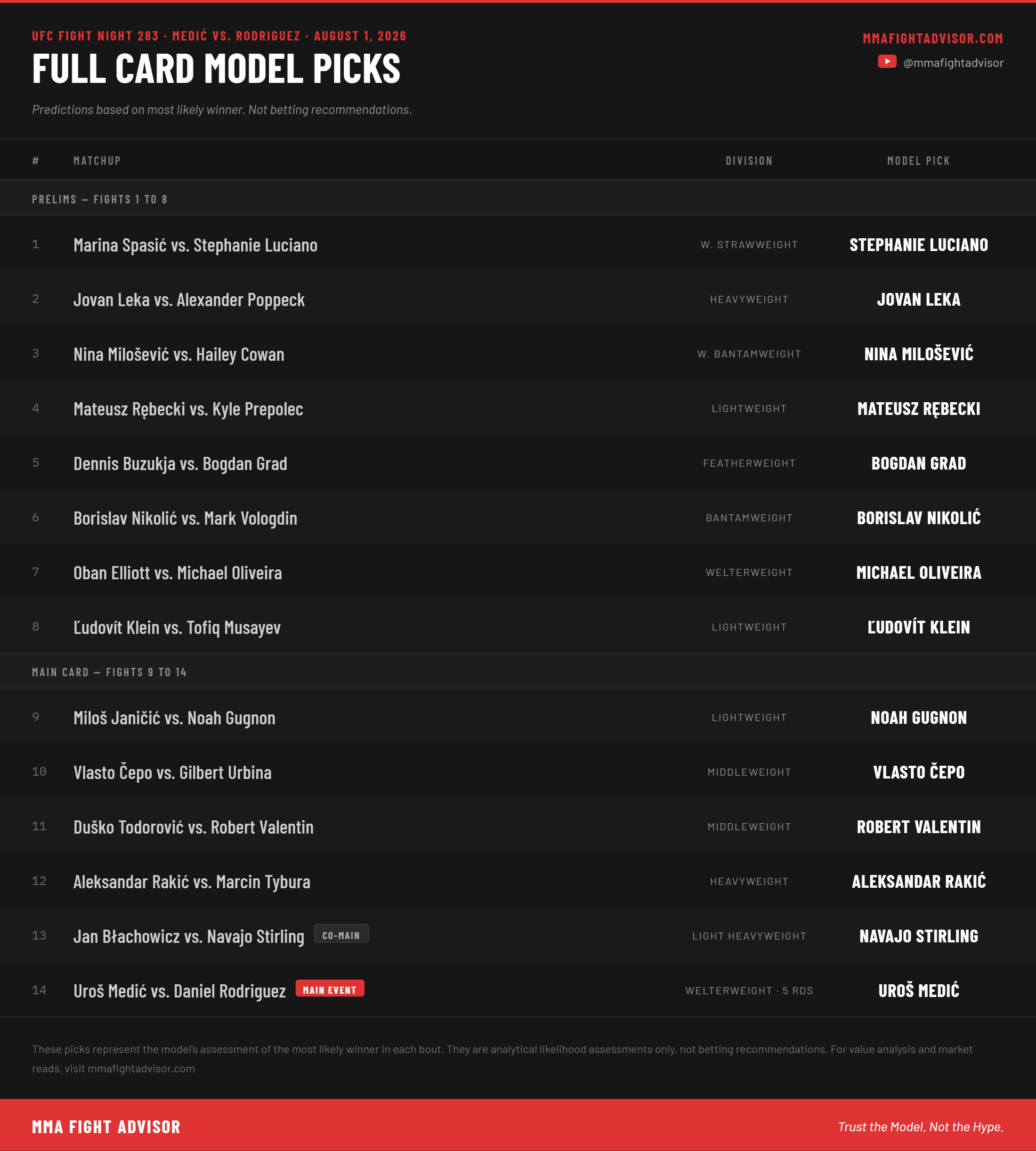
Prelims
Marina Spasić vs. Stephanie Luciano
Women's Strawweight
Spasić becomes the second Serbian woman on the UFC roster, following Nina Milošević onto it on the same night, and she opens the first card ever held in her country. She arrives 7-1 out of Car Dušan Silni in Belgrade, and beyond that the documentation thins out fast.
Luciano is the more complete fighter on anything that can be measured. She lands well over five significant strikes a minute while absorbing barely three, defends nearly two thirds of what comes at her, and converts better than seven in ten of her takedown attempts. Those are strong numbers across both phases, though they rest on only three Octagon appearances and should be held with that in mind. She is coming off a third-round rear-naked choke last October.
The debut factor and the crowd cut against her, and this is not a comfortable read. The model lands on Luciano.
Jovan Leka vs. Alexander Poppeck
Heavyweight
Two debutants, and a division only one of them belongs to.
Leka is 24, Serbian, and 13-2 on a six-fight winning streak with four stoppages inside it. He fought at heavyweight on Contender Series last year, won a decision, and was passed over for a contract. He finished two more men before the UFC came back around.
Poppeck is the more accomplished fighter on paper and the one carrying every disadvantage. He is 21-5 with thirteen wins by knockout and has been unbeaten since 2023, including a unanimous decision over former two-division KSW champion Tomasz Narkun in April in a hostile Polish arena. That is the best single win either man owns. But he took this on ten days notice, he is 34, and he is moving up a full division from light heavyweight to do it.
Size, timing and a home crowd all point one direction. Leka gets the nod.
Nina Milošević vs. Hailey Cowan
Women's Bantamweight
Milošević is Serbian-Swedish, fights out of Sydney under Renato Subotic, and is the first woman from Serbia to reach the promotion. She is 8-1 with eight consecutive wins, five of them finishes and four of those in the opening round. She is also a multiple-time IMMAF amateur world champion, which is a meaningful marker of pedigree even before the professional record.
Cowan is 0-3 in the UFC and her profile contains a specific problem. She defends four takedowns in five, which is genuinely good, but she stops only two in five strikes thrown at her, which is not. She has been finished in her last two, by choke and by knee.
A fighter who finishes early meeting a fighter who cannot avoid being hit is not a complicated read. The model sides with Milošević, and this is among the firmer calls on the card.
Mateusz Rębecki vs. Kyle Prepolec
Lightweight
Rębecki has lost three straight and is 1-4 across his last five, which makes him look worse than the matchup does. He is still a pressure wrestler who averages better than three takedowns a fight at close to fifty percent accuracy, and his striking rates remain workable across a sample of eight Octagon fights that is large enough to trust.
Prepolec is 0-4 in the UFC across appearances spanning seven years, with more than five and a half years between his 2019 losses and his return last May. He connects on barely a third of what he throws, the worst accuracy figure on the card, while absorbing well over five strikes a minute. He has not attempted a single takedown in four Octagon fights.
The one caution is that Rębecki turns around in under three months after being submitted in the third round at UFC 328, and short returns from stoppage losses deserve a second look. It is not enough to move the read. Rębecki is the call.
Dennis Buzukja vs. Bogdan Grad
Featherweight
Buzukja is 1-4 in the UFC, Grad is 1-2, and both are on losing streaks. Both also absorb more strikes than they land, which is unusual to see on both sides of the same fight and explains why three of their eight combined appearances ended in knockout losses.
Grad is the more distinctive of the two. He averages better than four takedowns per fifteen minutes, one of the highest rates anywhere on this card, and he pursues them aggressively. Buzukja defends three in four, so the collision is direct, and both figures rest on small samples.
The tiebreaker is recovery. Buzukja was knocked out in eighty seconds in April and returns fourteen weeks later. Grad, narrowly.
Borislav Nikolić vs. Mark Vologdin
Bantamweight
Nikolić is the Brave CF bantamweight champion, 16-2 with fifteen of those wins by stoppage and six consecutive finishes coming in, split close to evenly between knockouts and submissions. He signed and stepped in on roughly one week's notice, and he makes his debut at home.
Vologdin has one Octagon appearance, a majority draw with John Castañeda in April, and he is a genuinely unusual physical proposition at five foot three. He is 12-4-2 with six knockouts, four submissions and six first-round finishes, and he has been stopped exactly once in his entire career. He also lost his Contender Series bout by decision and was handed a contract regardless, which says something about how he fights.
One week of preparation against a man who has been finished once in eighteen professional fights is a real concern, and the model does not love this. The model lands on Nikolić.
Oban Elliott vs. Michael Oliveira
Welterweight
Oliveira is 9-0 with eight knockouts, went 6-0 through LFA, and won his contract with a second-round stoppage on Contender Series. He has never fought in the UFC, so the striking figures attached to his name derive from that single appearance and are not treated as a career average here. He also carries a six-inch reach advantage.
Elliott is the proven side and the trend is unhelpful. He is 3-2 with both losses coming in his last two, and his last win came in November 2024, more than twenty months before fight night. His defensive numbers remain the best thing about him, and he is hit barely twice a minute, which is a legitimate asset against a knockout artist.
Eight finishes in nine professional wins is a hard pattern to argue with, and the model backs Oliveira to add a ninth.
Ľudovít Klein vs. Tofiq Musayev
Lightweight
Klein is the most accomplished fighter on these prelims by a clear margin at 8-3-1 in the Octagon, and he wins by controlling range across three rounds rather than by hunting finishes. He carries no submission average across twelve fights and six of his eight wins came on the cards. He also defends better than three quarters of takedowns, which matters, because taking him down is essentially Musayev's whole plan.
Musayev is a former Rizin lightweight grand prix winner but has only two Octagon fights, so his rate statistics are close to unusable. He was submitted in the opening round on his debut and rebounded with a decision over Ignacio Bahamondes in March. Klein beat Bahamondes by unanimous decision in 2023, which is the cleanest common opponent on the card.
Klein also holds a meaningful reach advantage and is five years younger. Klein takes this on the cards.
Main Card
Miloš Janičić vs. Noah Gugnon
Lightweight
Janičić becomes the first fighter from Montenegro ever to compete in the UFC, and he earned it in emphatic fashion, finishing longtime Octagon veteran Alex Oliveira in under two minutes to headline FNC 26 last December. He is 19-3 on an eight-fight winning streak that has not once reached the judges since 2020, and he is 4-1 across boxing, kickboxing and dirty-boxing rulesets on top of it.
Gugnon is 25, 9-2, and on a five-fight run in which every win came inside the distance, splitting roughly two knockouts for every submission. His last three came under Ares FC against opponents holding a combined 19-3.
This is the thinnest read on the card and it deserves to be labelled as such. Two debutants, no Octagon data on either side, and regional records that cannot be directly compared. The model comes down on Gugnon, and it comes down barely.
Vlasto Čepo vs. Gilbert Urbina
Middleweight
Čepo has no UFC record, so this case cannot be built on rate statistics and is not going to pretend otherwise. It is built on the shape of the record instead, and the shape is unusual. Fourteen professional wins, fourteen finishes. Not one has reached a judge. He has spent four years under the Oktagon MMA banner and arrives on a two-fight streak, the most recent a first-round stoppage last October.
Urbina is the known quantity and what is known is not encouraging. He is 1-3 in the UFC with three stoppage losses in four appearances, and his single victory came in May 2023. His most recent outing was the sixty-three second knockout he absorbed from the man headlining this card. His striking output is respectable, but he is hit almost as often as he lands and he has not stopped a takedown in the Octagon.
A perfect finishing rate against a fighter who has been finished three times in four is about as clean a mismatch as this card offers. Čepo is the call, and it is the firmest one on the card.
Duško Todorović vs. Robert Valentin
Middleweight
This is where the model turns against the home fighter, and it does so narrowly.
Todorović is Serbian, fights in Belgrade, and arrives on his first win in two years after a first-round rear-naked choke of José Daniel Medina last September. He is a pressure fighter with real stopping power, and all four of his Octagon wins came by finish. He has never won a decision in the UFC.
He has also been knocked out four times in six Octagon losses, and he defends fewer than half the takedowns thrown at him. That second number is the one that matters, because Valentin is not trying to win exchanges. The Swiss fighter lands barely more than one significant strike a minute, close to the lowest figure on the roster, while carrying a submission average approaching two. He is looking for a neck, and when he finds one it works. His lone Octagon win came by first-round submission in April.
Valentin is 1-3 and his four-fight sample makes every rate around him unstable. This is not a confident read. But pressure walking into a submission specialist with soft takedown defence is a specific and recurring way to lose a fight, and the model favours Valentin.
Aleksandar Rakić vs. Marcin Tybura
Heavyweight
The story everyone will tell about this fight is that neither man has won in a long time, and that is true. It is also not the fight.
Rakić defends more than four in five takedowns, the single best defensive figure in this bout and one of the best on the card. Tybura's only reliable route to victory is the takedown, and he converts barely a third of what he attempts. That collision is the whole contest. If Tybura cannot get him down, this becomes a striking match between two men whose output, accuracy and defensive rates are nearly identical, with identical reach on top of it, and Rakić is the busier and more accurate of the two.
Tybura is 40 years old, 1-3 across his last four, and has been stopped by strikes five times across twenty-four Octagon appearances. He was knocked out in the first round by Ante Delija last September and outpointed by Tyrell Fortune in March.
The flags on Rakić are real and worth stating. He has lost four straight, he has been stopped three times, and he is moving up a full division for the first time. But the specific matchup is favourable and the model is not close to neutral on it. Rakić gets the call.
Jan Błachowicz vs. Navajo Stirling
Light Heavyweight
Błachowicz has not won a fight in more than four years. His last victory came in May 2022 against Aleksandar Rakić, who fights one bout earlier on this same card, and since then he has gone winless in four with two draws and two decision losses. He turned 43 in February.
What has never stopped being true is that he is extraordinarily difficult to finish. Across twenty-two Octagon appearances he has been stopped by strikes exactly once, by Thiago Santos in 2019. In December he was badly hurt in the second round against Bogdan Guskov and rallied to take the third. That is the entire late-career profile: he does not win much anymore, but he does not break.
Stirling is 10-0, 5-0 in the UFC, and lands close to twice as many strikes a minute as Błachowicz while absorbing fewer. That is the widest statistical separation on the main card. His last two both ended by ground strikes in the second round against opponents who had to be worn down first, which is precisely the shape this fight would need to take.
The caution is the turnaround. Stirling fought on June 20 and fights again six weeks later, which is quick for a ranked main-card assignment, and five Octagon fights is a modest sample for one. Stirling is the call, though anyone expecting a stoppage should remember only one man has ever managed it.
Uroš Medić vs. Daniel Rodriguez
Welterweight — Main Event
Medić has never had a professional fight reach the scorecards. Not once, anywhere. Ten Octagon appearances, seven wins all by knockout, three losses all by stoppage, and no decision in either direction. His last three all ended in the first round, two of them at exactly sixty-three seconds.
That is the most striking number on this card and it defines the matchup, because Rodriguez's entire method is the opposite. He is a volume welterweight who wins by occupying the pocket, outworking opponents across fifteen minutes, and absorbing what that costs him. He lands more per minute than Medić does. He also takes more than five significant strikes a minute in return, and against a man with a perfect finishing rate that price stops being survivable in the way it was against Kevin Holland and Alex Morono.
Both are southpaws, which removes the lead-hand battle that usually shapes a welterweight main event and pushes everything onto the rear hand. That is exactly where Medić ends fights.
Rodriguez has the tools to make it awkward. He carries a three-inch reach advantage at identical height, he has been stopped by strikes only once in fourteen Octagon fights, and he trains at 10th Planet Jiu Jitsu, which matters because two of Medić's three UFC losses came by submission and his takedown defence is soft for a ranked welterweight. The complication is that Rodriguez almost never wrestles. He averages barely half a takedown per fifteen minutes and his submission rate across fourteen fights is close to zero. The threat lives on paper more than on tape.
Then there is everything outside the cage. Rodriguez is 39. He has not fought in more than a year, and eight months of that were spent in a Mexican prison after being detained at a Tijuana border check last July with less than an ounce of marijuana in his vehicle. He has described training in a cell and living on tortillas, rice and thin soups. He has had roughly three and a half months of proper preparation since his release in April, and he takes his first career main event in a hostile arena.
Neither man has fought five rounds in the UFC. Medić's longest Octagon fight lasted about twelve and a half minutes. Rodriguez has gone the full fifteen eight times, so if this becomes a marathon it favours him considerably. The problem is getting there. Everything in Medić's record says the fight will be decided long before the championship rounds arrive, and the model reads it the same way. Medić, at home, early.
Summary
The model backs the home side in six of the nine bouts featuring a regional fighter, which is roughly what you would expect on a card built to launch a market. The three exceptions are where the analytical work actually lives: Valentin over Todorović on a submission threat against soft takedown defence, Luciano over Spasić on the only measurable profile in the fight, and Gugnon over Janičić in a bout so thin that either name would have been defensible.
The strongest reads sit in the middle of the card rather than at the top. Čepo, Oliveira, Milošević and Rakić are all cases where a clear stylistic mismatch lines up with a clear record shape, and none of them headline anything.
The top two bouts are the most interesting and the least comfortable. Rakić and Błachowicz have gone a combined nine and a half years without a victory between them, and they fight back to back, one immediately after the other, having last won meaningful fights against each other. Above them sits a headliner who has never seen a judge's scorecard in his life, against a man who has seen eight of them and just spent eight months somewhere no fighter should have to train.
Belgrade is going to be loud. On the model's reading, it will mostly be loud for the right reasons.
For more, head to mmafightadvisor.com.