September 3, 2026
UFC Paris: Full Card Analysis, Hooker vs. Parnasse
Fourteen bouts at Accor Arena, seven promotional debutants, and a ranked veteran standing in front of a French headliner making his UFC debut. Here is the model's read on every fight on the card.
The Octagon returns to Accor Arena on Saturday for the fifth straight September, and this card is built differently from the four that came before it. Seven of the twenty eight fighters have never competed in the UFC. Three of the eight prelims put a debutant against another debutant or against a man with a single appearance to his name. The promotion has stacked the building with French talent and then handed the main event to a New Zealander whose job is to stand in the doorway.
That is the shape of the night. Salahdine Parnasse arrives as a two division KSW champion and one of the more closely watched free agent signings of the year, and the UFC has given him a headline slot in his home city against Dan Hooker, who has lost his last two and has been openly cast as the obstacle rather than the attraction. Underneath it, Farès Ziam and Axel Sola fight each other in an all French lightweight bout, Michael Page returns to middleweight, and Nathaniel Wood gets a replacement opponent who accepted on five days' notice.
Depth varies enormously across this card. Some of these fighters have fifteen or more UFC appearances behind them and a settled statistical profile. Others have none at all, and where that is the case the read is built from record, method, and reporting rather than from figures that do not exist. All rate figures below are recomputed from UFC bouts only.
Here is how the model reads all fourteen, first fight to last.
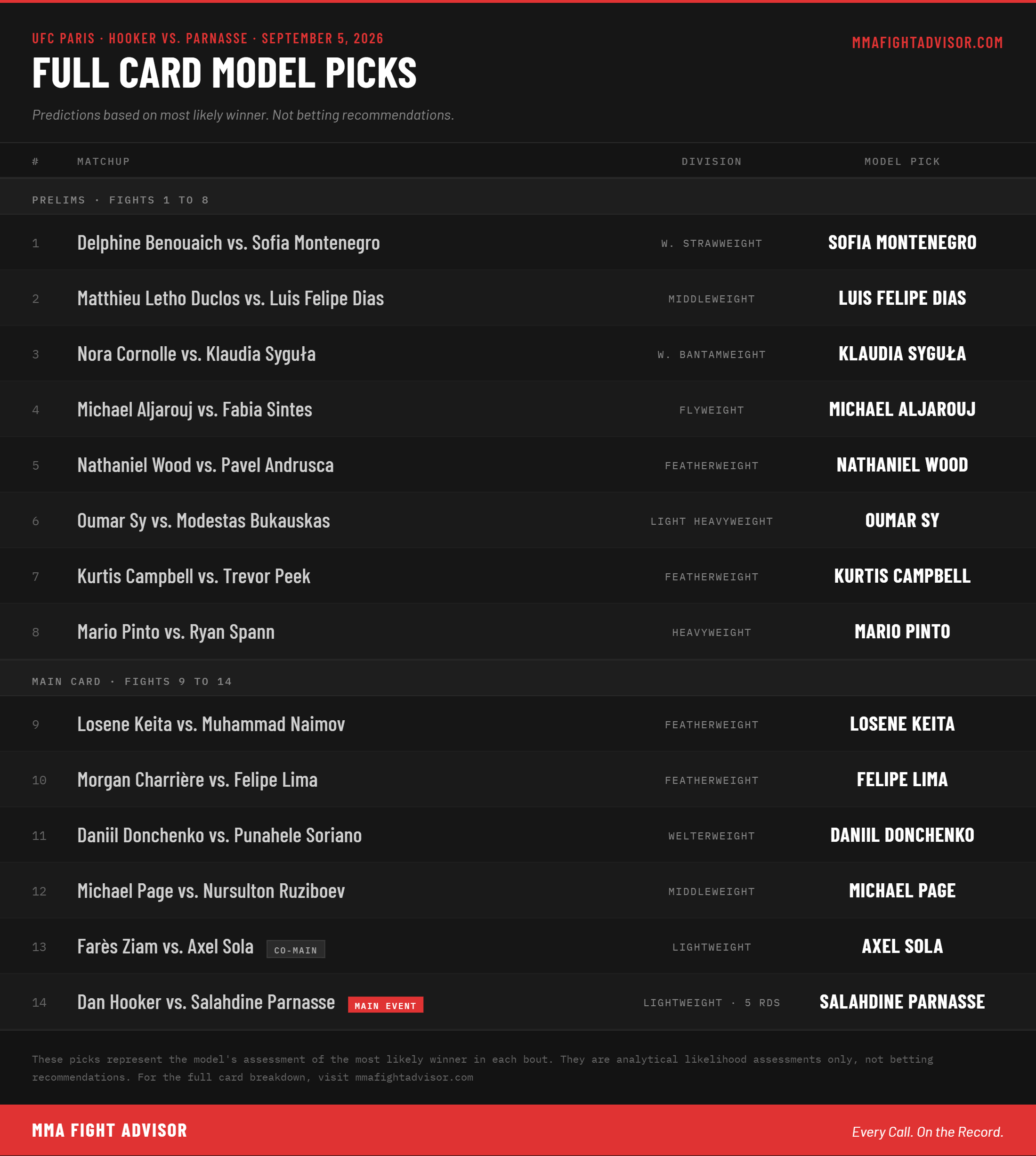
Prelims
Delphine Benouaich vs. Sofia Montenegro
Women's Strawweight
Two debutants open the card, and neither has a single second of UFC data behind her. Benouaich fights at home at 31, carrying a 7-2 professional record and a run to the semifinals of The Ultimate Fighter. Montenegro is 27, comes in at 6-2, and arrives from Argentina by an unusual route, having lost a split decision on the Contender Series last season and being signed anyway.
That last detail is the one worth sitting with. The promotion watched Montenegro lose and offered her a contract regardless, which is not something it does often. Whatever the matchmakers saw was enough to override the result.
Everything else here is projection. Neither woman has faced this level of opposition, neither has fought in a building like this one, and the crowd belongs entirely to Benouaich. Home advantage cuts both ways for a debutant, and there is no way to know in advance which way it cuts for her.
On balance, the model sides with Sofia Montenegro.
Matthieu Letho Duclos vs. Luis Felipe Dias
Middleweight
Duclos is another French debutant with a story behind the booking. He lost his Contender Series appearance in Season 7, won four straight afterward, and earned the call the long way round. He is 31 and 6-3 as a professional.
Dias has been to the Octagon once, in Macau in May, where he stopped YiSak Lee in the first round. One bout is not enough to build a statistical profile from, so his numbers stay out of this, but the result itself is a fact and it is a violent one. He is 18-5 as a professional, which is a considerably deeper career than his opponent's.
Physically the bout favors Duclos, who is five inches taller and holds a three inch reach advantage. That is a meaningful physical gap in a middleweight fight and it is the strongest argument in the debutant's favor. The counter is experience, both in professional bouts and in the specific experience of having already walked out under these lights once and finished someone.
The model backs Luis Felipe Dias.
Nora Cornolle vs. Klaudia Syguła
Women's Bantamweight
Cornolle is 36 and has split her six UFC appearances evenly, three wins and three losses, with the losses coming more recently. She lands 2.73 significant strikes per minute against 2.04 absorbed at 55.1 percent accuracy, which is a competent striking profile. The problem is underneath it. She concedes 472.6 seconds of control per fifteen minutes and defends takedowns at 47.6 percent across twenty one attempts faced. Opponents who want to put her on the mat have generally been able to.
Syguła is 27, has three UFC bouts, and fights at far higher volume, landing 7.27 per minute and absorbing 5.50. Both her wins came on the scorecards and her one loss came by knockout. Three appearances is a thin sample and these figures should be read with that in mind, but the shape is consistent: she throws a great deal and she wears some of it coming back.
Neither woman converts takedowns with any regularity, Cornolle at 11.1 percent across nine attempts and Syguła at 12.5 percent across eight. That points toward a striking contest by default rather than by preference. Syguła holds two inches of reach and an inch of height.
The model favors Klaudia Syguła.
Michael Aljarouj vs. Fabia Sintes
Flyweight
Both men debut, so there are no UFC figures on either side and no stored physicals to compare. What exists is regional record and reputation.
Aljarouj is 29, fights out of the Paris suburbs, holds a 13-3 record and comes in on an extended unbeaten run. He built his name on stoppages and on a Hexagone MMA title. Sintes is 32, holds an 11-3 record, comes from Menorca, and arrives as the WOW FC flyweight champion with seven straight wins and two title defences behind him. He was signed without going through the Contender Series, which the promotion does not do for everybody.
The honest read is that there is no data here to analyze. What tilts it is activity and recency. Sintes has been busy and winning titles. Aljarouj has the building and the momentum of a long unbeaten stretch, but he has been out of action for a considerable stretch by regional standards.
The model lands on Michael Aljarouj.
Nathaniel Wood vs. Pavel Andrusca
Featherweight
This is a sharp stylistic collision, and it exists only because Mairon Santos withdrew with illness and Andrusca took the fight on five days' notice.
Wood is a known quantity across fourteen UFC appearances. He is 11-3 in the promotion and the method split tells the story better than any single figure: eight of those eleven wins came on the scorecards, three came by submission, and none came by knockout. He lands 5.64 significant strikes per minute against 4.25 absorbed at 51.1 percent accuracy, and his average fight lasts thirteen and a half minutes. He is usually still there in the third round, still throwing. He converts takedowns at 48.6 percent across thirty five attempts and defends at 73.3 percent across forty five faced, which is a genuine two way grappling record rather than a one way one. He has five knockdowns in fourteen bouts and has never turned one into a finish.
Andrusca is the exact inverse and entirely unmeasured at this level. He is 24, undefeated at 8-0, and has finished seven of those eight. Six came by knockout and five came inside the first round. He won his professional debut on the scorecards in 2021 and has not been to the judges since. He took the Vendetta Fight Nights bantamweight title in 2024, defended it twice, then knocked out both of his UAE Warriors opponents in the opening round.
Two things work against him. He has spent his entire career at bantamweight and is moving up a division. And he has had under a week to prepare for a fighter who has been stopped by strikes once in fourteen appearances, six years ago at bantamweight, and who drags opponents into deep water as a matter of habit. Short notice is a real factor and it belongs in the read rather than being waved away.
The model stays with Nathaniel Wood.
Oumar Sy vs. Modestas Bukauskas
Light Heavyweight
Sy is long, controlling, and hard to hit. Across five UFC bouts he lands 3.41 significant strikes per minute against 1.87 absorbed and defends at 66.8 percent, and he holds 305.1 seconds of control per fifteen minutes against 55.7 conceded. He also brings a seven inch reach advantage into this bout at 83 inches against 76, which is a substantial gap in any division.
Bukauskas is the deeper and more worn sample. Thirteen UFC appearances, 8-5, and four of those five losses came by knockout against a striking defense of 50.5 percent. He lands 3.14 and absorbs 3.86, a negative differential.
The figure that complicates the obvious path is Bukauskas defending takedowns at 82.1 percent across twenty eight attempts faced. If Sy cannot get him down, the control advantage that defines his profile becomes theoretical, and the fight turns into fifteen minutes of striking against a man who has absorbed a great deal and kept walking. Sy converts at 35.0 percent across twenty attempts, which is respectable but not overwhelming.
Reach and control against durability and experience. The model goes with Oumar Sy.
Kurtis Campbell vs. Trevor Peek
Featherweight
Both men need this one. Campbell is 24, 8-1 as a professional, and his entire UFC experience amounts to a knockout loss early in the second round in London in March. That is a single appearance and no career figures can be built from it.
Peek has five UFC bouts, all of them contested at lightweight, and this is his featherweight debut. He is 2-3 in the promotion, and three of his last four went to the scorecards as losses, including the two most recent. He has not competed since September 2024, which is a layoff of 728 days to Saturday.
His numbers underneath are the concern. He defends takedowns at 53.2 percent across forty seven attempts faced and concedes 5.08 takedowns per fifteen minutes along with 305.8 seconds of control. Those are deep sample figures and they describe a fighter who gets held down. He lands 4.08 per minute and absorbs 3.34 with a striking defense of 46.3 percent.
A weight class change, two years out of competition, and a defensive grappling profile that has not held up. Campbell holds two inches of reach and a seven year age advantage.
The model comes down on Kurtis Campbell.
Mario Pinto vs. Ryan Spann
Heavyweight
Reach and height are identical here at 79 inches and 77 inches, which strips away the physical questions and leaves style.
Pinto is 12-0 as a professional and 3-0 in the UFC, and his profile is not what the finishing reputation suggests. He holds 423.1 seconds of control per fifteen minutes against 31.2 conceded, throws at a low rate of 2.55 significant strikes per minute, and lands 66.7 percent of what he throws. He also attempts submissions at 1.01 per fifteen. That is a grappler who happens to punch hard, not a swinger. Three bouts is a thin sample and the figures carry that caveat.
Spann is 35 with sixteen UFC appearances and a 10-6 record built almost entirely on finishes in both directions: four knockout wins, four submission wins and two decisions, against three knockout losses, two submission losses and one decision. Nothing about his career suggests a fight that goes long, and his average bout lasts a little over six minutes. He absorbs 3.85 significant strikes per minute at 43.6 percent defense and has six knockdowns of his own. He is dangerous and he is hittable, and those have been true simultaneously for years.
Pinto's last outing went to a decision against a natural light heavyweight taking the fight on short notice, which cooled some of the enthusiasm around him. The underlying control numbers did not cool.
Mario Pinto gets the nod.
Main Card
Losene Keita vs. Muhammad Naimov
Featherweight
Keita has one UFC appearance, a split decision loss to Nathaniel Wood in March, and one bout is not a foundation for career figures. What sits outside the promotion is more useful: he is 16-2 as a professional and held titles in two divisions in Oktagon before signing. Almost none of that is measurable here, and the read on him is correspondingly thin.
Naimov has seven UFC bouts and a settled profile that is easier to describe. He is 5-2, lands 2.32 significant strikes per minute against 2.85 absorbed, and his accuracy of 40.5 percent and striking defense of 44.7 percent are both modest. He converts takedowns at 34.6 percent across twenty six attempts and defends at 73.5 percent across thirty four faced, which is his most solid number. He has gone 2-2 across his last four.
Keita was scheduled to make his debut in this same building last year and missed weight, which scrapped the bout entirely. He returns to the same arena for the same debut, a year later and a loss heavier. Keita carries two inches of reach at 72 inches against 70, while Naimov is two inches taller.
The model takes Losene Keita.
Morgan Charrière vs. Felipe Lima
Featherweight
Charrière is a finisher and there is no ambiguity about it. All three of his UFC wins came by knockout, none went to the scorecards, and he has three knockdowns across six appearances. He lands 4.02 significant strikes per minute and absorbs 4.51, which is the trade he accepts. His takedown defense of 83.3 percent across twelve attempts faced holds up better than his striking defense of 53.9 percent. He is 2-0 at Accor Arena with two stoppages, and he lost to Melquizael Costa in December.
Lima has three UFC bouts and a very different shape. He lands 2.86 per minute against 2.91 absorbed at 45.0 percent accuracy, attempts submissions at 0.73 per fifteen minutes, and has no knockdowns. He attempts takedowns at genuine volume, twenty two of them, converting 27.3 percent. His three fight sample means these figures should be read carefully.
One fact deserves stating plainly because most of the coverage of this bout does not mention it. Lima has not competed since June 2025, a layoff of 434 days to Saturday. He debuted on short notice by submitting Naimov, won a decision over Miles Johns, then dropped to bantamweight and lost to Payton Talbott. He is now returning to featherweight after more than a year away.
Against a home fighter who has stopped everyone he has beaten in this promotion, that is a great deal to overcome. The pick is Felipe Lima.
Daniil Donchenko vs. Punahele Soriano
Welterweight
Donchenko is 25, unbeaten at 3-0 in the UFC, and his three bout profile is unusual enough to be worth stating carefully. He lands 8.07 significant strikes per minute against 2.80 absorbed, at 62.3 percent accuracy, with four knockdowns in three appearances. Those are extreme numbers off a small sample and they will regress, but the direction is not ambiguous. He fights in the pocket, leads with elbows, and puts himself in range to do damage. He won the Ultimate Fighter welterweight tournament final last September and has not lost since arriving.
Soriano is 33, has eleven UFC appearances, and went 3-4 at middleweight before dropping to welterweight, where he has won four straight. He lands 4.60 per minute against 3.44 absorbed with six knockdowns, and his grappling is real: 48.1 percent takedown conversion across twenty seven attempts and 275.5 seconds of control per fifteen.
The vulnerability is on the same side of the ledger. Soriano defends takedowns at 48.8 percent across forty one attempts faced and concedes 2.96 takedowns per fifteen minutes, and his striking defense sits at 47.5 percent. Against a fighter throwing at Donchenko's rate and accuracy, that is a difficult combination to carry.
Soriano is the more complete fighter on paper and the more proven one. Donchenko is the more dangerous one right now. The model settles on Daniil Donchenko.
Michael Page vs. Nursulton Ruziboev
Middleweight
Page is the more legible of the two men here. All five of his UFC appearances have gone the full fifteen minutes. Every one. His average bout lasts exactly nine hundred seconds, he lands 2.15 significant strikes per minute against 1.57 absorbed at 56.5 percent accuracy, and he has landed zero knockdowns in the promotion. He does not get hit and he does not finish. At 39 he holds a three inch reach advantage here.
Ruziboev is the opposite in nearly every respect. Four of his five UFC wins came inside the distance, three by knockout and one by submission, and his average fight lasts a little over seven minutes. He converts takedowns at 80.0 percent, though only across five attempts, and he is two inches taller than Page.
The structural question is control. Page concedes 282.4 seconds per fifteen minutes against 55.0 exerted, and his takedown defense of 68.4 percent across nineteen attempts faced is adequate rather than strong. If Ruziboev can close and hold him, the elusiveness that defines Page's game stops mattering. Cutting the other way, Ruziboev's own takedown defense sits at 33.3 percent across nine faced, and his striking defense of 49.4 percent is well below Page's.
Fifteen minutes of range management against a man who wants five. The model points to Michael Page.
Farès Ziam vs. Axel Sola
Lightweight
Two French lightweights, one of whom leaves with his home record intact.
Ziam is the deeper sample and the more controlled fighter. Eleven UFC bouts, 8-3, six of his eight wins on the scorecards, and an average fight length of thirteen minutes and twelve seconds. He lands 2.68 significant strikes per minute against 1.58 absorbed and defends at 63.8 percent, a positive differential built on avoiding damage rather than on volume. He converts takedowns at 42.9 percent across forty two attempts, which is real grappling activity. He is 2-0 in Paris and his six fight run ended against Tom Nolan in June.
There is one figure in his profile that sits awkwardly against the rest. He concedes 303.4 seconds of control per fifteen minutes against 244.9 exerted. For a fighter whose identity is control, being controlled more than he controls is a genuine tension, not a rounding artifact.
Sola is 2-1 across three UFC appearances and trades far more freely, landing 4.50 per minute against 4.53 absorbed. He has one knockout and one submission in three bouts, holds an accuracy of 50.4 percent, and concedes only 60.4 seconds of control per fifteen. Three bouts is thin and these numbers carry that caveat. He submitted Ismael Bonfim in the first round in July and is turning around in forty two days, which is quick, and he fights southpaw against Ziam's orthodox stance.
Ziam holds an inch of reach and an inch of height. The model has Axel Sola.
Dan Hooker vs. Salahdine Parnasse
Lightweight
Five rounds, and the entire card has been built toward it.
Hooker has twenty four UFC appearances, which is a deep sample by any standard, and it says something specific. He lands 4.82 significant strikes per minute and absorbs 4.94. He is not a fighter who wins by avoiding damage. He wins by being long enough and durable enough to accumulate more than he gives away, and that arrangement has stopped holding. His striking defense of 49.1 percent is where the recent stoppages come from. Nine knockdowns landed against four knockout losses is a career summarized in one line.
What has held is his grappling defense. He turns away 77.1 percent of takedowns across one hundred and five attempts faced, which is the single most load bearing figure in this fight, and his control is close to neutral at 157.9 seconds exerted against 133.8 conceded. Seven of his fourteen UFC wins came by knockout. He is 36 and has lost his last two, to Arman Tsarukyan and Benoît Saint Denis.
Parnasse arrives with nothing measurable at this level. He is 28, 23-2 as a professional, held the KSW featherweight title twice and the lightweight title through a run of defences, and signed as a free agent after appearing on the MVP card in May. Every figure that would tell you how he fights sits outside the promotion, and no amount of regional dominance guarantees the transition.
The case for Hooker is that debutants pay a tax, that his takedown defense removes the most reliable path to beating a fighter of his experience, and that he has shared a cage with the division's best for a decade. The case for Parnasse is that Hooker is 36, has been stopped twice recently, and is fighting a younger man with better defensive habits in front of a crowd that will carry him.
Hooker has said openly that he had never heard of his opponent before the offer came. He knows what he is here for.
The model picks Salahdine Parnasse.
Summary
The debutants dominate this card numerically and the model does not treat them uniformly. It sides with the newcomers in Paris where the opposition is equally untested, and it stays with the established fighter where one exists and has a deep record behind him. Wood over Andrusca and Page over Ruziboev are experience calls. Parnasse over Hooker runs the other way, and it is the read the night turns on.
Three of the fourteen bouts feature a fighter with a single UFC appearance, and two more put debutants against each other on both sides. Those sections are shorter here for a reason. Where there is no data, saying so is more useful than inventing confidence.
The model keeps updating as new data comes in. The current read on this card is on Predictions, and the fighter by fighter breakdown is on Fighter Stats.