August 20, 2026
UFC Sacramento: Full Card Analysis, Hernandez vs. Rodrigues
Thirteen fights in Sacramento, four fighters with no Octagon record between them, and two of the firmest reads on the card sitting nowhere near the main event. Here is how the model sees all of it.
The UFC returns to Sacramento on Saturday for the first time in more than seven years, and the card it brings is split down the middle in a way that makes it harder to read than the matchmaking suggests.
The top half is built on experience. Anthony Hernandez, Gregory Rodrigues, Serghei Spivac, Roman Dolidze, and Nasrat Haqparast have close to seventy Octagon appearances between them. The bottom half is built on almost nothing. Four fighters on this card have never fought in the UFC at all, and one bout, Anthony Wint against Terrance Chatman, has no Octagon history on either side. Four more have a single appearance, and one of those lasted eighty seconds.
That creates an unusual shape. Most of what can be measured sits at the top of the card, and most of what has to be argued sits at the bottom. It also means the two firmest reads of the night are a main card opener and a preliminary bout, while the main event is one of the closest calls on the card.
Here is how the model reads all thirteen, first fight to last.
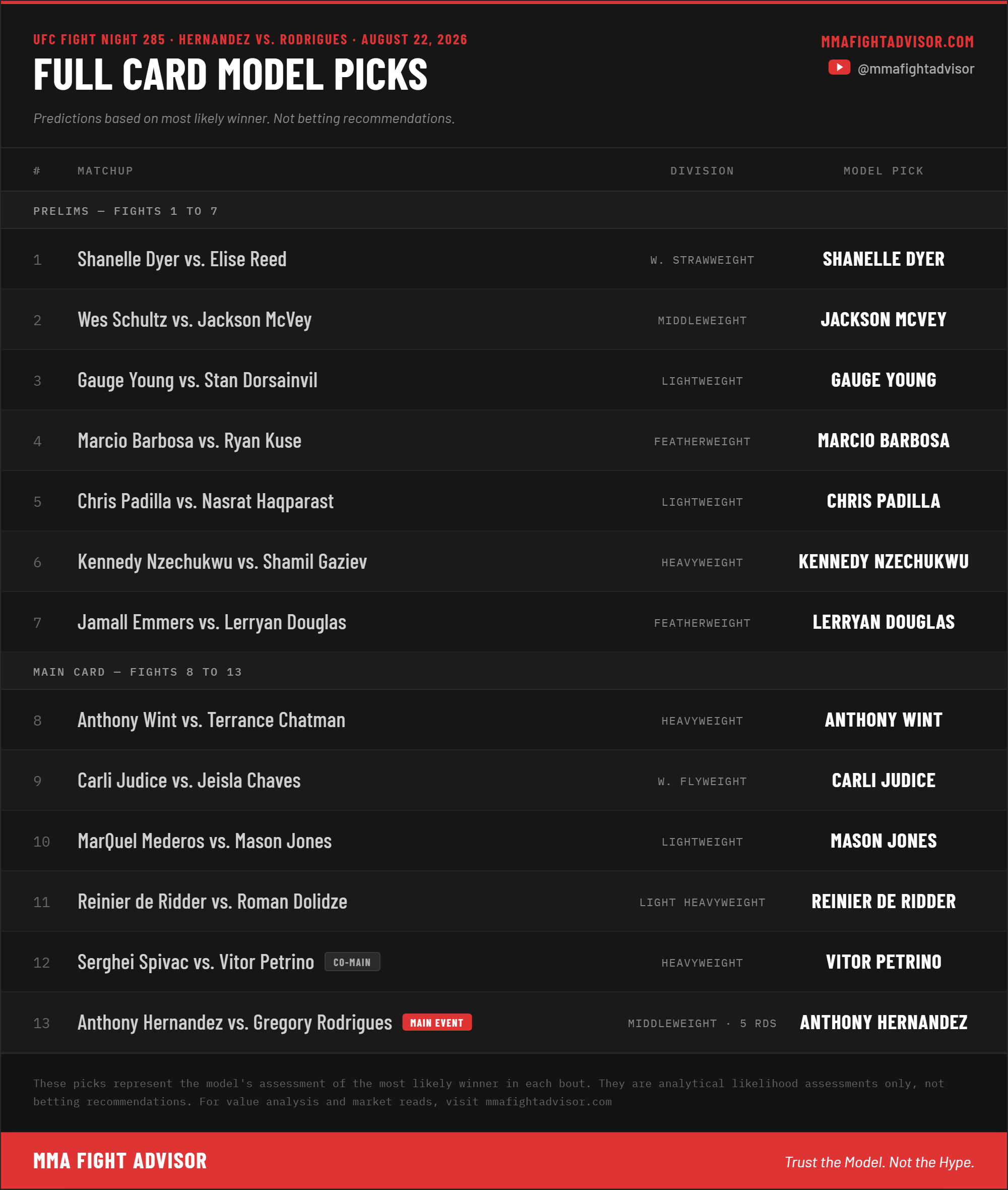
Prelims
Shanelle Dyer vs. Elise Reed
Women's Strawweight
Elise Reed has nine UFC fights and a pattern that has held across all of them. She has been controlled for roughly forty percent of her total cage time while exerting under nine, she concedes takedowns at a heavy clip, and she stops just over half of the ones attempted against her. Her four Octagon wins have all come by decision. Her five losses have not. Three ended by knockout, two by submission, and none of them reached the scorecards.
That is a specific vulnerability, and Shanelle Dyer arrives with the one thing that exploits it. Dyer has a single UFC appearance, a knockout of Ravena Oliveira in March, which is too thin to build a statistical case from. What is not thin is the shape of the mismatch. Reed has never lost a fight that went to the judges, and she has been out roughly fifteen months.
Dyer holds three inches of height and two of reach in a division that decides two thirds of its fights on the cards. The path here is not a long one, and the model takes Dyer.
Wes Schultz vs. Jackson McVey
Middleweight
Two fighters, five UFC appearances, and under thirty minutes of combined Octagon time. Every rate figure either man carries is drawn from a sample too small to mean much, so this comes down to what they have actually done.
What they have done is submit people, and get submitted. Schultz's only UFC win came by guillotine in the third round at Perth. McVey's only UFC win came by finishing Sedriques Dumas. Both of McVey's UFC losses came by submission. Every professional win McVey owns has ended inside the distance.
So the tactical question is narrow: whoever establishes the grip first is probably going to end this. McVey has three inches of height, fights southpaw against Schultz's orthodox, and has been the more active striker of the two by a wide margin in the little cage time available. Schultz has spent most of his Octagon minutes on the wrong end of position.
Middleweight submits roughly one fight in five, and both of these men are well above that line. The read is McVey.
Gauge Young vs. Stan Dorsainvil
Lightweight
Gauge Young has three UFC fights and all three went the full fifteen minutes. That is the most useful fact available about him. He lands seven significant strikes a minute against five absorbed, at just over fifty percent accuracy, and both of his Octagon wins came on the cards against Maheshate and Thiago Moises.
Stan Dorsainvil arrives undefeated at 5-0 with four finishes, three of them in the opening round, on six days notice after Kody Steele withdrew. He has never fought in the UFC, so there is nothing to measure.
The bout is a straight collision of shapes. Dorsainvil has ended nearly everything early and has not been asked to fight deep at this level. Young has never been in a fight that ended early and has never finished anyone in the Octagon. If the first round passes without a resolution, the arrangement tilts hard.
Young started his own UFC run as a late replacement and lost. He is on the other side of that now, and Young gets the call here.
Márcio Barbosa vs. Ryan Kuse
Featherweight
Barbosa has eighty seconds of UFC cage time. That is the entire sample, a first round knockout of Dennis Buzukja in April, and it is not enough to support a single rate figure about him.
What supports the read is everything before it. Barbosa is 18-2 with five consecutive first round finishes, and the debut fit the pattern exactly. Ryan Kuse comes in at 9-2 on short notice, replacing Danny Silva after Silva was hospitalized with a pulmonary embolism. Kuse has won his last two mixed martial arts appearances with a pair of Karate Combat bouts interleaved, and he has never fought in the UFC.
Featherweight sends more than half its fights to the judges. Nothing about this matchup suggests it joins them. Short notice against a finisher who has ended five straight in the opening round is a hard first assignment, and the model lands on Barbosa.
Chris Padilla vs. Nasrat Haqparast
Lightweight
The most interesting number in this fight is Padilla's, and it is a defensive one. Across five UFC appearances he has been controlled for barely one percent of his total cage time. Nobody has been able to hold him anywhere. He lands just over six significant strikes a minute at close to fifty percent accuracy, and he exerts control himself at a rate approaching twenty percent.
Haqparast is the more polished striker and the better defensive one, turning away sixty three percent of what comes at him against Padilla's forty nine. But he lands and absorbs at nearly the same rate, and he does essentially nothing on the mat, exerting under four percent control while conceding eleven.
That gap is the fight. Haqparast has spent nine years on the roster without often being made to answer a grappling question, and Padilla asks one in every fight. Haqparast turns thirty one on fight night, has not competed in ten months, and arrives off a knockout loss to Quillan Salkilld, only the second of his career.
Padilla is unbeaten in five UFC starts with wins over Jai Herbert and Ismael Bonfim, though the run stalled at a draw with MarQuel Mederos in April, a fight he also missed weight for. Eight of Haqparast's ten UFC wins have come on the cards. Padilla has finished three of his four. The call is Padilla.
Kennedy Nzechukwu vs. Shamil Gaziev
Heavyweight
This is the cleanest tactical split on the card. Nzechukwu is the striker, landing more than he absorbs where Gaziev does the reverse. Gaziev is the grappler, and emphatically so, controlling better than forty percent of his cage time while conceding almost none of it and turning away more than eighty percent of takedowns attempted on him.
So the fight is simple to state. Gaziev wins if he can put Nzechukwu on the mat and keep him there. Nzechukwu wins if he cannot.
Gaziev's control figures are as dominant as any on the card. The problem is that his last two fights ended before the grappling became relevant. Both were knockout losses. Before that he stopped Martin Buday on debut, then got rushed into a main event and retired on his stool after four rounds.
Nzechukwu carries five inches of reach and a southpaw stance, and his own record is a jagged thing: first round stoppages of Chris Barnett and Lukasz Brzeski, a heel hook loss to Valter Walker, and a draw with Marcus Buchecha in December. Six of his eight Octagon wins have come by knockout. Reach, power, and an opponent who has been stopped twice running is enough here, and the model sides with Nzechukwu.
Jamall Emmers vs. Lerryan Douglas
Featherweight
Douglas has 213 seconds in the Octagon, so nothing about him is measurable yet. Everything about him outside it is.
He has won six straight, every one by stoppage. He holds eight professional knockouts and seven first round finishes across a 14-5 record. He took the LFA interim featherweight title from Javier Reyes and unified it by stopping Elijah Johns. His contract came from a thirty six second knockout on the Contender Series. Then he debuted against Julian Erosa, a forty four fight veteran with nine UFC wins and finishes over Sean Woodson and Nate Landwehr, and dropped him repeatedly before ending it in under four minutes.
He is also a black belt in both jiu jitsu and Muay Thai and a Brazilian freestyle wrestling champion, which matters because the one thing nobody has tested at this level is his takedown defense. Nobody has attempted a takedown on him in the Octagon at all.
Emmers is exactly the fighter to test it. Across nine Octagon appearances he exerts control for close to a third of his cage time while conceding under five percent, lands better than half his takedowns, and stops four out of five aimed at him. He is the gatekeeper this division uses on climbers, and he has been good at it.
But he is thirty seven to Douglas's thirty one and has not fought since November. The fight is whether Emmers can make it wrestling before Douglas lands, and the model favors Douglas.
Main Card
Anthony Wint vs. Terrance Chatman
Heavyweight
Neither man has fought in the UFC, so there is no statistical basis here of any kind. There is, however, a story worth telling.
Wint knocked out Matt Adams in thirty four seconds on the Contender Series on August 11, asked for a booking on the spot, and got this one eleven days later. He becomes the first alumnus of the season to debut, two weeks into it. He is 7-0 with five knockouts, and before mixed martial arts he was a professional football player who spent time with the New York Jets.
Chatman comes in at 5-1 with four stoppage wins, most recently a first round finish by leg kicks in July, training out of 4oz. Fight Club in Houston.
The only real question is what eleven days does to a heavyweight who just competed. Wint took a short fight and ended it fast, which is the version of that turnaround least likely to cost him, but it remains a camp compressed into a week and a half in the division that punishes small margins most. Heavyweight ends over half its fights by knockout, and both of these men finish. Wint is the pick.
Carli Judice vs. Jeisla Chaves
Women's Flyweight
Judice throws more than anyone else on this card, landing close to nine significant strikes a minute against under five absorbed. That is a wide gap and it is the argument for her. The argument against her sits lower down: she exerts control for barely eight percent of her cage time, concedes twice that, and gives up takedowns at a real rate.
Chaves has one UFC fight, a split decision over Yuneisy Duben in June, which tells you she can compete for fifteen minutes without breaking but supports nothing beyond that. She is undefeated and arrived on a contract decision that drew argument, then won a debut that drew argument too. Two close fights, two nods her way.
There is a useful comparison available. Judice also beat Duben, and she did it by knockout.
Women's flyweight sends nearly two thirds of its fights to the judges and produces knockouts in roughly one in six. Judice has two knockouts among three Octagon wins, which puts her well outside what the division normally does. Chaves needs to make this a grappling fight, and that route is available. It is just narrower than the one in front of Judice, who gets the nod.
MarQuel Mederos vs. Mason Jones
Lightweight
Mederos is the more precise striker by a distance, landing close to fifty eight percent of what he throws against Jones at forty three. In a pure exchange he is the better technician and the more efficient one.
Everything below the neck runs the other way. Mederos exerts control for around eleven percent of his cage time and concedes better than twenty seven, giving up takedowns at a meaningful rate, and he attempts almost none himself. Jones exerts nearly thirty percent, concedes under twelve, and completes more than half of what he shoots. That is a wrestler aimed directly at a striker who has not yet shown he can stop one.
Jones also carries five inches of reach at identical height, which limits how easily Mederos can control range without engaging.
This is closer than the tactical read suggests. Mederos is unbeaten across ten straight overall, and his three Octagon wins have all come on the cards, so he knows how to stay in a fight he is not dominating. Jones has won seven consecutive dating back to the end of his first UFC stint, trains regularly at Team Alpha Male, and fights here as an adopted local closing out his contract. Lightweight decides close to half its fights on the scorecards, and the likeliest version of this is Jones taking rounds rather than finding a finish. The pick is Jones.
Reinier de Ridder vs. Roman Dolidze
Light Heavyweight
Two men arrive here on two fight losing runs, both leaving middleweight, and neither can afford a third.
It will be decided on the mat, because neither is going to outpoint the other standing. De Ridder lands under two and a half significant strikes a minute, Dolidze just over three, and both defend under fifty percent of what comes at them. Neither man has ever been an output fighter and neither is about to start.
What makes it live is that both takedown defense figures are poor. Dolidze stops under a third of the attempts against him. De Ridder stops around forty percent. Offense is favored on both sides, and whoever commits first is likely to get there.
De Ridder concedes close to a quarter of his cage time, which is the real risk in taking him. But he exerts more than a third, he holds two inches of height and reach, and he fights southpaw into an orthodox opponent. Eighteen of his twenty one professional wins have ended inside the distance and he is 8-1 across his light heavyweight career, having changed camps and said he is finished at 185. Dolidze has been submitted only once in the UFC, by Anthony Hernandez, who headlines this card. Against a man defending fewer than one takedown in three, the submission is the live path, and de Ridder gets the call.
Serghei Spivac vs. Vitor Petrino
Heavyweight
Two grapplers with nearly identical control profiles and different reasons for having them. Spivac and Petrino exert control at almost the same rate. The separation shows up defensively: Petrino concedes less and stops four out of five takedowns aimed at him, where Spivac stops closer to three in five.
Spivac is the more accomplished wrestler by volume and completes nearly sixty percent of his attempts. But he absorbs more significant strikes than he lands, and at heavyweight a negative striking differential is a standing invitation. Petrino lands more than he takes.
So the collision is Spivac's takedown accuracy against Petrino's takedown defense, and Petrino has been unusually hard to reach.
This one is close and worth saying so. Spivac debuted just before the UFC's last Sacramento card in 2019 and has hovered around the rankings since, with his win over Ante Delija his first in a year and a half. Petrino spent four years at light heavyweight, lost to Anthony Smith and Dustin Jacoby, moved up, and has gone 3-0 since. He has been handed a veteran gatekeeper twice before and neither went his way. Heavyweight ends more than half its fights by knockout, and neither of these men reflects that, so a long fight is the likelier shape. Petrino is where the model lands.
Anthony Hernandez vs. Gregory Rodrigues
Middleweight, five rounds
Hernandez fights in the places nobody wants to be. He lands better than sixty percent of his significant strike attempts, which is not the profile of a volume striker but of someone who only throws once he has already arrived somewhere hard to leave. From there it becomes grappling, and once it does it stays there. He controls better than half of his total UFC cage time and concedes barely a tenth of it.
Rodrigues is the cleaner striker and the more conventional threat, landing a full strike per minute more than Hernandez. And his best number is the one that matters most here: he turns away three quarters of the takedowns attempted against him, the strongest defensive figure in the fight.
That is the entire bout in miniature. Hernandez has to convert against the one thing Rodrigues is measurably good at stopping. If he does, the fight belongs to him. If Rodrigues stays vertical, he wins exchanges, and he does not need many.
Both men are more finish prone than middleweight generally, which sends nearly two in five fights to the judges. Hernandez has finished five of his nine Octagon wins by submission, well above what the division produces. Rodrigues has seven knockouts among his ten, also well above it. Five rounds gives the grappling more room to compound than the power, though power needs less room.
Hernandez fights in Sacramento for the first time, in his third consecutive main event, coming off the first real interruption of his career. Sean Strickland ended an eight fight run in February and then took the title, and Hernandez has been training with him since. Rodrigues has won three straight since Jared Cannonier stopped him in the fourth round of his own first headliner. Both know what a main event loss costs.
This is one of the closest reads on the card, and the case for Rodrigues is real. But control that dominant tends to decide long fights, and the model stays with Hernandez.
Summary
The card splits cleanly. Four bouts sit in heavyweight or light heavyweight, where the knockout is the most common ending, and two sit in women's divisions where the scorecards decide most fights. In between is a preliminary slate stacked with prospects whose Octagon record is measured in minutes.
The firmest reads of the night are not where the billing puts them. De Ridder against Dolidze and Douglas against Emmers are the two clearest calls on the card, and one of them sits in the middle of the main card while the other happens before it. The main event, the fight everyone is here for, is genuinely close.
The model keeps updating as new data comes in. The current read on this card is on Predictions.