August 27, 2026
UFC Shanghai: Full Card Analysis, Nurmagomedov vs. Song
Thirteen fights in Shanghai, eight fighters who have never set foot in the Octagon, and a main event where both men beat the same opponent inside eight months. Here is how the model reads all of it.
The UFC returns to Shanghai for the third time, and the card it brings is built out of two things that do not have much to do with each other. At the top sits a bantamweight main event with real consequence for the division. Underneath it sits a developmental undercard carrying almost no Octagon history at all.
Eight of the twenty-six fighters here have never fought in the UFC. Two bouts have no Octagon experience on either side. Three more fighters have exactly one appearance to their name, which is closer to a debut than to a record. Most of what can be measured on this card sits in the top half, and most of what has to be argued sits in the bottom.
The pipeline explains the shape. Two fighters arrive from Road to UFC, the promotion's Asia-Pacific feeder tournament. One earned his contract on the Contender Series eighteen days ago. Three more are replacements booked inside the last ten days. The rest are regional signings placed on a card in their own time zone.
Here is how the model reads all thirteen, first fight to last.
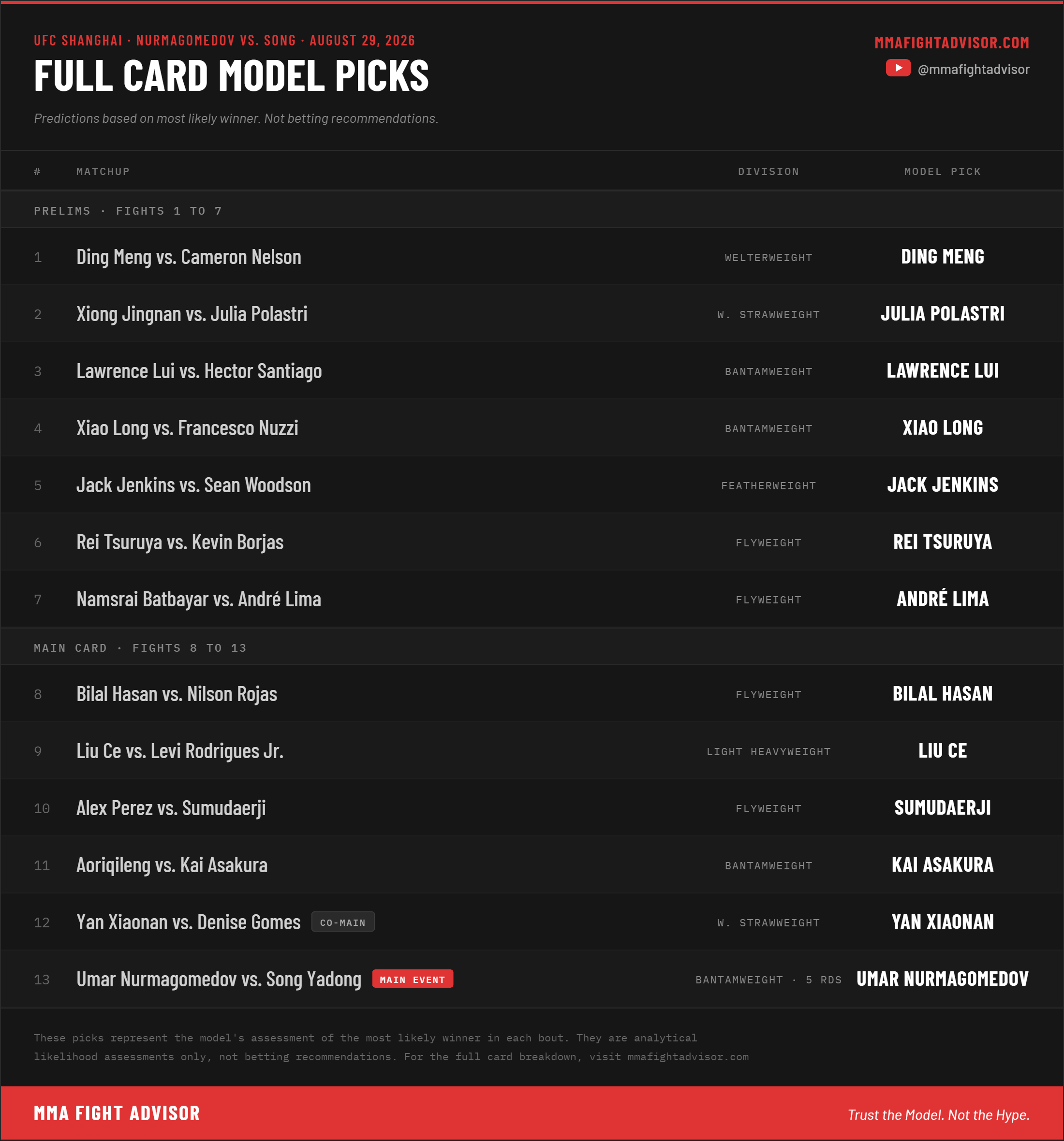
Prelims
Ding Meng vs. Cameron Nelson
Welterweight
Ding Meng has forty-five professional fights and one UFC appearance, and that gap is most of what there is to work with here. He is 35-10 as a professional, arrived through the Contender Series, and made his Octagon debut in Macau in May, dropping a split decision to Jose Souza in a bout where both men were debuting. Fifteen minutes is not enough to describe a fighter with that much behind him, and the figures from a single bout do not survive being treated as a career picture.
What is knowable is that Ding stands six foot two with a seventy-three inch reach, and that forty-five fights is a volume of experience almost nobody on this card can match at any level.
Cameron Nelson enters 7-1 on a five-fight winning streak, having taken the Fight League Atlantic welterweight title in June with a second-round finish. He is twenty-eight, out of Prince Edward Island, and this is his first UFC appearance.
This is a hard fight to read with confidence, and the case rests on experience against momentum rather than on anything measurable. The model goes with Ding Meng.
Xiong Jingnan vs. Julia Polastri
Women's Strawweight
Xiong Jingnan arrived in the UFC last May carrying a reputation built somewhere else. She is 19-3 as a professional and held a ONE Championship strawweight title, but her Octagon record is a single fifteen-minute decision loss to Angela Hill. One fight does not establish a rate, and the numbers from that night describe an evening rather than a fighter.
Julia Polastri has the sample. Five UFC bouts, seventy-three minutes of cage time, and a striking profile that holds up: 6.22 significant strikes landed per minute at fifty-eight percent accuracy, with fifty-eight percent defense. Her two wins split a knockout and a decision, and all three of her losses came on the scorecards. She beat Karolina Kowalkiewicz last October and lost to Talita Alencar in April.
The structural question is whether either woman drags this to the mat, and neither profile suggests it. Polastri controls twelve percent of cage time and concedes twenty-three. Xiong conceded fourteen percent in her one appearance. This reads like a striking match, and in a striking match the fighter with seventy-three minutes of Octagon evidence and the higher output has the clearer case. There is a ten-year age gap running in Polastri's favor as well.
Julia Polastri gets the call here.
Lawrence Lui vs. Hector Santiago
Bantamweight
Both men are making their UFC debuts, and neither has a single Octagon figure to build from.
Lawrence Lui comes in 8-1 having won the Road to UFC Season 4 bantamweight tournament, taking the final by split decision over Sulangrangbo on the UFC 325 card in Sydney after stopping Nghiem Van Y in the second round in Shanghai a year earlier. That tournament run is real experience, but it is not UFC experience, and the distinction matters for what can honestly be said about him. He is thirty, five foot seven, with a seventy-two inch reach.
Hector Santiago is 6-1 and thirty-three, and he is here on short notice as a replacement for Colby Thicknesse. This will be his third fight of the year and his first in the UFC. A late booking is a genuine analytical factor, not a footnote, and it cuts against him.
The read is Lawrence Lui, on tournament pedigree and a full camp against an opponent who has neither.
Xiao Long vs. Francesco Nuzzi
Bantamweight
Xiao Long is 1-3 in the UFC, and the record undersells him. All three losses came by decision, none of them lopsided, and his most recent was the strangest of them: against Cody Garbrandt in March he lost two points for a pair of low kicks landed within thirty seconds of each other and then lost 28-27 on all three scorecards. Without the deductions that is a different result.
The underlying numbers are respectable. He lands 4.99 significant strikes per minute against 4.14 absorbed, defends takedowns at eighty-eight percent across twenty-five attempts faced, and concedes only five percent of cage time. He has not been dominated in the Octagon. He has lost close rounds.
Francesco Nuzzi is thirty, debuting, and 11-2 as a professional out of Cage Warriors and the PFL. He took this on ten days notice. His most recent bout was itself waved off as a no contest after an accidental low blow, which makes two fighters in this matchup whose last outing was disrupted below the belt.
With no Octagon tape on Nuzzi and a short camp on his side, the model stays with Xiao Long.
Jack Jenkins vs. Sean Woodson
Featherweight
Sean Woodson is six foot two with a seventy-eight inch reach. Jack Jenkins is five foot seven with sixty-eight. Ten inches of reach and seven of height is the kind of gap that usually decides how a fight is fought before it starts.
Woodson has the tools to use it. He lands 5.84 significant strikes per minute, and his takedown defense reads eighty-seven percent across fifty-three attempts faced. That is not a small-sample figure. Fighters have tried to take him down for years and mostly failed.
Jenkins has to close that distance and has the profile to try. He lands at sixty percent accuracy, the better mark in the bout, attempts 1.57 takedowns per fifteen minutes at fifty-seven percent conversion, and controls twenty percent of cage time to Woodson's eight. Woodson absorbs 4.34 per minute and concedes seventeen percent control, so the openings exist even if they are hard to reach.
Both men have been away a long time. Woodson has not fought since UFC 314 in April 2025, where a four-fight winning streak and a seven-fight unbeaten run ended against Dan Ige. Jenkins last appeared in September, beating Ramon Taveres to get back into the win column. Both carry two losses, and in a symmetry worth noting, each man's pair came one by knockout and one by submission.
The reach argues one way and the accuracy and grappling argue the other. The model backs Jack Jenkins.
Rei Tsuruya vs. Kevin Borjas
Flyweight
Rei Tsuruya is twenty-four, 11-1 as a professional, and his only defeat came against Joshua Van, who has since become champion. He returned from a fourteen-month absence in May with a first-round submission. His UFC sample is three bouts and thirty-three minutes, which is thin, but what is in it is consistent: he attempts 3.60 takedowns per fifteen minutes and controls thirty-seven percent of cage time. His conversion rate is low at twenty-five percent across thirty-two attempts, and it has not mattered much, because the volume produces the position anyway.
Kevin Borjas is 0 for 11 on career UFC takedown attempts. He has never completed one. He lands 3.49 per minute and absorbs 5.74, and both of his losses came by knockout. What he does have is eighty-one percent takedown defense across twenty-one attempts faced, which is the figure that complicates the obvious read. Borjas has stopped better grapplers than his record suggests.
He also beat André Lima in June, two bouts further down this same card, which is a useful piece of context for both fights.
The volume of Tsuruya's entries against a fighter who wins exchanges but absorbs a lot is the argument, and the model favors Rei Tsuruya.
Namsrai Batbayar vs. André Lima
Flyweight
André Lima is 4-1 across sixty-six minutes in the Octagon, and the shape of his game is unusually clear for a fighter with five appearances. He lands 3.91 significant strikes per minute at fifty-five percent accuracy, controls twenty-four percent of cage time, and concedes six. His submission attempt rate of 1.14 per fifteen minutes is high, and one of his four wins came that way. Another came by disqualification, which is a real result and an unusual line on a record.
He lost his unbeaten record in June to Kevin Borjas, who fights on this card as well.
Namsrai Batbayar is twenty-five and makes his UFC debut on the back of a Road to UFC Season 4 run that included stoppages of Wataru Yamauchi and Agulali and a win over Yin Shuai in May. He is 10-1 as a professional. He holds a one-inch reach edge and gives up three inches of height, and none of his tournament work is Octagon work.
Debutants have beaten fighters with Lima's profile before, but the control differential is the widest structural gap in this matchup and it runs one way. André Lima gets the nod.
Main Card
Bilal Hasan vs. Nilson Rojas
Flyweight
Two undefeated fighters, both debuting, neither with a minute of Octagon time.
Bilal Hasan is 9-0 and twenty-five, and he earned his contract on the Contender Series on August 11. That is an eighteen-day turnaround into a UFC debut, which is fast by any standard, and he has spoken about the date falling on Michael Jackson's birthday as something he takes meaning from.
Nilson Rojas is 9-0 and twenty-seven, signed out of the Peruvian regional scene.
There is no Octagon data to compare, no measured reach differential, and no method history at this level for either man. What separates them, thinly, is that one of them has already been evaluated against UFC-adjacent competition in a UFC facility in front of the people who make these decisions, and came out with a contract. That is not much, and it is what there is.
The pick is Bilal Hasan.
Liu Ce vs. Levi Rodrigues Jr.
Light Heavyweight
Two fighters with almost no Octagon evidence between them, and a bout likely to look nothing like whatever anyone expects.
Liu Ce is twenty-nine and makes his UFC debut with a 3-1 professional record built on the regional circuit.
Levi Rodrigues Jr. has one Octagon appearance, a knockout loss to Felipe Franco at 1:40 of the second round on July 18. He returns forty-two days later, having stepped in for Junior Tafa, who withdrew injured. He is six foot even with a seventy-six inch reach.
A six-week turnaround after a knockout loss is a meaningful factor on its own, and it is arguably the most concrete thing in this matchup. Beyond that, both men's professional experience came against opposition that does not tell you much about how either handles this level.
The model sides with Liu Ce.
Alex Perez vs. Sumudaerji
Flyweight
They already fought this year, and it did not resolve. On May 30 in Macau the bout was waved off at 1:45 of the second round after an accidental groin strike left Perez unable to continue past the recovery period. It went into the books as a no contest, and everything that was building in it is still unsettled.
The stylistic terms are clean. Sumudaerji is the longer man by seven inches of reach and two of height, a southpaw against an orthodox fighter, and he is difficult to hit: 2.29 significant strikes absorbed per minute behind sixty-three percent defense. He lands 4.40 per minute himself at fifty percent accuracy. Five of his six UFC wins came by decision.
Perez is the grappler. He attempts 2.13 takedowns per fifteen minutes across thirty-three attempts at forty-five percent, controls twenty-seven percent of cage time, and concedes only ten. His submission attempt rate is 0.71 per fifteen, and this matters, because three of Sumudaerji's four UFC losses came by submission. That is the crack in an otherwise sturdy profile.
The complication is that Perez has the same crack. Three of his six losses also came by submission, and his fights do not last: his fifteen UFC bouts average just over seven minutes, with six of eight wins and five of six losses ending inside the distance. He is thirty-four to Sumudaerji's thirty.
Range and durability against grappling and finishing pressure. The model takes Sumudaerji.
Aoriqileng vs. Kai Asakura
Bantamweight
Aoriqileng has ten UFC bouts and a profile that explains four wins, five losses, and a no-decision without much interpretation needed. He lands 4.40 significant strikes per minute and absorbs 5.66. He wins exchanges and he loses them, and his fights average under ten minutes because of it. He was stopped by Cody Haddon in Macau in May.
Kai Asakura has three UFC appearances totalling nineteen minutes, which is a small enough sample that his rates should be read with that attached. What is in it is stark: two submission losses to open his UFC run, then a knockout win in May. He concedes 4.04 takedowns per fifteen minutes, which is a soft grappling profile by any measure.
That exposure is the case against him, and Aoriqileng attempts takedowns at forty-seven percent accuracy, so the tool exists. The case for him is that Aoriqileng's defense sits at forty-seven percent and he concedes thirty-two percent of cage time, which means the grappling threat runs in both directions and neither man is safe standing.
Aoriqileng is thirty-three with a lot of hard rounds behind him. Asakura is thirty-two and his knockout power is the most reliable thing in the fight.
The model lands on Kai Asakura.
Yan Xiaonan vs. Denise Gomes
Women's Strawweight
Yan Xiaonan has not fought since April 2025, which is a long time to be away at thirty-seven. What she brings back is 195 minutes of Octagon time across thirteen bouts, 4.69 significant strikes landed per minute, and sixty percent striking defense. Eight of her nine UFC wins came by decision. She wins by accumulating, and she has done it against better opposition than most of this card will see.
Denise Gomes is twenty-six and arrives on a four-fight winning streak with three of her six wins by knockout. She lands at fifty-one percent accuracy, better than Yan's forty-five, but her defense sits at forty-six percent against Yan's sixty, and that is the gap that decides most strawweight fights that go the distance.
The grappling picture is more interesting than either record suggests. Gomes exerts thirty percent control and Yan concedes twenty-nine, which means Gomes is likely to be the one initiating. But Gomes also concedes twenty-eight percent herself and gives up 2.54 takedowns per fifteen minutes, so the mat is not a refuge for her either. Yan attempts takedowns rarely, 0.84 per fifteen, though she converts them at seventy-three percent when she does.
The eleven-year age gap and the layoff both argue for Gomes. The defensive numbers and the volume argue for Yan, and so does the fact that a decision heavily favors her. That combination is what the model weighs, and it settles on Yan Xiaonan.
Umar Nurmagomedov vs. Song Yadong
Bantamweight
Both of these men beat Deiveson Figueiredo inside eight months of each other, Umar in January and Song in May. That is about where the similarity ends.
Umar Nurmagomedov controls thirty-nine percent of cage time and concedes under three. He attempts just over four takedowns per fifteen minutes across seventy-three career attempts at forty-seven percent conversion, and he absorbs 1.86 significant strikes per minute behind sixty-one percent defense. Those numbers describe a fighter who decides where a fight takes place and does not get hit while deciding it. He is 8-1 across nine UFC appearances and holds a two-inch reach advantage.
Song Yadong is the more experienced fighter by a wide margin: seventeen UFC bouts and 221 minutes of Octagon time against Umar's 127. He lands 4.34 significant strikes per minute to Umar's 3.86, and his five knockout wins are the most direct path to ending this. His takedown defense reads seventy-four percent across sixty-five attempts faced, which is well sampled and genuinely good.
The problem is that it has never faced this. Umar attempts 4.03 takedowns per fifteen minutes and Song concedes 1.15. Nobody has come at Song with this volume, and seventy-four percent defense against four entries a round is a different proposition than seventy-four percent against one. Song also absorbs 3.81 per minute behind fifty-five percent defense, both worse than Umar's marks.
Song knows exactly where the danger is. He built his camp in Georgia specifically to prepare for the wrestling, and he is the hometown fighter in a building that will be entirely behind him. He fought ninety-one days ago while Umar has been out 217, and over five rounds his experience advantage is real. If he survives the first two rounds without giving up meaningful position, the fight changes shape.
That is the live path, and it requires everything to go right. The model comes down on Umar Nurmagomedov.
Summary
The main event is the reason to be up early, and it is a genuine stylistic collision rather than a mismatch dressed as one. Below it, the card asks a different question, which is how much weight to put on fighters nobody has seen at this level. Eight of them debut on Saturday, and two bouts have no Octagon history on either side at all.
That means several of these reads are built on regional records, tournament runs, and short-notice bookings rather than on measured Octagon evidence. Where the data is thin, the confidence is thin with it, and the sections above reflect that rather than papering over it.
The model keeps updating as new data comes in. The current read on this card is on Predictions, and the fighter by fighter breakdown is on Fighter Stats.