August 6, 2026
UFC Vegas 120: Full Card Analysis, Gamrot vs. Salkilld
Twelve fights in Las Vegas, a retirement in the middle of the main card, and a lightweight main event where both arguments hold up.
Meta APEX on Saturday is a twelve fight card with one ranked bout at the top, another buried on the main card, and a lot of names unfamiliar to anyone who does not follow the sport closely.
What makes it interesting is what it keeps asking. Salkilld, Thainara, Ty Miller, Rosas, and Foro are all fighters being moved up. Gamrot, Ferreira, Quarantillo, Lemos, and Johns are all being asked whether they are still what they were. Nearly every bout is a version of that question, and the main event is the sharpest version of it.
Five fighters walk in with no UFC record at all, and one more has never won inside the Octagon. Darren Elkins retires after sixteen years in the middle of the main card.
Here is how the model reads all twelve, first fight to last.
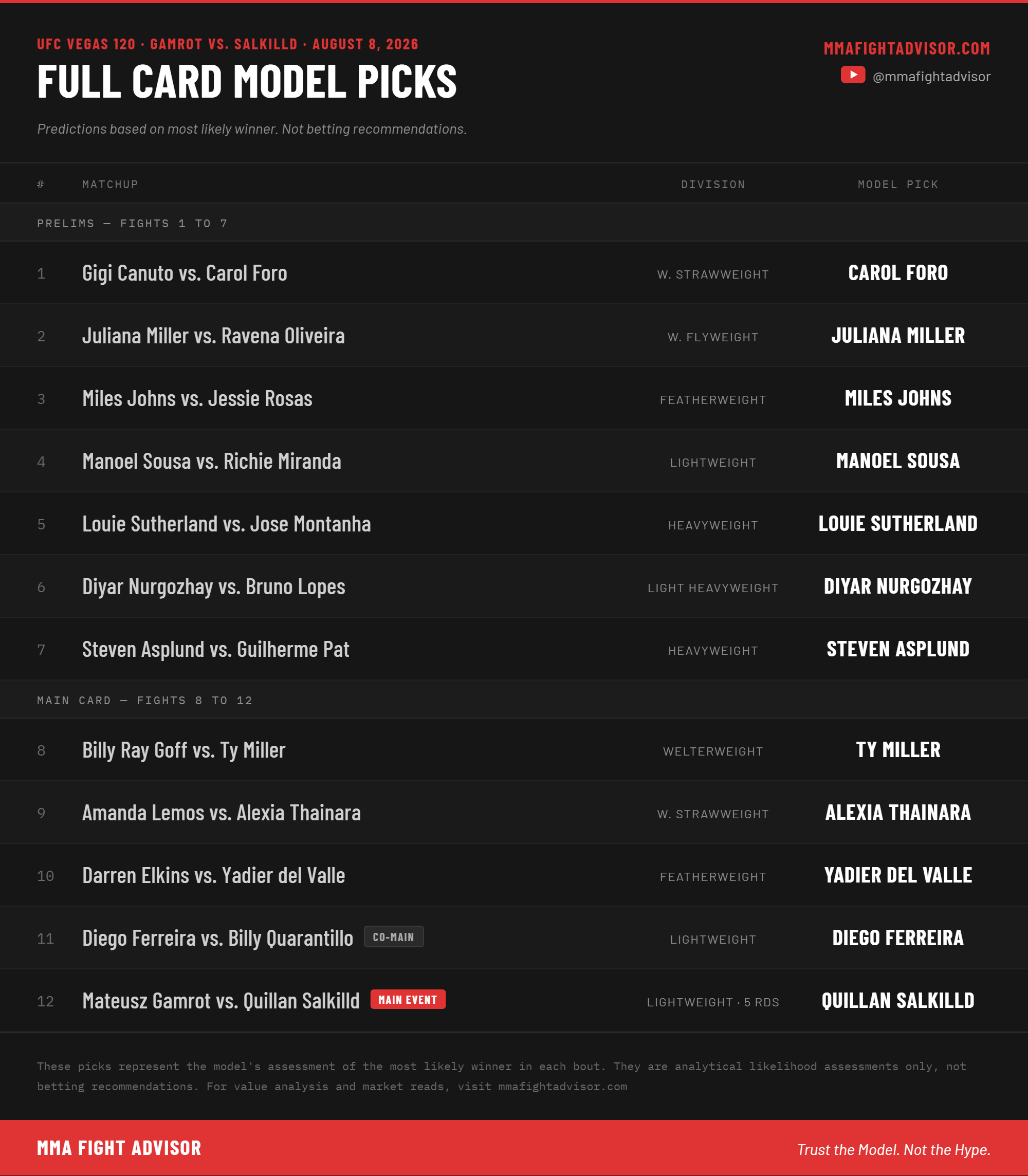
Prelims
Gigi Canuto vs. Carol Foro
Women's Strawweight
The last fight added to the card and the hardest to read, because neither woman has fought in the UFC and Canuto took the booking on four days' notice.
What exists is this. Canuto is 7-1 with six of her seven wins by stoppage, two of them first round submissions during her current three fight run. She came through The Ultimate Fighter as a grappler who has been openly working to stop being only a grappler, which is a useful thing to know about a fighter's self assessment even when it does not tell you what happens in the cage.
Foro is 9-1 and arrives the conventional way, with a Contender Series contract in hand after beating Shanelle Dyer. Her wins skew hard toward knockouts. She had a full camp. Canuto had four days.
There is no statistical case to make here in either direction, and pretending otherwise would be dishonest. What there is: a grappler on short notice against a striker who prepared, and a striker who was already the more accomplished of the two before the notice gap entered it. The model takes Foro.
Juliana Miller vs. Ravena Oliveira
Women's Flyweight
Two fighters who need this badly. Miller is 2-3 in the UFC and has not won since May of last year. Oliveira is 0-3 and has not won at all, with her three losses arriving three different ways, which is its own kind of information.
Miller's case is positional. She has controlled roughly 37 percent of her total Octagon time against 21 percent conceded, and that gap is essentially her whole game. She takes people down, she holds them there, and when she cannot, she loses. Oliveira defends 46 percent of takedowns, which is not a wall.
The uncomfortable part is that neither woman wins the striking exchanges. Miller lands 2.65 significant strikes per minute and absorbs 4.14. Oliveira lands 1.91 and absorbs 3.72. Both are net negative, which is unusual to see on both sides of the same fight and worth stating plainly rather than dressing up.
Three of Miller's five UFC fights have gone to the scorecards. This probably does too. The model lands on Miller for the grappling, without much enthusiasm.
Miles Johns vs. Jessie Rosas
Featherweight
Johns is the checkpoint here. Thirty two years old, three straight losses, 270 days out of the cage, and a defensive striking profile that reads considerably better than his recent results. He blocks 65 percent of what comes at him and both of his UFC knockouts landed in the third round, which describes a fighter whose power does not evaporate late.
His problem is documented and consistent. Both of his submission losses came after he was held down first, and at 26 percent takedown accuracy he does not have the wrestling to solve that himself. Daniel Marcos found it in November. John Castaneda found it in 2022.
Rosas is 23, 8-1, on a three fight run, and finished a title fight in early June. He has no UFC tape, so anything said about his style is borrowed from regional footage rather than earned. That is a real limitation on this read.
Johns is the pick, on the striking defense and the power that holds into the third.
Manoel Sousa vs. Richie Miranda
Lightweight
Between them, twenty nine professional fights and two losses. That number says something about how both men have been matched to this point, and Saturday is where it gets examined.
Sousa has one UFC appearance, a third round knockout of Bolaji Oki in March in which he scored two knockdowns. Notably, he was on the wrong end of the control time in that fight and finished it anyway, which is a more useful data point than any rate figure drawn from fourteen minutes of Octagon work.
Miranda is 31, 13-1, and debuting with seven straight wins. No UFC data at all. Southpaw, and that is close to the extent of what the record establishes.
This is a fight with more variance than analysis, and the honest framing is that one competent Octagon performance is thin ground to stand on. It is still more than the other man has. Sousa.
Louie Sutherland vs. Jose Montanha
Heavyweight
Sutherland is the strangest statistical profile on the card. He lands 1.81 significant strikes per minute, the lowest figure among all twenty four fighters, and connects on 68 percent of what he throws. That is a heavyweight who throws almost nothing and is accurate when he does, because he is not trying to strike with you. He is trying to take you down. He beat Tai Tuivasa in May by controlling him for roughly three quarters of the fight.
The counterweight is severe. He blocks 30 percent of strikes aimed at him, the worst figure on the card, and both of his recent losses came inside 108 seconds. He is either wrestling you or he is in real trouble, and there is no third mode.
Montanha is 6-1, Brazilian, and debuting after his booking reportedly collapsed twice. Three straight stoppages on the regional circuit. No Octagon data.
This is Sutherland's fourth fight in ten months, 98 days after the biggest win of his career. The model reads it as a grinding decision or a fast finish with very little available in between, and takes Sutherland.
Diyar Nurgozhay vs. Bruno Lopes
Light Heavyweight
Identical frames, 188 centimetres tall with 188 centimetre reach on both men, which almost never happens and removes a variable that usually matters at 205.
Nurgozhay is the better striker by a clear margin. He lands 4.52 per minute at 59 percent accuracy and absorbs 2.81 while blocking 61 percent. Positive on both sides of the exchange, which nobody else in this fight can claim.
His flaw is precise. Both of his UFC losses came by submission, one in the first round and one in the second, both against grapplers. When the fight reaches the floor he has not solved it.
Lopes has the tools to test that. His one Octagon win came from controlling Magomed Gadzhiyasulov for around 62 percent of fifteen minutes. The trouble is everything else. He lands 2.88 per minute and absorbs 4.21, and his last two losses were both knockouts, most recently to Navajo Stirling in March.
So the question is whether Lopes can drag this into the one place Nurgozhay has failed before Nurgozhay's volume finds a chin that has been cracked twice in fourteen months. Four of the six results between these two came by stoppage. Nurgozhay.
Steven Asplund vs. Guilherme Pat
Heavyweight
Neither man has landed a takedown in the UFC. This fight happens standing because neither fighter has demonstrated the ability to put it anywhere else.
Asplund is the volume and the chaos. His December knockout of Sean Sharaf was a genuine firefight, an enormous strike count compressed into under nine minutes at heavyweight, which is not a thing that normally happens. He also absorbs 6.64 per minute and blocks half of what comes at him. He wins shootouts rather than avoiding them.
Pat is the tidier fighter. He lands 2.70 per minute at 61 percent accuracy against 2.03 absorbed, the cleanest striking differential in the bout. His problem is underneath: he has been controlled for roughly 55 percent of his Octagon time, most of it by Thomas Petersen in April, and a heavyweight who cannot stand up has one exit and no others.
Asplund gives up three inches of reach and an inch of height. Both men are coming off losses. Asplund's only Octagon win is a knockout. Pat's only Octagon win is a decision, and he has never finished anyone in the UFC. The model takes Asplund, on the belief that the shootout is the likelier version of this fight.
Main Card
Billy Ray Goff vs. Ty Miller
Welterweight
Miller is 7-0 with a no contest and has spent 299 seconds in the UFC, all of it in a first round knockout of Adam Fugitt in January. He is 26 and carries a 196 centimetre reach, the longest in this fight by thirteen centimetres. Beyond that there is very little, and building a stylistic profile from one five minute performance would be manufacturing confidence that does not exist.
Goff is the known quantity, and what is known is not encouraging. He is a high volume striker who has lost two of three, and the losses expose the same hole twice. Trey Waters outpointed him across fifteen minutes. Ramiz Brahimaj controlled him for the duration and submitted him in three. At 16 percent takedown accuracy he has no wrestling of his own to answer with, and he returns after 434 days away.
Both men have exactly one UFC win and both came by first round knockout. Neither has won a decision in the promotion. The model lands heavily on Miller, and the appropriate caveat is that a call this confident resting on five minutes of tape is a combination worth acknowledging out loud.
Amanda Lemos vs. Alexia Thainara
Women's Strawweight
Lemos is a legitimate power striker whose recent history is a catalogue of being taken down and held there. Across her UFC career she has conceded roughly 41 percent of total fight time in control against 17 percent imposed. In her last three losses the numbers were worse: 62, 64, and 66 percent. Gillian Robertson found that door in March, Tatiana Suarez found it in September, Virna Jandiroba found it before them.
Thainara is built to find it again. Across three UFC wins she has controlled roughly 67 percent of total fight time while conceding under one percent. She has not been taken down in the Octagon. She also out lands Lemos by nearly two significant strikes per minute, 4.62 against 2.75, while absorbing half a strike less.
Lemos's path is genuine and should not be waved away. She is the more accurate striker at 55 percent, she has stopped five opponents in the UFC, and Thainara has not shared a cage with anyone who hits like that. At 39 against 30, level on height and giving up two inches of reach, she needs the fight to stay vertical for fifteen minutes.
She has not managed that in a while. Two wins in her last six, nothing since March of last year. Thainara arrives 3-0 in the UFC with wins over Molly McCann, Loma Lookboonmee, and Bruna Brasil, and this is the first ranked name she has been handed. The model takes Thainara.
Darren Elkins vs. Yadier del Valle
Featherweight
Elkins is retiring after this, and that fact sits over the fight whether or not it changes the analysis.
Sixteen years. Thirty UFC appearances, 19-11 inside the promotion and 29-12 overall. He debuted in March 2010 with a knockout of Duane Ludwig at lightweight and lost his second Octagon fight to Charles Oliveira, which is the kind of detail that makes you recalculate how long ago 2010 actually was. Along the way he beat Michael Johnson, Dennis Bermudez, Mirsad Bektic, and Hatsu Hioki, and lost to Alexander Volkanovski, Ricardo Lamas, Chad Mendes, and Cub Swanson. He was never the most talented man in the division and never pretended to be. He won by being harder to break than the other guy expected, over and over, for a decade and a half.
He lands 3.40 significant strikes per minute and absorbs 3.34. He has never comfortably out struck anybody. The wins came from pressure, chain wrestling, and refusal.
The question is whether any of that survives at 42, after 483 days away and a first round knockout loss to Julian Erosa.
Del Valle is 30, 10-1, and the better athlete by the numbers. He lands 4.05 per minute at 60 percent accuracy, the best accuracy figure on the card among fighters with real sample size, against 2.16 absorbed. Both of his UFC wins are first round submissions.
His weakness is precisely what Elkins spent a career exploiting. Jordan Leavitt controlled him for around 53 percent of their February fight and took a clear decision. Del Valle has been controlled more than he has controlled.
So the fight is a direct test of whether a 42 year old wrestler can still be that wrestler. Elkins has been finished five times across eleven UFC losses and three of those came in the last eight years, which is what erosion looks like on a stat sheet. The model says the years have taken too much and goes with del Valle, with the clear understanding that Elkins has spent sixteen years making that exact prediction look foolish.
Diego Ferreira vs. Billy Quarantillo
Lightweight, Co-Main Event
Two aging pressure fighters carrying the same flaw into the co-main, at the point where the flaw has become decisive for both.
Ferreira is 41, lands 4.70 per minute against 3.46 absorbed, and remains a real finisher: eleven of nineteen wins by stoppage, with knockouts of Michael Johnson and Mateusz Rebecki in the last three years. His decline is specific rather than general. He has been controlled for roughly 24 percent of Octagon time against 12 percent imposed, and that gap has been widening. Grant Dawson controlled him through most of fifteen minutes in January 2025. Alexander Hernandez knocked him out eight months later.
Quarantillo is 37 and a high volume striker at 7.44 significant strikes landed per minute. He also absorbs 5.83 and blocks only 42 percent, the second worst defensive figure here. Durable and extremely hittable, which is a combination that has produced some of the best fights in his division and two knockout losses in the UFC.
He has been out 602 days, comfortably the longest layoff on the card, and this is his first UFC lightweight bout after ten appearances at featherweight and one at catchweight. The lightweight framing in the coverage refers to his regional career, not his Octagon record, which is worth being precise about.
Ferreira holds a ten centimetre reach advantage, 188 against 178, despite conceding three centimetres in height. That is among the largest reach gaps on the card.
Neither man defends well and both throw constantly. Eleven of Ferreira's seventeen UFC fights ended inside the distance. The read is that this does not reach the scorecards and that the man whose chin holds is the man who wins it. The model gives that to Ferreira, though a 602 day layoff combined with a division change is a genuine unknown rather than a factor that can be cleanly priced.
Mateusz Gamrot vs. Quillan Salkilld
Lightweight, Main Event
The framing everywhere on this fight is wrestler against wrestler, and it does not hold up.
Gamrot's wrestling is real and it is spread across his career: fifty four takedowns in thirteen UFC fights on 140 attempts, 38 percent accuracy. His biggest night was eleven against Rafael dos Anjos, which leaves forty three across the other twelve fights. He controls around 32 percent of fight time and concedes 5 percent, and at 83 percent takedown defense the traffic moves in one direction.
Salkilld's takedown numbers tell a different story than they appear to. Eight of his ten UFC takedowns came in one fight, a decision over Yanal Ashmouz, on twenty three of his thirty two career attempts. Across his four finishes he landed two takedowns on nine attempts. He is not a volume wrestler who happens to finish. He is a finisher who wrestled once, in the only fight where he had to fill fifteen minutes.
What he actually is: five UFC fights, five wins, four of them inside the distance, and an average fight time under five minutes. He lands 5.01 significant strikes per minute at 57 percent accuracy, and both figures are better than Gamrot's. He knocked out Nasrat Haqparast, submitted Jamie Mullarkey, and knocked out Beneil Dariush.
That last one deserves a closer look. Dariush controlled Salkilld for roughly three quarters of that fight in May. Salkilld knocked him out at 3:29 of the first round anyway. Being underneath did not stop him from ending it, which is an uncomfortable detail for anyone planning to be on top of him.
And that is precisely the fight Gamrot wants. He beat Arman Tsarukyan, he beat Rafael Fiziev, he beat dos Anjos, he lost a five round headliner to Charles Oliveira in October and answered it with a submission of Esteban Ribovics in April. He is 35 and ranked eighth and this is close to the last version of this fight where winning still moves him upward.
The physical gap runs the other way. Salkilld is five centimetres taller with a twelve centimetre reach advantage, 190 against 178. He is 26 to Gamrot's 35. He has also spent 24 minutes in the Octagon across five fights, against Gamrot's 155 minutes across thirteen, and he has never been past the third round. Gamrot has been past the third round once.
Both arguments survive contact. Gamrot's is that 83 percent takedown defense and 131 additional minutes under the lights decide a fight that goes long, and that Salkilld has never had to find out what he has in round four. Salkilld's is that he has finished four of five, that the reach and the accuracy are his, and that Dariush controlled him for three quarters of a round in May and got knocked out anyway.
The pick is Salkilld, and the case against him is the strongest case against any pick on this card.
Summary
Twelve fights, and the through line is the same one from top to bottom.
The clearest version of it is Lemos against Thainara, where the control numbers over Lemos's last three losses describe exactly how a ranked fighter becomes someone else's resume. Ty Miller and del Valle are the same story with less evidence behind it, one built on five minutes of Octagon tape and the other on a 42 year old's mileage.
The main event is the version with the most at stake and the least settled. Gamrot at 35 needs the win to still mean something upward. Salkilld at 26 has not yet been asked a question he could not answer inside a round.
What ties the evening together is the retirement. Elkins is the last man on this roster who debuted in 2010, and whatever happens Saturday, the featherweight division loses the fighter who defined what refusing to quit actually looks like. The model does not favor him. It has been wrong about him before, and so has everyone else.